
Free · Step by step · Checked
Antiderivative Calculator with Steps
Type any function and get its antiderivative in seconds. You see every step in plain English, and each answer is checked by taking its derivative.
Antiderivative Calculator is loading…
34
free calculus calculators
6+
integration methods
✓
every answer checked
$0
no sign-up, no limits
Calculators
Popular calculators
Each tool shows its steps, a graph and a check. All of them are free.
Antiderivative Calculator
Any antiderivative, every step
Open calculator →Integral Calculator
Indefinite and definite
Open calculator →Derivative Calculator
Product, quotient, chain rule
Open calculator →Limit Calculator
L’Hôpital and one-sided limits
Open calculator →Definite Integral Calculator
Area under a curve, with a graph
Open calculator →U-Substitution Calculator
Finds u and du for you
Open calculator →Factoring Calculator
Factor any polynomial
Open calculator →Quadratic Formula Calculator
Exact roots and the vertex
Open calculator →How it works
Three steps to a checked answer
Type your function
Write it the way you would on paper, like 3x^2 + sin(x). A live preview shows how we read it.
Press Solve
The calculator picks the right method, such as the power rule, u-substitution or parts.
Learn from the steps
Read each step, look at the graph, and see the check that proves the answer is right.
Worked example
See every step, not just the answer
For \(\int x e^x\,dx\), the calculator picks integration by parts. It explains why u = x is the best choice (the LIATE rule), and then checks the answer by taking its derivative.
Choose u and dv
\(u = x,\quad dv = e^x\,dx\)
Find du and v
\(du = dx,\quad v = e^x\)
Use the formula
\(\int u\,dv = uv – \int v\,du\)
Answer
\(x e^x – e^x + C = e^x(x-1) + C\)
✓ Checked
\(\frac{d}{dx}\big[e^x(x-1)\big] = x e^x\)
Why students use it
Built to help you learn, not just copy
A good calculator should teach you the method. Here is what you get with every problem.
Steps in plain English
Every step says what rule was used and why, in simple words.
Answers that are checked
We take the derivative of each answer. If it does not match, you never see it.
Graphs you can read
See your function and its antiderivative on the same graph.
Math keyboard
Tap buttons for √, π, sin, ln and powers. Great on a phone.
Share links
Send a problem to a friend or teacher with one link.
Works on any device
Fast on phones, tablets and laptops. No app and no sign-up.
Learn the methods
Short, clear guides with worked examples for each rule.
From the blog
Latest calculus guides
Plain-English lessons with worked examples you can check.
-
October 8, 2026
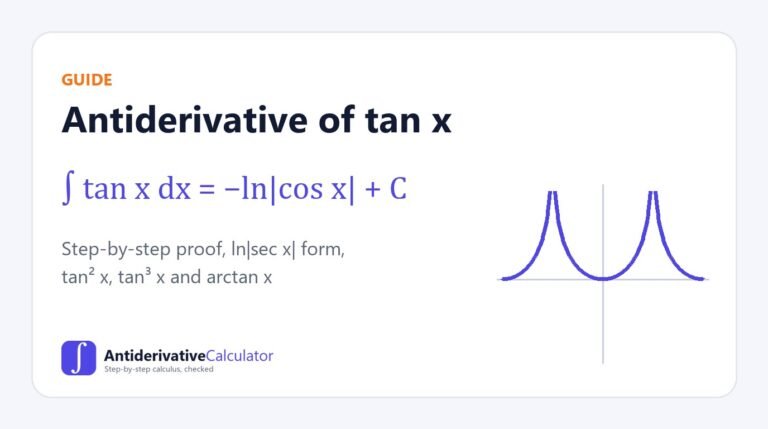
Antiderivative of tan x: −ln|cos x| + C, Derived Step by Step
The antiderivative of tan x is −ln|cos x| + C, or ln|sec x| + C. See two proofs, why the absolute value matters, tan² x, tan³ x and arctan x.Read the guide → -
October 8, 2026
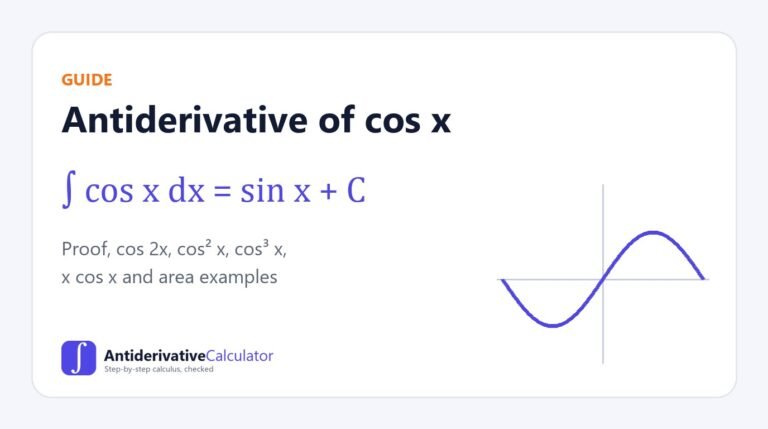
Antiderivative of cos x: sin x + C (Plus cos 2x, cos² x and More)
The antiderivative of cos x is sin x + C. See three quick proofs, then work up from cos 2x to cos² x, cos³ x, x cos x and e^x cos x, with practice.Read the guide → -

March 26, 2026
7 Common Antiderivative Mistakes (and How to Fix Them)
Spot and fix the 7 most common antiderivative mistakes, from forgetting + C to fake chain rules, with wrong vs correct work and a quick self-test.Read the guide → -

March 26, 2026
How to Study Calculus on Your Own: A Roadmap With Checkpoints
Learn calculus on your own with a 5-stage roadmap, a prerequisite quiz, checkpoint tests, a weekly schedule and the study loop that actually works.Read the guide → -

March 26, 2026
Why Is Integration So Hard? 6 Reasons and How to Fix Each One
Why is integration harder than differentiation? See 6 real reasons, a self-diagnosis table, and the order that makes integration much easier to learn.Read the guide → -
March 26, 2026
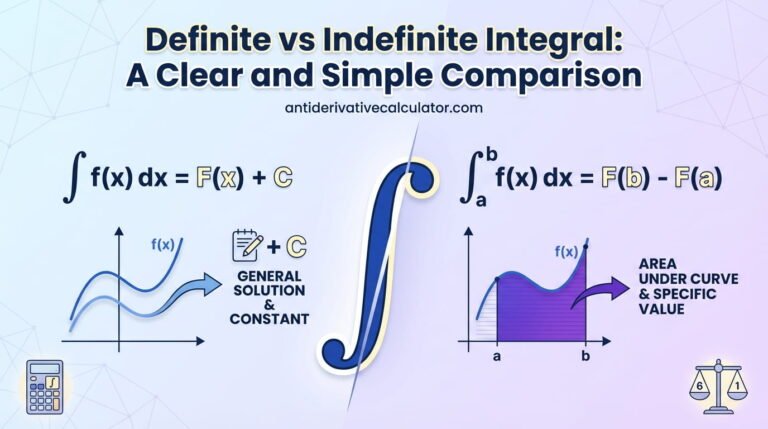
Definite vs Indefinite Integral: The Difference, Explained Simply
What is the difference between a definite and an indefinite integral? See a side-by-side table, one function done both ways, signed area and examples.Read the guide →
An antiderivative calculator finds a function \(F(x)\) whose derivative is your function \(f(x)\), then adds the constant \(C\). For example, the antiderivative of \(2x\) is \(x^2 + C\). This calculator also shows each integration step and checks the result by taking its derivative.
How to Use the Antiderivative Calculator
- Type your function in the box. You can write
3x^2without a star. - Look at the preview under the box. It shows how your input was read, as real math.
- Choose the variable if it is not x.
- Press Solve or Enter. Open the steps, the graph, or press Share link to send the problem to someone.
Input Guide
| Math | Type | Math | Type |
|---|---|---|---|
| \(x^3\) | x^3 | \(\sqrt{x}\) | sqrt(x) |
| \(5x\) | 5x | \(\sqrt[3]{x}\) | x^(1/3) |
| \(\frac{1}{x}\) | 1/x | \(\ln x\) | ln(x) |
| \(e^{-x}\) | e^(-x) | \(\pi\) | pi |
| \(\cos^2 x\) | cos(x)^2 | \(\sec x\tan x\) | sec(x)tan(x) |
What This Antiderivative Calculator Can Do
You may know this tool by another name: an antiderivative solver, an anti-differentiation calculator, an integral finder or a “reverse derivative” calculator. They all do the same job: given \(f(x)\), find a function \(F(x)\) whose derivative is \(f(x)\).
- General antiderivative with steps. Every answer includes \(+C\), so you get the whole family of antiderivatives, not just one. Each step names the rule used.
- A particular antiderivative. If your problem gives a starting value such as \(F(0) = 2\), find \(F(x) + C\) here, then solve for \(C\) as shown in the constant of integration guide.
- A second antiderivative. Integrate the answer again (drop the \(+C\) first, then add a new one at the end). For example, the second antiderivative of \(6x\) is \(x^3 + C_1x + C_2\).
- Any variable. Change the variable box to \(t\), \(y\) or \(\theta\) for physics and engineering problems.
Handheld calculators such as the TI-84 can only give a definite integral as a number. To get an antiderivative formula, you need a computer algebra system like this one. See which calculators can do integrals.
What Is an Antiderivative?
An antiderivative of \(f(x)\) is a function \(F(x)\) whose derivative is \(f(x)\). In symbols, \(F'(x) = f(x)\).
For example, the derivative of \(x^2\) is \(2x\). So \(x^2\) is an antiderivative of \(2x\). But so are \(x^2 + 1\) and \(x^2 – 7\), because constants disappear when you take a derivative. That is why we add + C:
\[\int 2x\,dx = x^2 + C.\]
New to the topic? Start with What Is an Antiderivative? A Simple Guide for Beginners and why the constant of integration matters.
Antiderivative Formulas
These are the formulas used most often. The calculator applies them for you and tells you which one it used.
Learn each rule with examples in Antiderivative Rules You Must Know. There are also full guides for sin(x), ln(x), eˣ, and 1/x.
Worked Examples
Example 1: \(\int (6x^2 – 4x + 1)\,dx\)
Use the power rule on each term: \(\frac{6x^3}{3} – \frac{4x^2}{2} + x = 2x^3 – 2x^2 + x\).
Answer: \(2x^3 – 2x^2 + x + C\).
Example 2: \(\int \frac{3}{x}\,dx\)
Pull out the 3, then use \(\int\frac1x\,dx = \ln|x|\).
Answer: \(3\ln|x| + C\).
Example 3: \(\int \cos(4x)\,dx\)
The inside is \(4x\), so divide by 4: \(\frac14\sin(4x)\).
Answer: \(\frac14\sin(4x) + C\).
Example 4: \(\int x\cos(x^2)\,dx\)
Use u-substitution with \(u = x^2\), \(du = 2x\,dx\).
Answer: \(\frac12\sin(x^2) + C\).
How to Check Any Antiderivative
Take the derivative of your answer. If you get back the function you started with, your answer is right. The calculator does this for every problem and shows it under “Check by differentiating.” Read more in how to check your antiderivative answer.
Common Mistakes
- Forgetting + C.
- Writing \(\int \sin x\,dx = \cos x\). The correct answer is \(-\cos x\).
- Using the power rule on \(x^{-1}\). Use \(\ln|x|\) instead.
- Splitting a product into two integrals. \(\int x e^x\,dx \ne \int x\,dx\cdot\int e^x\,dx\).
See all five big ones in Top 5 Mistakes Students Make When Solving Antiderivatives.
Frequently Asked Questions
Is an antiderivative the same as an integral?
An antiderivative is the same as an indefinite integral. A definite integral is a number found from an antiderivative. Use the definite integral calculator for those.
What is anti-differentiation?
Anti-differentiation is the process of finding an antiderivative: working backward from a derivative to the original function. It is the same thing as finding an indefinite integral, and the answer always includes \(+C\).
How do I find an antiderivative on a TI-84?
You can’t get a formula on a TI-84. It only computes definite integrals as numbers with fnInt. For the antiderivative itself, use this calculator or a CAS calculator such as the TI-89 or TI-Nspire CX CAS.
Can every function be integrated?
Every continuous function has an antiderivative, but some cannot be written with normal functions. Examples are \(e^{x^2}\) and \(\frac{\sin x}{x}\). The calculator tells you when this happens.
Why does my textbook answer look different?
Two answers can look different and both be right. They may differ by a constant, or use a trig identity. For example, \(-\ln|\cos x|\) and \(\ln|\sec x|\) are equal.
Does this calculator work on phones?
Yes. Tap Math keyboard to get buttons for √, π, sin, ln, and more.
Who made this calculator?
It was built and math-checked by Prof. Adrian Cole. Read more about us, or contact us if you find a problem.
More Free Guides
Stuck on a different problem?
Try the integral, derivative or limit calculator. Every one shows its steps and checks the answer.