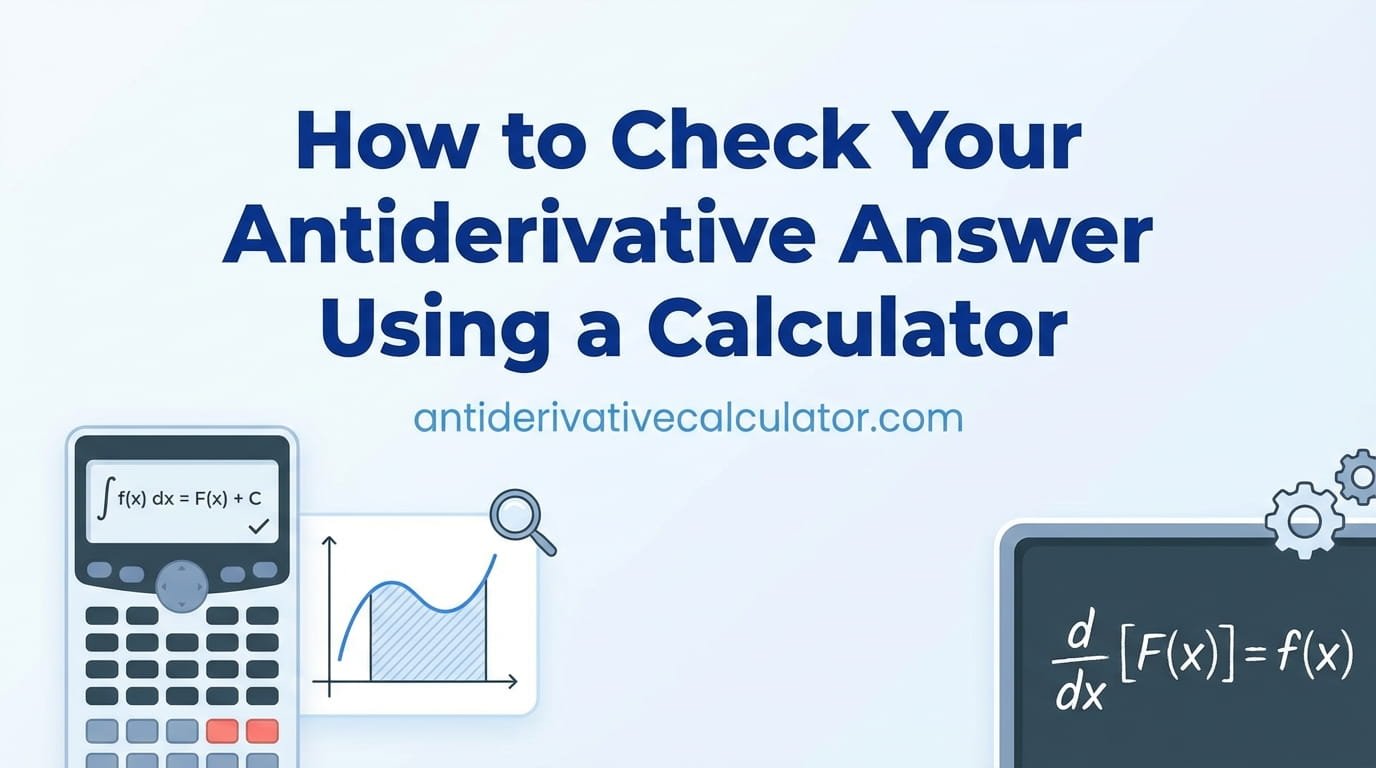
To check an antiderivative, differentiate your answer. If the derivative equals the function you integrated, your answer is correct. For example, to check \(\int x\cos x\,dx = x\sin x + \cos x + C\), differentiate: \(\sin x + x\cos x – \sin x = x\cos x\). ✓ You can also plug in numbers, compare with another correct form, or look at a graph.
Finding an antiderivative can be hard. Checking one is almost always easy. That makes checking the most useful habit in integral calculus: it catches sign errors, missing factors and wrong methods before your teacher does. Here are four ways to check, from the one you will use every day to backups for special situations.
Method 1: Differentiate Your Answer (Use This Every Time)
An antiderivative is defined by its derivative, so the definition is also the test:
Example: a correct answer
Claim: \(\int \frac{\ln x}{x}\,dx = \frac{(\ln x)^2}{2} + C\).
Check: \(\frac{d}{dx}\frac{(\ln x)^2}{2} = \frac{2\ln x}{2}\cdot\frac1x = \frac{\ln x}{x}\). ✓
Example: catching a mistake
Claim: \(\int e^{3x}\,dx = e^{3x} + C\).
Check: \(\frac{d}{dx}e^{3x} = 3e^{3x}\). That is 3 times too big, so the answer needs a \(\frac13\): the correct result is \(\frac13e^{3x} + C\).
Notice how the check does more than say “wrong”. The leftover factor of 3 tells you exactly how to fix it.
Example: a check that needs the product rule
Claim: \(\int \ln x\,dx = x\ln x – x + C\).
Check: \(\left(\ln x + x\cdot\frac1x\right) – 1 = \ln x\). ✓ When your answer is a product, you will need the product rule; when it has an inside function, you will need the chain rule. The derivative calculator can do this part for you.
Method 2: Plug In Numbers (When the Derivative Is Messy)
If differentiating your answer is long, test it numerically. Pick any \(x\), a tiny step \(h\) like 0.001, and compare
\[\frac{F(x + h) – F(x)}{h} \quad\text{with}\quad f(x).\]
Example: check \(F(x) = x\sin x + \cos x\) against \(f(x) = x\cos x\) at \(x = 1\). A calculator gives \(F(1) \approx 1.381773\) and \(F(1.001) \approx 1.382313\), so the slope is about \(0.540\). And \(f(1) = \cos 1 \approx 0.540\). They match. ✓
If the two numbers are clearly different (say 0.54 vs 1.08), the answer is wrong. Test two or three different \(x\)-values to be safe.
Method 3: Compare With Another Correct Form
Sometimes your answer is right but looks nothing like the answer key. Two antiderivatives of the same function always differ by a constant. So subtract them and see if the difference is a constant.
Example: For \(\int \tan x\sec^2 x\,dx\), you get \(\frac{\tan^2 x}{2} + C\), but the book says \(\frac{\sec^2 x}{2} + C\).
Since \(\sec^2 x = \tan^2 x + 1\), the difference is \(\frac{\sec^2 x}{2} – \frac{\tan^2 x}{2} = \frac12\), a constant. Both answers are correct. You can also test this with numbers: at \(x = 0.5\), the two forms give about 0.149 and 0.649, a difference of exactly 0.5, and at \(x = 1\) the difference is again 0.5.
The constant of integration page has a puzzle with three different correct answers to the same problem.
Method 4: Check the Graph
A graph will not prove an answer, but it catches big mistakes fast:
- Where \(f(x) > 0\), your \(F(x)\) must be increasing.
- Where \(f(x) < 0\), \(F(x)\) must be decreasing.
- Where \(f(x) = 0\), \(F(x)\) should have a flat spot (a peak, valley or level point).
Example: \(f(x) = \sin x\) is positive on \((0, \pi)\). If your answer were \(\cos x\), it would be decreasing there, which is wrong. The correct \(-\cos x\) rises from \(-1\) to \(1\) on that interval. ✓ The antiderivative calculator draws \(f\) and \(F\) together so you can see this.
Which Check Should I Use?
| Situation | Best check |
|---|---|
| Homework and tests (almost always) | Differentiate |
| Your answer is long and differentiating it is painful | Plug in numbers |
| Your answer looks different from the key | Subtract the two forms |
| Quick sanity check, or a multiple-choice question | Graph shape |
| Definite integral | Estimate the area roughly, and check the sign |
Checking Definite Integrals
For a definite integral, check the antiderivative first with Method 1, then sanity-check the number. If the function is positive on the whole interval, the answer must be positive. If the region looks like a triangle or a rectangle, estimate its area with geometry. For example, \(\int_0^2 x^2\,dx = \frac83 \approx 2.67\) should be less than the rectangle \(2 \times 4 = 8\) around it, and it is.
Calculators for This Topic
Practice what you just read. Each tool shows full steps and checks its own answer.
- d/dxDerivative Calculator – Product, quotient and chain rule steps for any function.
- ∫Antiderivative Calculator – Find any antiderivative with full steps and a check.
- ∫Integral Calculator – Solve indefinite and definite integrals step by step.
Frequently Asked Questions
How do you check if an antiderivative is correct?
Differentiate it. If the derivative equals the original function, the antiderivative is correct.
Can two different antiderivatives both be correct?
Yes. Any two antiderivatives of the same function differ by a constant. Forms that look very different, such as \(\frac{\tan^2x}{2}\) and \(\frac{\sec^2x}{2}\), can both be right.
Do I need to include C when I check?
No. The derivative of \(C\) is 0, so it does not affect the check. Just remember to keep it in your final answer.
Can a calculator check my antiderivative?
Yes. Our calculator differentiates every answer automatically and shows the result under “Check by differentiating”. You can also type your own answer into the derivative calculator.