
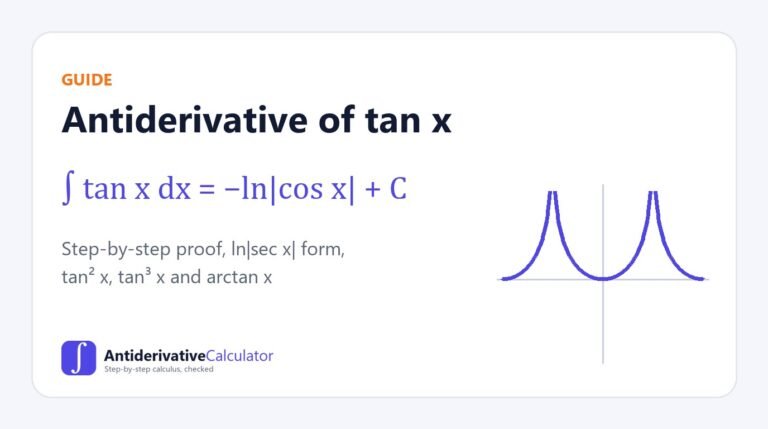
Antiderivative of tan x: −ln|cos x| + C, Derived Step by Step
The antiderivative of tan x is −ln|cos x| + C, or ln|sec x| + C. See two proofs, why the absolute value matters, tan² x, tan³ x and arctan x.
 Prof. Adrian Cole
The antiderivative of tan x is −ln|cos x| + C, or ln|sec x| + C. See two proofs, why the absolute value matters, tan² x, tan³ x and arctan x.
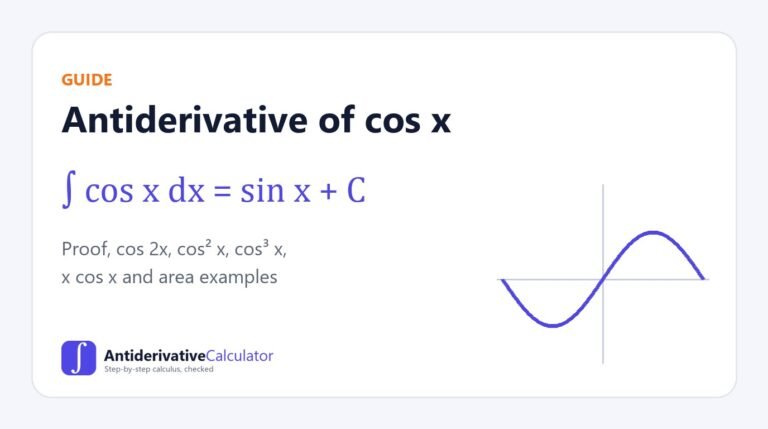
The antiderivative of cos x is sin x + C. See three quick proofs, then work up from cos 2x to cos² x, cos³ x, x cos x and e^x cos x, with practice.

Spot and fix the 7 most common antiderivative mistakes, from forgetting + C to fake chain rules, with wrong vs correct work and a quick self-test.

Learn calculus on your own with a 5-stage roadmap, a prerequisite quiz, checkpoint tests, a weekly schedule and the study loop that actually works.

Why is integration harder than differentiation? See 6 real reasons, a self-diagnosis table, and the order that makes integration much easier to learn.
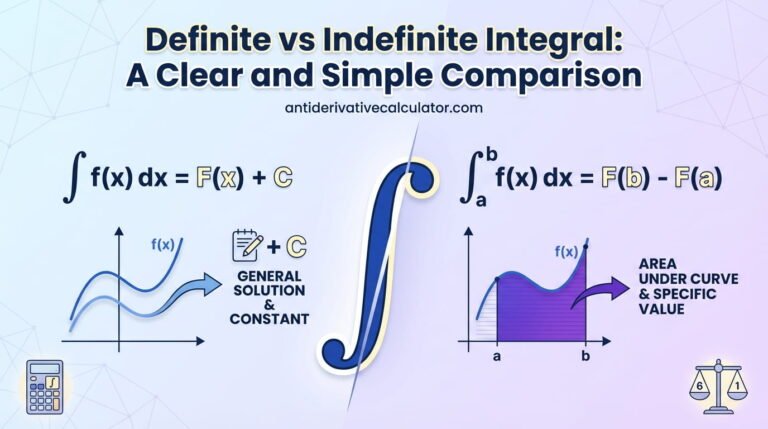
What is the difference between a definite and an indefinite integral? See a side-by-side table, one function done both ways, signed area and examples.
See how calculus is used in real life, in medicine, driving, business, engineering, AI and biology, with a small worked example for each one.

Practice antiderivatives with 10 problems in three levels, from basic rules to integration by parts, each with a hint, a full solution and a score guide.
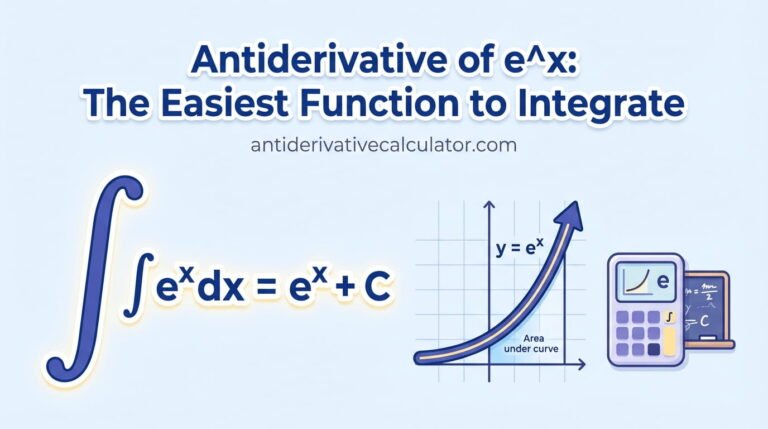
The antiderivative of e^x is e^x + C. Learn why, then work through e^2x, e^-x, e^(3x+1), x e^x and 2^x, and see why e^(x²) has no formula.
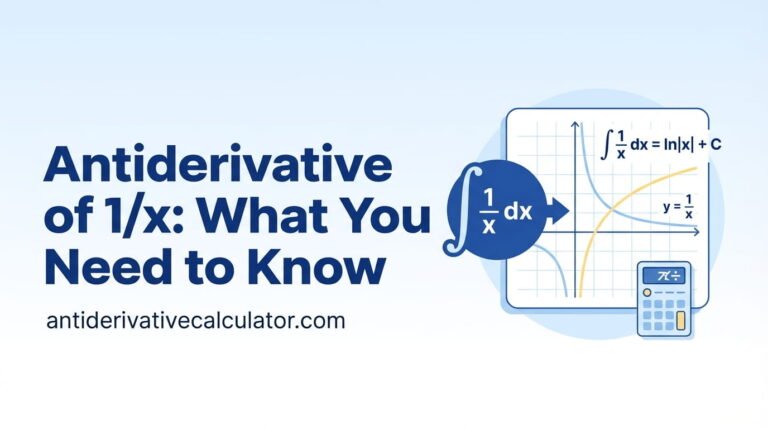
The antiderivative of 1/x is ln|x| + C. Learn why the power rule fails, why the absolute value matters, how 1/x² is different, and see worked examples.