
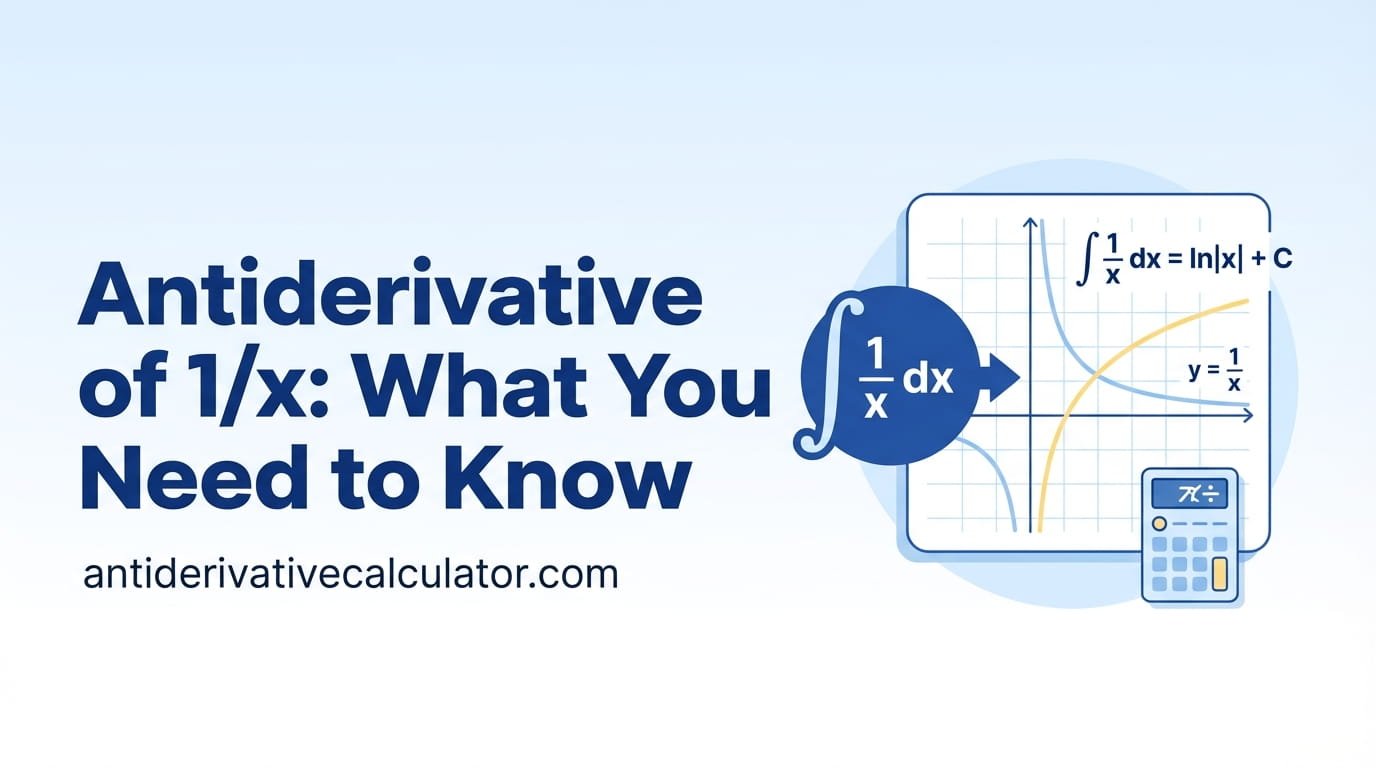
The antiderivative of \(\frac{1}{x}\) is \(\ln|x| + C\). The absolute value matters: it makes the answer work for negative \(x\) too. Check: \(\frac{d}{dx}\ln|x| = \frac{1}{x}\) for every \(x \ne 0\).
\(\frac{1}{x}\) is the one power of \(x\) that breaks the usual rule, so it gets its own page. Here are the questions students ask most about it, answered one at a time, with examples you can check yourself.
Why doesn’t the power rule work for 1/x?
The power rule says \(\int x^n\,dx = \frac{x^{n+1}}{n+1} + C\). Write \(\frac1x\) as \(x^{-1}\), so \(n = -1\):
\[\int x^{-1}\,dx = \frac{x^{0}}{0} + C \quad\longleftarrow\ \text{dividing by zero!}\]
The formula breaks, so we need a different function. That function is the natural logarithm.
Where does ln x come from?
The natural logarithm has a special derivative: \(\frac{d}{dx}\ln x = \frac{1}{x}\) for \(x > 0\). Read backward, that says \(\ln x\) is an antiderivative of \(\frac1x\). In fact, mathematicians often define \(\ln x\) as the area under \(\frac1t\) from 1 to \(x\):
Why is there an absolute value in ln|x|?
\(\frac1x\) exists for negative numbers, like \(x = -2\), but \(\ln x\) does not. The absolute value fixes this. For \(x < 0\), \(\ln|x| = \ln(-x)\), and the chain rule gives
\[\frac{d}{dx}\ln(-x) = \frac{1}{-x}\cdot(-1) = \frac{1}{x}.\]
So \(\ln|x|\) has derivative \(\frac1x\) on both sides of zero. That is why the complete answer is \(\int \frac{1}{x}\,dx = \ln|x| + C\).
What is the antiderivative of 1/x²?
This one is different, because \(\frac{1}{x^2} = x^{-2}\) and \(n = -2\) is allowed in the power rule:
\[\int x^{-2}\,dx = \frac{x^{-1}}{-1} + C = -\frac{1}{x} + C.\]
Students often mix the two up, so here they are side by side:
| Function | Antiderivative | Why |
|---|---|---|
| \(\frac{1}{x}\) | \(\ln|x| + C\) | Special case, \(n = -1\) |
| \(\frac{1}{x^2}\) | \(-\frac{1}{x} + C\) | Power rule, \(n = -2\) |
| \(\frac{1}{x^3}\) | \(-\frac{1}{2x^2} + C\) | Power rule, \(n = -3\) |
| \(\frac{1}{\sqrt{x}}\) | \(2\sqrt{x} + C\) | Power rule, \(n = -\frac12\) |
What about 1/(ax + b) and other variations?
| Integral | Answer |
|---|---|
| \(\int \frac{5}{x}\,dx\) | \(5\ln|x| + C\) |
| \(\int \frac{1}{x+4}\,dx\) | \(\ln|x+4| + C\) |
| \(\int \frac{1}{3x-2}\,dx\) | \(\frac13\ln|3x-2| + C\) |
| \(\int \frac{2x}{x^2+1}\,dx\) | \(\ln\left(x^2+1\right) + C\) |
| \(\int \frac{1}{x\ln x}\,dx\) | \(\ln\left|\ln x\right| + C\) |
The pattern behind all of these is \(\int \frac{f'(x)}{f(x)}\,dx = \ln|f(x)| + C\): when the top is the derivative of the bottom, the answer is the log of the bottom. That is a special case of u-substitution.
Worked example: \(\int \frac{1}{3x-2}\,dx\)
Let \(u = 3x – 2\). Then \(du = 3\,dx\), so \(dx = \frac13\,du\):
\[\int \frac{1}{3x-2}\,dx = \frac13\int\frac{du}{u} = \frac13\ln|3x-2| + C.\]
What does the answer mean as an area?
Because of the definition above, areas under \(\frac1x\) are logarithms:
- \(\int_1^2 \frac1x\,dx = \ln 2 \approx 0.693\)
- \(\int_1^{e} \frac1x\,dx = \ln e = 1\). This is one way to define the number \(e \approx 2.718\): it is where the area under \(\frac1x\) reaches exactly 1.
- \(\int_1^{\infty} \frac1x\,dx\) is infinite. The curve gets low, but not fast enough. Compare it with \(\int_1^{\infty} \frac{1}{x^2}\,dx = 1\) in the improper integral calculator.
Do not integrate across zero. \(\int_{-1}^{1}\frac1x\,dx\) is not \(\ln 1 – \ln 1 = 0\). The function blows up at \(x = 0\), so this integral is improper and does not have a finite value.
How do I check my answer?
Differentiate it. For \(\frac13\ln|3x-2|\), the chain rule gives \(\frac13\cdot\frac{3}{3x-2} = \frac{1}{3x-2}\). ✓ You can also type the problem into the antiderivative calculator, which shows this check automatically.
Frequently Asked Questions
What is the antiderivative of 1/x?
It is \(\ln|x| + C\). For positive \(x\) only, \(\ln x + C\) is also correct.
Why is the antiderivative of 1/x not x⁰/0?
The power rule needs to divide by \(n + 1\). For \(\frac1x = x^{-1}\), that is \(-1 + 1 = 0\), and you cannot divide by zero. The natural logarithm fills this gap.
What is the antiderivative of 1/x²?
It is \(-\frac{1}{x} + C\). Here the power rule works because the exponent is \(-2\), not \(-1\).
What is the antiderivative of 1/(2x)?
Pull out the constant: \(\int \frac{1}{2x}\,dx = \frac12\ln|x| + C\). The answer \(\frac12\ln|2x| + C\) is also correct, because it differs from the first one by a constant.
Is ln|x| + C the most general antiderivative?
Strictly speaking, you may use a different constant on each side of zero, because the graph is in two separate pieces. For almost all homework, \(\ln|x| + C\) is the expected answer.
Related Guides
- Antiderivative of ln x (the reverse question)
- All antiderivative rules
- Glossary: power rule
1 thought on “Antiderivative of 1/x: Why It Is ln|x| + C”