
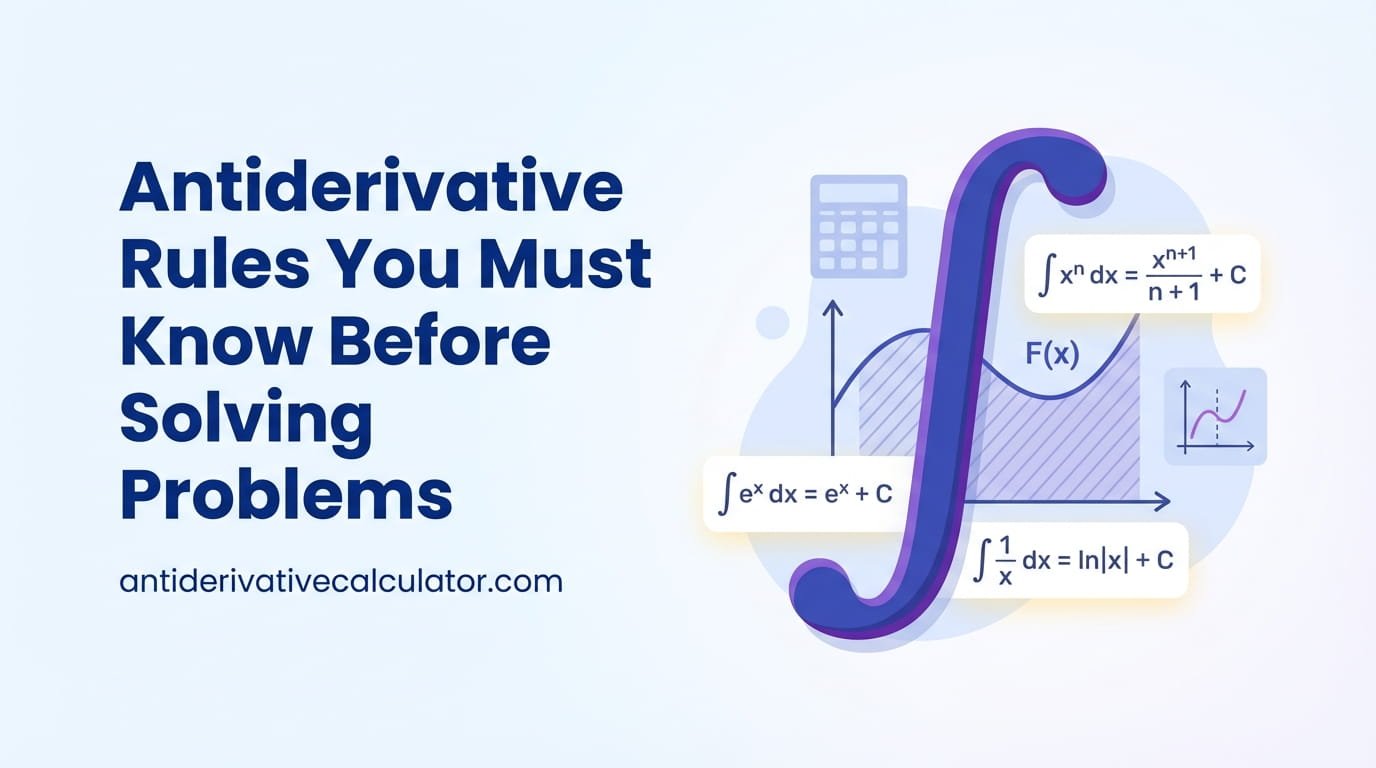
The main antiderivative rules are: the power rule \(\int x^n\,dx = \frac{x^{n+1}}{n+1} + C\) (for \(n \ne -1\)), \(\int \frac1x\,dx = \ln|x| + C\), \(\int e^x\,dx = e^x + C\), \(\int \sin x\,dx = -\cos x + C\), \(\int \cos x\,dx = \sin x + C\), plus the constant multiple and sum rules, which let you work one term at a time.
This page is a cheat sheet you can come back to. Every antiderivative formula you need for a first calculus course is grouped into five short tables, each with a worked example. At the end, there is a section most guides skip: the rules that do not exist, which is where most mistakes come from.
Group 1: The Basic Rules
These four rules handle every polynomial.
| Rule | Formula |
|---|---|
| Constant rule | \(\int k\,dx = kx + C\) |
| Power rule | \(\int x^n\,dx = \frac{x^{n+1}}{n+1} + C,\ n \ne -1\) |
| Constant multiple rule | \(\int k\,f(x)\,dx = k\int f(x)\,dx\) |
| Sum and difference rule | \(\int \left[f(x) \pm g(x)\right]dx = \int f(x)\,dx \pm \int g(x)\,dx\) |
Example: \(\int \left(6x^2 – 4x + 7\right)dx = 2x^3 – 2x^2 + 7x + C\).
Roots and fractions are powers in disguise: \(\sqrt{x} = x^{1/2}\) and \(\frac{1}{x^3} = x^{-3}\). Rewrite them first, then use the power rule.
Group 2: Exponential and Logarithm Rules
| Function | Antiderivative |
|---|---|
| \(e^x\) | \(e^x + C\) |
| \(e^{kx}\) | \(\frac{1}{k}e^{kx} + C\) |
| \(a^x\) | \(\frac{a^x}{\ln a} + C\) |
| \(\frac{1}{x}\) | \(\ln|x| + C\) |
| \(\ln x\) | \(x\ln x – x + C\) |
Example: \(\int \left(3e^{2x} + \frac{5}{x}\right)dx = \frac32e^{2x} + 5\ln|x| + C\).
Deeper explanations: e^x, 1/x, ln x, and other exponential functions.
Group 3: Trigonometric Rules
| Function | Antiderivative |
|---|---|
| \(\sin x\) | \(-\cos x + C\) |
| \(\cos x\) | \(\sin x + C\) |
| \(\sec^2 x\) | \(\tan x + C\) |
| \(\csc^2 x\) | \(-\cot x + C\) |
| \(\sec x\tan x\) | \(\sec x + C\) |
| \(\csc x\cot x\) | \(-\csc x + C\) |
| \(\tan x\) | \(-\ln|\cos x| + C\) |
| \(\cot x\) | \(\ln|\sin x| + C\) |
| \(\sec x\) | \(\ln|\sec x + \tan x| + C\) |
| \(\csc x\) | \(-\ln|\csc x + \cot x| + C\) |
A quick pattern: every trig function whose name starts with “co” (cos, cot, csc) picks up or loses a minus sign compared with its partner. Learn more in antiderivatives of trig functions.
Example: \(\int \left(2\cos x – \sec^2 x\right)dx = 2\sin x – \tan x + C\).
Group 4: Rules That Give Inverse Trig Functions
| Function | Antiderivative |
|---|---|
| \(\frac{1}{1 + x^2}\) | \(\tan^{-1}x + C\) |
| \(\frac{1}{\sqrt{1 – x^2}}\) | \(\sin^{-1}x + C\) |
| \(\frac{1}{a^2 + x^2}\) | \(\frac{1}{a}\tan^{-1}\frac{x}{a} + C\) |
| \(\frac{1}{\sqrt{a^2 – x^2}}\) | \(\sin^{-1}\frac{x}{a} + C\) |
Example: \(\int \frac{1}{9 + x^2}\,dx = \frac13\tan^{-1}\frac{x}{3} + C\).
Group 5: The Linear Inside Rule
If you know \(\int f(x)\,dx = F(x) + C\), then for any numbers \(a \ne 0\) and \(b\):
Examples: \(\int \cos(5x)\,dx = \frac15\sin(5x) + C\) and \(\int (2x – 1)^4\,dx = \frac{(2x-1)^5}{10} + C\).
This is a shortcut for u-substitution when the inside is a straight line.
Rules That Do NOT Exist
Derivatives have a product rule, a quotient rule and a chain rule. Integrals do not have simple versions of any of them. Using made-up versions is the most common mistake on tests.
No product rule: \(\int x e^x\,dx \ne \int x\,dx \cdot \int e^x\,dx\). Use integration by parts.
No quotient rule: \(\int \frac{x}{x^2 + 1}\,dx \ne \frac{\int x\,dx}{\int (x^2+1)\,dx}\). Use substitution, or partial fractions for rational functions.
No simple chain rule: \(\int \sin(x^2)\,dx \ne -\frac{\cos(x^2)}{2x}\). Differentiate that guess and you will see it does not work. In fact, \(\int \sin(x^2)\,dx\) has no formula in elementary functions.
Putting Several Rules Together
Find \(\int \left(4x^3 – \frac{2}{x} + 3\sin x + \frac{1}{1+x^2}\right)dx\).
- Split with the sum rule. Handle each term on its own.
- Power rule: \(\int 4x^3\,dx = x^4\).
- Log rule: \(\int \frac{2}{x}\,dx = 2\ln|x|\).
- Trig rule: \(\int 3\sin x\,dx = -3\cos x\).
- Inverse trig rule: \(\int \frac{1}{1+x^2}\,dx = \tan^{-1}x\).
- Combine and add one C: \(x^4 – 2\ln|x| – 3\cos x + \tan^{-1}x + C\).
Type the same problem into the antiderivative calculator to see each rule named as it is used.
One-Line Summary to Memorize
- Powers: add 1 to the exponent, divide by the new exponent (except \(\frac1x\), which gives \(\ln|x|\)).
- \(e^x\): stays the same. \(e^{kx}\) gets divided by \(k\).
- sin and cos: one step backward in the cycle \(\sin \to \cos \to -\sin \to -\cos\).
- Always: add \(+C\), and check by differentiating.
Calculators for This Topic
Practice what you just read. Each tool shows full steps and checks its own answer.
- ∫Antiderivative Calculator – Find any antiderivative with full steps and a check.
- ∫Integral Calculator – Solve indefinite and definite integrals step by step.
- =Simplify Calculator – Simplified, expanded and factored forms.
Frequently Asked Questions
What are the basic antiderivative rules?
The constant rule, the power rule, the constant multiple rule and the sum and difference rule. Together they let you find the antiderivative of any polynomial term by term.
Is there a product rule for antiderivatives?
No. The integral of a product is not the product of the integrals. Products usually need integration by parts or a substitution.
What is the antiderivative formula for x to the n?
\(\int x^n\,dx = \frac{x^{n+1}}{n+1} + C\) for every real number \(n\) except \(-1\). For \(n = -1\), the answer is \(\ln|x| + C\).
Why do all antiderivative formulas have + C?
Because adding a constant does not change a derivative, every function has infinitely many antiderivatives that differ by a constant. \(+C\) stands for all of them. Read more about the constant of integration.
How can I check if I used the right rule?
Differentiate your answer. If you get back the original function, every rule was applied correctly.
1 thought on “Antiderivative Rules and Formulas: The Complete Cheat Sheet”