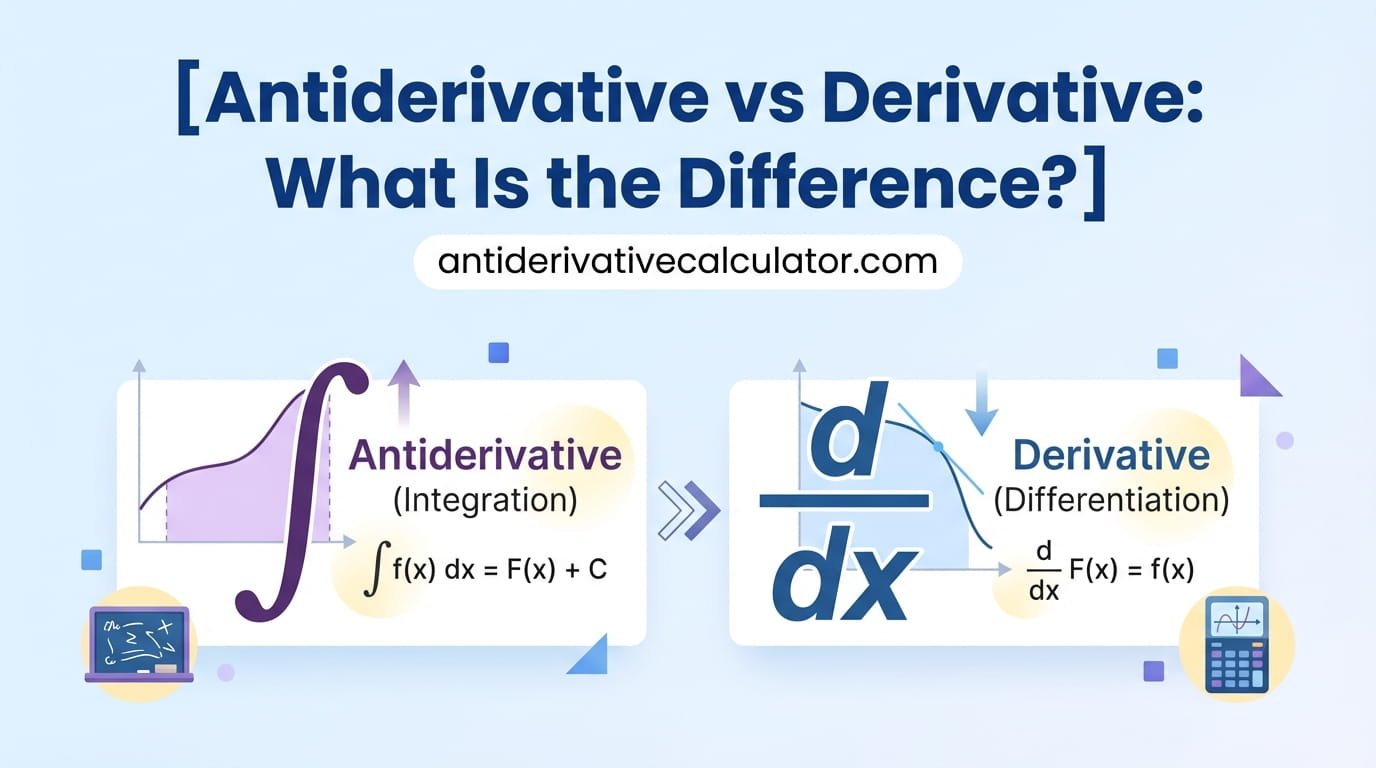
A derivative measures how fast a function changes (its slope). An antiderivative goes the other way: it is a function whose derivative is the one you started with. Derivatives give one answer, such as \(\frac{d}{dx}x^3 = 3x^2\). Antiderivatives give a family, such as \(\int 3x^2\,dx = x^3 + C\).
Derivatives and antiderivatives are opposite operations, like multiplication and division. Knowing exactly how they differ, and how they connect, makes the rest of calculus much easier. Here is the comparison side by side, then one example worked in both directions.
The Differences at a Glance
| Derivative | Antiderivative | |
|---|---|---|
| Question it answers | How fast is \(F\) changing? | Which function changes like \(f\)? |
| Notation | \(F'(x)\) or \(\frac{d}{dx}F(x)\) | \(\int f(x)\,dx\) |
| Result | One function | A family: \(F(x) + C\) |
| Graph meaning | Slope of the tangent line | Accumulated area |
| Difficulty | Always possible with rules | Sometimes impossible as a formula |
| Typical use | Speed from position | Position from speed |
One Function, Two Directions
Start in the middle with \(f(x) = x^3\).
- Go down (derivative): \(\frac{d}{dx}x^3 = 3x^2\). One exact answer.
- Go up (antiderivative): \(\int x^3\,dx = \frac{x^4}{4} + C\). A whole family, because any constant could have been there.
Now check that the two directions undo each other:
\[\frac{d}{dx}\left(\frac{x^4}{4} + C\right) = x^3 \qquad\text{and}\qquad \int 3x^2\,dx = x^3 + C.\]
Going down then up brings you back to where you started, plus a constant. That constant is the price of undoing a derivative.
A Motion Example You Can Picture
A ball is dropped from a tall building. Let \(s(t)\) be how far it has fallen (in meters) after \(t\) seconds.
| Quantity | Formula | How you get it |
|---|---|---|
| Distance fallen | \(s(t) = 4.9t^2\) | Antiderivative of velocity (with \(s(0) = 0\)) |
| Velocity | \(v(t) = 9.8t\) | Derivative of distance, or antiderivative of acceleration |
| Acceleration | \(a(t) = 9.8\) | Derivative of velocity |
Read down the table and you take derivatives. Read up and you take antiderivatives. Physicists do this every day: measure the acceleration, then integrate twice to predict where something will be. Try it in the acceleration calculator.
Rule by Rule: How Each Derivative Rule Reverses
| Derivative rule | Antiderivative counterpart |
|---|---|
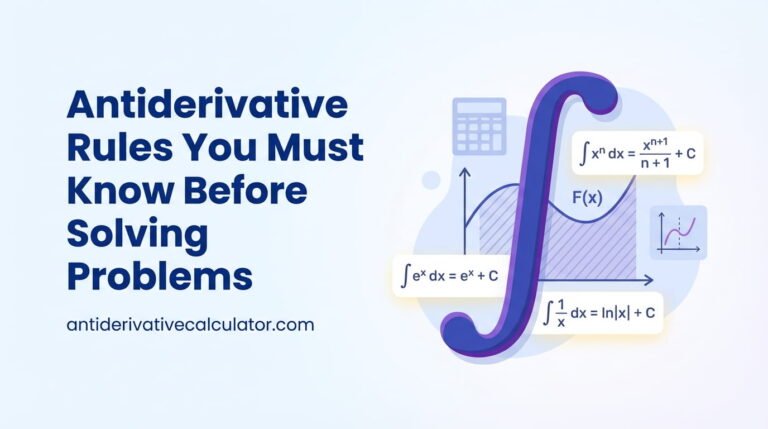
| Power rule: \(\frac{d}{dx}x^n = nx^{n-1}\) | \(\int x^n\,dx = \frac{x^{n+1}}{n+1} + C\) |
| \(\frac{d}{dx}e^x = e^x\) | \(\int e^x\,dx = e^x + C\) |
| \(\frac{d}{dx}\ln x = \frac1x\) | \(\int \frac1x\,dx = \ln|x| + C\) |
| \(\frac{d}{dx}\sin x = \cos x\) | \(\int \cos x\,dx = \sin x + C\) |
| Chain rule | U-substitution |
| Product rule | Integration by parts |
| Quotient rule | No direct counterpart |
Why Antiderivatives Are Harder
Differentiation is like following a recipe: there is a rule for every situation, so you can always finish. Antidifferentiation is like guessing which recipe made a cake. You have to recognize a pattern, and sometimes no recipe made of ordinary functions exists at all. For example, \(\frac{d}{dx}e^{x^2} = 2xe^{x^2}\) is easy, but \(\int e^{x^2}\,dx\) has no elementary formula. Read more in why integration is so hard.
The good news: you can always check an antiderivative by differentiating it, which is the easy direction.
How They Connect: The Fundamental Theorem
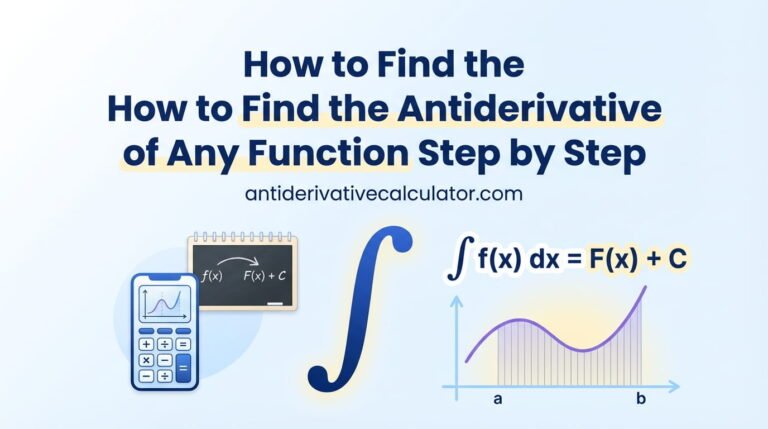
The fundamental theorem of calculus is the bridge. It says the area under \(f\) from \(a\) to \(b\) equals the change in an antiderivative:
So slopes (derivatives) and areas (integrals) are two sides of the same coin. Before this theorem, finding areas under curves was extremely hard. After it, you can find many areas with a single antiderivative.
Which One Do I Need? A Quick Guide
- You know the amount and want the rate → take a derivative.
- You know the rate and want the amount or a total → find an antiderivative.
- You want a slope or a maximum → derivative.
- You want an area, volume or total distance → antiderivative (definite integral).
Calculators for This Topic
Practice what you just read. Each tool shows full steps and checks its own answer.
- d/dxDerivative Calculator – Product, quotient and chain rule steps for any function.
- ∫Antiderivative Calculator – Find any antiderivative with full steps and a check.
- mInstantaneous Rate of Change Calculator – The slope at one point, with a limit table and tangent line.
Frequently Asked Questions
What is the difference between a derivative and an antiderivative?
A derivative turns a function into its rate of change. An antiderivative does the reverse: it finds a function whose rate of change is the one you were given. Derivatives give a single answer; antiderivatives include \(+C\).
Is the antiderivative the opposite of the derivative?
Yes. That is why an antiderivative is sometimes called a “reverse derivative” or “anti-differentiation”. Differentiating an antiderivative gives back the original function. Taking the antiderivative of a derivative gives back the original function plus a constant.
Is an antiderivative the same as an integral?
An indefinite integral is the same as the general antiderivative. A definite integral is a number calculated from an antiderivative.
Why does the derivative have no + C?
Because differentiating removes constants. Any constant in the original function becomes 0, so the derivative is a single, exact function.
Which is used more in real life?
Both, and often together. Engineers use derivatives to find rates and maximums, and antiderivatives to find totals such as distance, work and volume.