
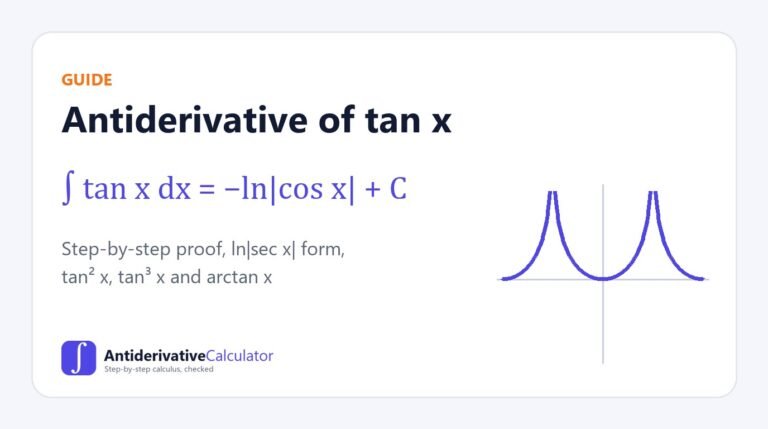
Antiderivative of tan x: −ln|cos x| + C, Derived Step by Step
The antiderivative of tan x is −ln|cos x| + C, or ln|sec x| + C. See two proofs, why the absolute value matters, tan² x, tan³ x and arctan x.
Worked examples for the antiderivatives students ask about most, like sin(x), ln(x), eˣ and 1/x. Each one has full steps and a check at the end.
The antiderivative of tan x is −ln|cos x| + C, or ln|sec x| + C. See two proofs, why the absolute value matters, tan² x, tan³ x and arctan x.
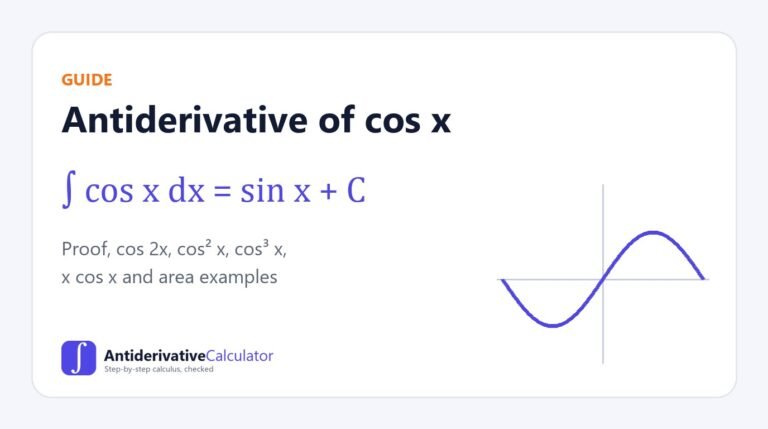
The antiderivative of cos x is sin x + C. See three quick proofs, then work up from cos 2x to cos² x, cos³ x, x cos x and e^x cos x, with practice.

Practice antiderivatives with 10 problems in three levels, from basic rules to integration by parts, each with a hint, a full solution and a score guide.
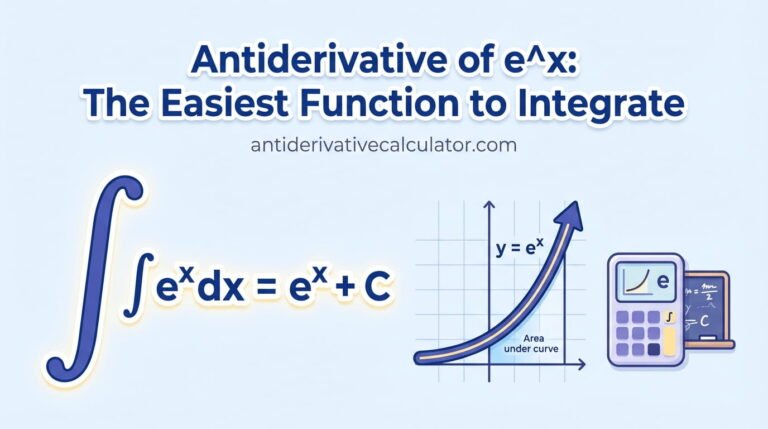
The antiderivative of e^x is e^x + C. Learn why, then work through e^2x, e^-x, e^(3x+1), x e^x and 2^x, and see why e^(x²) has no formula.
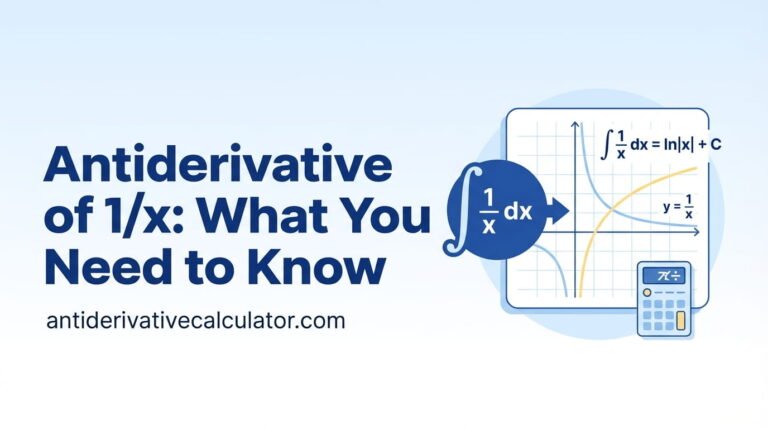
The antiderivative of 1/x is ln|x| + C. Learn why the power rule fails, why the absolute value matters, how 1/x² is different, and see worked examples.
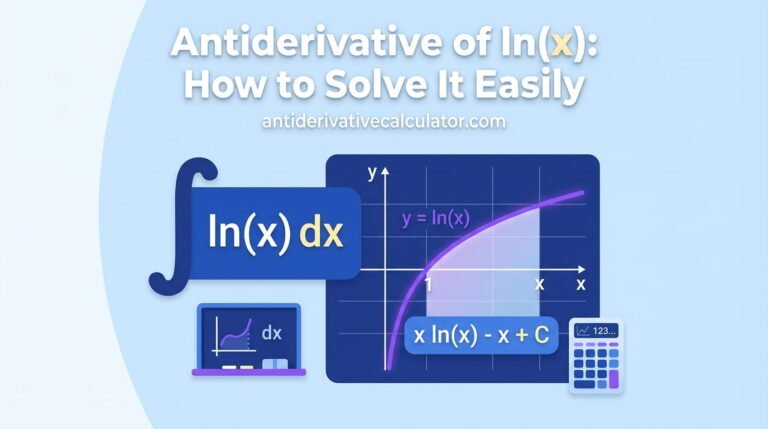
The antiderivative of ln x is x ln x − x + C. See the integration by parts trick, a quick check, and the integrals of ln(2x), (ln x)², ln x/x and log x.
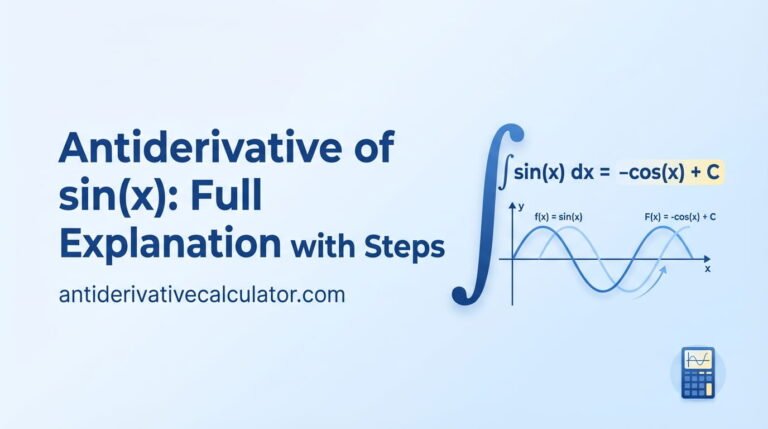
The antiderivative of sin x is −cos x + C. See why the minus sign appears, a memory trick, the antiderivative of cos x, and sin 2x, sin²x and x sin x.