What Is an Antiderivative? A Simple Guide for Beginners
Have you ever wondered how to “undo” a math operation? In calculus, we do this all the time. Just like subtraction undoes addition, an antiderivative undoes a derivative. It sounds tricky at first, but once you see how it works, it starts to make a lot of sense.
In this guide, you will learn exactly what an antiderivative is, why it matters, and how to find one — step by step. No confusing jargon. No scary formulas. Just clear, simple explanations made for beginners like you.
Whether you are studying for a test or just curious about calculus, this post has you covered. Let’s dive in!
What Is an Antiderivative?
An antiderivative is a function that, when you take its derivative, gives you back the original function. Think of it like rewinding a video — you are going backwards from the derivative to the original.
Here is a simple way to think about it:
- If you take the derivative of x² , you get 2x.
- So the antiderivative of 2x is x².
That’s the core idea! We are just asking: “What function, when differentiated, gives me this?”
In math, antiderivatives are closely connected to integration — one of the two big ideas in calculus. You will often hear teachers say “find the integral” when they really mean “find the antiderivative.” The two terms are used almost interchangeably for beginners.
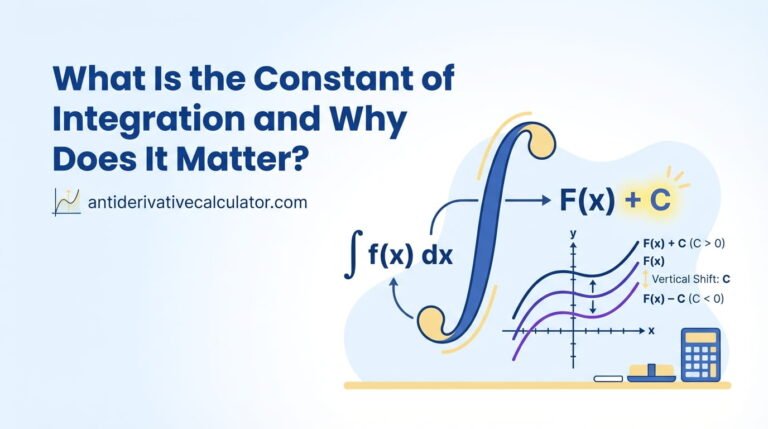
Why Do We Add “+ C” at the End?
You may have noticed that antiderivatives always end with a mysterious + C. What does that mean?
The letter C stands for the constant of integration. Here is why it matters:
When you take the derivative of a constant number — like 5 or 100 — it disappears and becomes zero. So when we work backwards, we have no way of knowing what constant was there originally. It could have been 0, it could have been 50, or anything else.
To be accurate, we always write + C to say, “there might be a constant here, and we just don’t know what it is.”
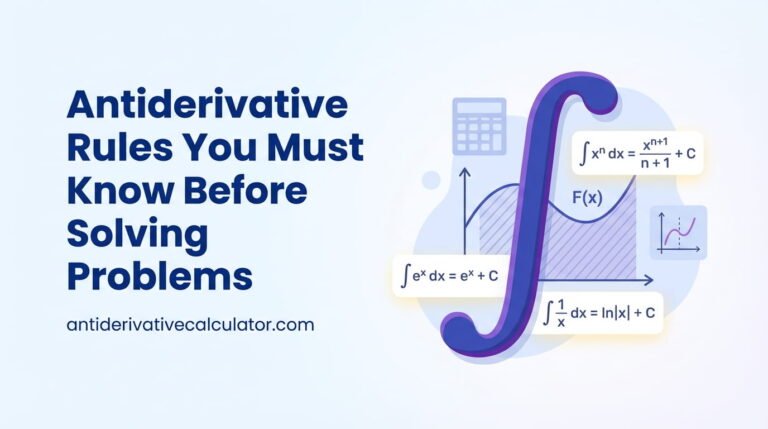
The Basic Rules for Finding an Antiderivative
Learning to find the antiderivative becomes much easier once you know a few basic rules. These rules work for most functions you will see as a beginner.
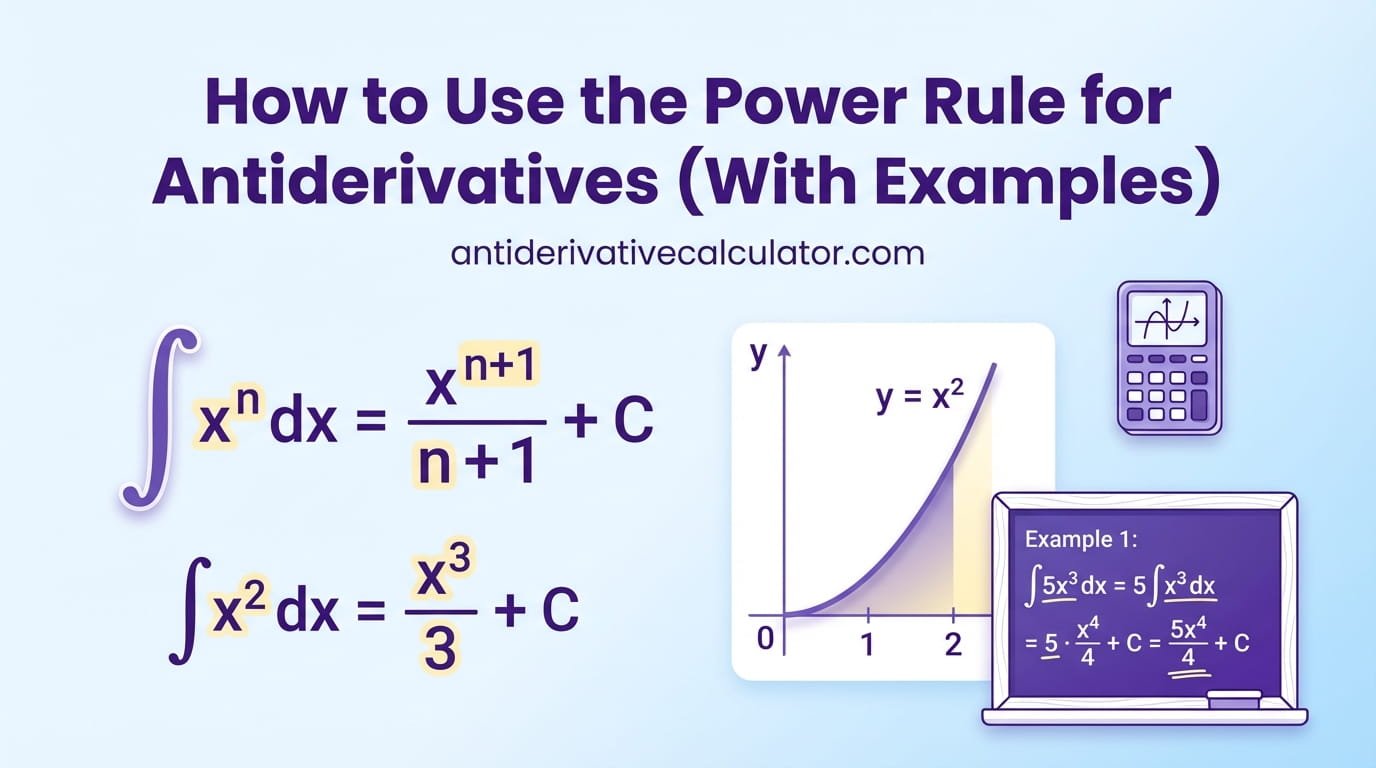
The Power Rule (Reversed)
This is the most important rule. For any variable raised to a power, follow these steps:
- Add 1 to the exponent (the small number on top).
- Divide the whole term by that new exponent.
- Add + C at the end.
So if you have xⁿ, the antiderivative is x^(n+1) / (n+1) + C.
Constant Rule
The antiderivative of a plain number (like 6) is just that number multiplied by x. So the antiderivative of 6 is 6x + C.
Sum Rule
If your function has two or more parts added together, you can find the antiderivative of each part separately. Then combine your answers at the end.
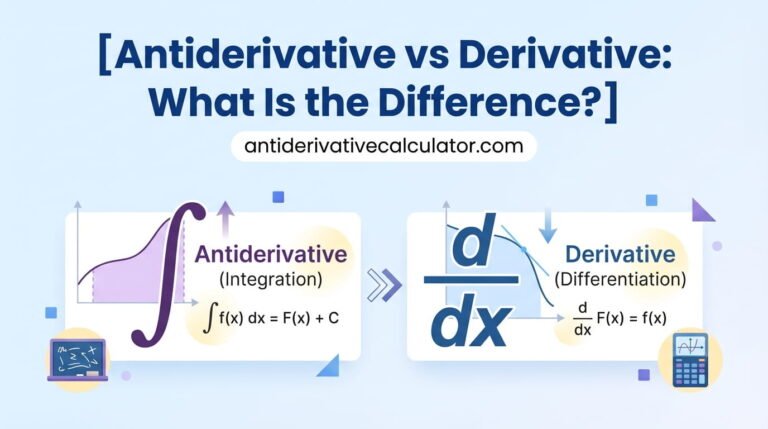
Antiderivative vs. Integral — What Is the Difference?
Many beginners confuse these two terms. Here is a quick breakdown:
- Antiderivative: The general “reverse derivative” of a function. It always includes + C because the answer is not a single number — it is a family of functions.
- Definite Integral: When you apply specific numbers (called limits) to an antiderivative, you get a definite integral. This gives you an actual number as the answer — for example, the area under a curve.
- Indefinite Integral: This is just another name for the antiderivative. Same thing, different label.
For now, just know that integration and finding an antiderivative are closely related. Mastering antiderivatives is the first step toward understanding integrals fully.
Where Are Antiderivatives Used in Real Life?
You might be thinking, “When will I ever use this?” Great question! Antiderivatives and integration show up in many real-world situations:
- Physics: If you know how fast something is moving (velocity), you can use an antiderivative to find how far it has traveled (distance).
- Engineering: Engineers use integration to calculate forces, energy, and the behavior of structures.
- Medicine: Doctors and scientists use integrals to study how drugs spread through the body over time.
- Economics: Economists use antiderivatives to find total cost or total revenue from a rate of change.
So even if calculus feels abstract right now, it is deeply connected to the world around you.
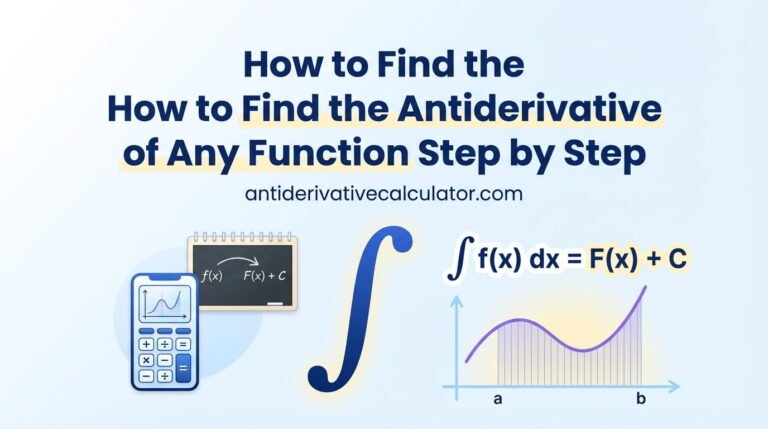
Worked Examples: How to Find the Antiderivative Step by Step
Step 1: Use the power rule. The exponent on x is 2.
Step 2: Add 1 to the exponent: 2 + 1 = 3. So x² becomes x³.
Step 3: Divide by the new exponent: x³ ÷ 3 = x³/3.
Step 4: The number in front was 3, and 3 × (x³/3) = x³.
Step 5: Add + C.
✅ Answer: x³ + C
Check it: The derivative of x³ is 3x² — which is exactly what we started with.
Step 1: Split the function into two parts: 5x and 4.
Step 2: Antiderivative of 5x → use the power rule: 5 × (x²/2) = 5x²/2.
Step 3: Antiderivative of 4 (a constant) → 4x.
Step 4: Combine both parts and add + C.
✅ Answer: 5x²/2 + 4x + C
Frequently Asked Questions
What is an antiderivative in simple terms?
An antiderivative is the reverse of a derivative. If you know the derivative of a function, the antiderivative helps you work backwards to find the original function. It always includes a + C because there may be a hidden constant.
Can I use an antiderivative calculator to check my work?
Absolutely! An antiderivative calculator is a great tool to double-check your answers after you have tried solving a problem by hand. It is perfect for learning because you can compare your steps with the correct solution and see where you went right — or wrong.
Is integration the same as finding the antiderivative?
For beginners, yes — they are basically the same thing. The indefinite integral of a function is its antiderivative. As you advance in calculus, you will learn about definite integrals too, which give you a specific number instead of a function.
Conclusion
Understanding what an antiderivative is does not have to be stressful. At its core, it is simply the reverse of a derivative — and with a few basic rules, you can find one step by step. The more you practice, the more natural it feels. If you want to check your work quickly or explore more problems, try using the antiderivative calculator right here on this site. It is a fast, easy way to build your confidence and sharpen your calculus skills!