
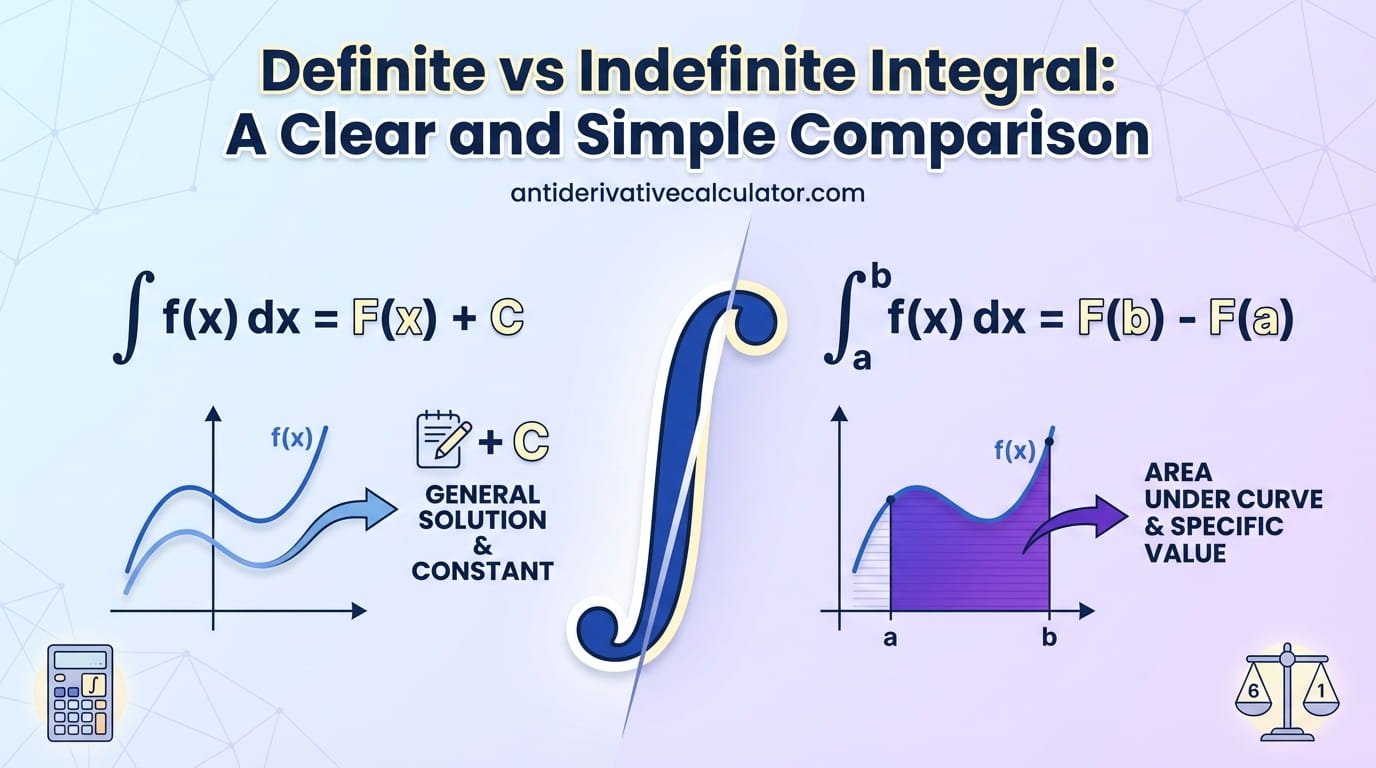
An indefinite integral, \(\int f(x)\,dx\), has no limits and its answer is a family of functions, \(F(x) + C\). A definite integral, \(\int_a^b f(x)\,dx\), has limits and its answer is a single number, \(F(b) – F(a)\), which is the signed area under the curve from \(a\) to \(b\).
The two kinds of integrals use almost the same symbol, so they are easy to mix up. The difference is whether there are numbers at the top and bottom of the \(\int\) sign. Those little numbers change everything: what the answer looks like, what it means, and whether you need \(+C\).
Side-by-Side Comparison
| Indefinite integral | Definite integral | |
|---|---|---|
| Looks like | \(\int f(x)\,dx\) | \(\int_a^b f(x)\,dx\) |
| Limits | None | Lower limit \(a\), upper limit \(b\) |
| Answer is | A function plus \(C\) | A number |
| Means | All antiderivatives of \(f\) | Signed area under \(f\) from \(a\) to \(b\) |
| Needs \(+C\)? | Yes | No, it cancels |
| Example | \(\int 2x\,dx = x^2 + C\) | \(\int_1^3 2x\,dx = 8\) |
| Calculator | Integral calculator | Definite integral calculator |
One Function, Both Ways
Take \(f(x) = 2x\).
As an indefinite integral
Ask: which functions have a derivative of \(2x\)? \(x^2\) does, and so do \(x^2 + 5\) and \(x^2 – 1\). So
\[\int 2x\,dx = x^2 + C.\]
The answer is a whole family of parabolas, all the same shape, shifted up or down. That family is what \(+C\) describes. See the constant of integration for why it matters.
As a definite integral
Now ask: what is the area under \(y = 2x\) from \(x = 1\) to \(x = 3\)? Take any antiderivative and subtract its values at the ends:
\[\int_1^3 2x\,dx = \Big[x^2\Big]_1^3 = 3^2 – 1^2 = 8.\]
You can check this with geometry: the region is a trapezoid with heights 2 and 6 and width 2, so its area is \(\frac{2 + 6}{2}\cdot 2 = 8\). ✓
Why the + C Disappears
Use \(x^2 + C\) instead of \(x^2\) and watch what happens:
\[\Big[x^2 + C\Big]_1^3 = (9 + C) – (1 + C) = 8.\]
Whatever \(C\) is, it is added once and subtracted once. That is why definite integrals never need \(+C\).
The Bridge Between Them: The Fundamental Theorem
The fundamental theorem of calculus connects the two ideas. It says that if \(F\) is any antiderivative of \(f\), then
In plain words: to find an area (definite), first find an antiderivative (indefinite), then plug in the limits. This is why you learn indefinite integrals first.
Signed Area: When the Answer Is Smaller Than You Expect
A definite integral counts area above the x-axis as positive and area below it as negative.
\[\int_0^{2\pi} \sin x\,dx = \Big[-\cos x\Big]_0^{2\pi} = -1 – (-1) = 0.\]
The sine wave clearly has area, but the hump above the axis (area 2) cancels the hump below (area 2). If a problem asks for total area, split the integral where the graph crosses the axis and add the absolute values: \(2 + 2 = 4\).
Reading the Notation
- \(\int\): a stretched S, for “sum”. An integral adds up tiny pieces.
- \(a\) and \(b\): where the adding starts and stops (only in definite integrals).
- \(f(x)\): the height of each tiny piece.
- \(dx\): the width of each tiny piece, and a label for the variable.
Put together, \(\int_a^b f(x)\,dx\) means “add up height times width for all the thin strips from \(a\) to \(b\)”, which is exactly a Riemann sum made infinitely fine.
Which One Does a Problem Want?
| If the problem says… | It wants |
|---|---|
| “Find the antiderivative” or “evaluate \(\int f(x)\,dx\)” | Indefinite: a function with \(+C\) |
| “Find the area”, “total distance”, “from \(x = a\) to \(x = b\)” | Definite: a number |
| “Find \(f(x)\) given \(f'(x)\) and \(f(0) = 3\)” | Indefinite first, then use the point to find \(C\) |
| “Average value on \([a, b]\)” | Definite, divided by \(b – a\) |
Worked Examples
Example 1
Indefinite: \(\int \left(3x^2 + 1\right)dx = x^3 + x + C\).
Definite: \(\int_0^2 \left(3x^2 + 1\right)dx = \big[x^3 + x\big]_0^2 = 10 – 0 = 10\).
Example 2
Indefinite: \(\int \frac{1}{x}\,dx = \ln|x| + C\).
Definite: \(\int_1^{e}\frac1x\,dx = \ln e – \ln 1 = 1\).
Example 3: a definite integral that goes to infinity
\(\int_1^{\infty} \frac{1}{x^2}\,dx = \lim_{b\to\infty}\left(1 – \frac1b\right) = 1\). Integrals with an infinite limit are called improper integrals. Try them in the improper integral calculator.
Calculators for This Topic
Practice what you just read. Each tool shows full steps and checks its own answer.
- ∫ₐᵇDefinite Integral Calculator – Area under a curve between two limits, with a graph.
- ∫Integral Calculator – Solve indefinite and definite integrals step by step.
- ∞Improper Integral Calculator – Check if an integral converges or diverges.
Frequently Asked Questions
What is the difference between a definite and an indefinite integral?
A definite integral has limits and gives a number (a signed area). An indefinite integral has no limits and gives a family of functions written with \(+C\).
Is an indefinite integral the same as an antiderivative?
Yes. The indefinite integral \(\int f(x)\,dx\) is the set of all antiderivatives of \(f\), written \(F(x) + C\).
Can a definite integral be negative?
Yes. If more of the area lies below the x-axis than above it, the definite integral is negative. Area itself is never negative, so for total area you take absolute values piece by piece.
Why don’t definite integrals have + C?
Because the constant is added at the upper limit and subtracted at the lower limit, so it cancels out.
Do I always need an antiderivative to find a definite integral?
Not always. If the antiderivative has no formula, like for \(e^{x^2}\), you can still estimate the definite integral numerically with sums of thin rectangles.



1 thought on “Definite vs Indefinite Integral: The Difference, Explained Simply”