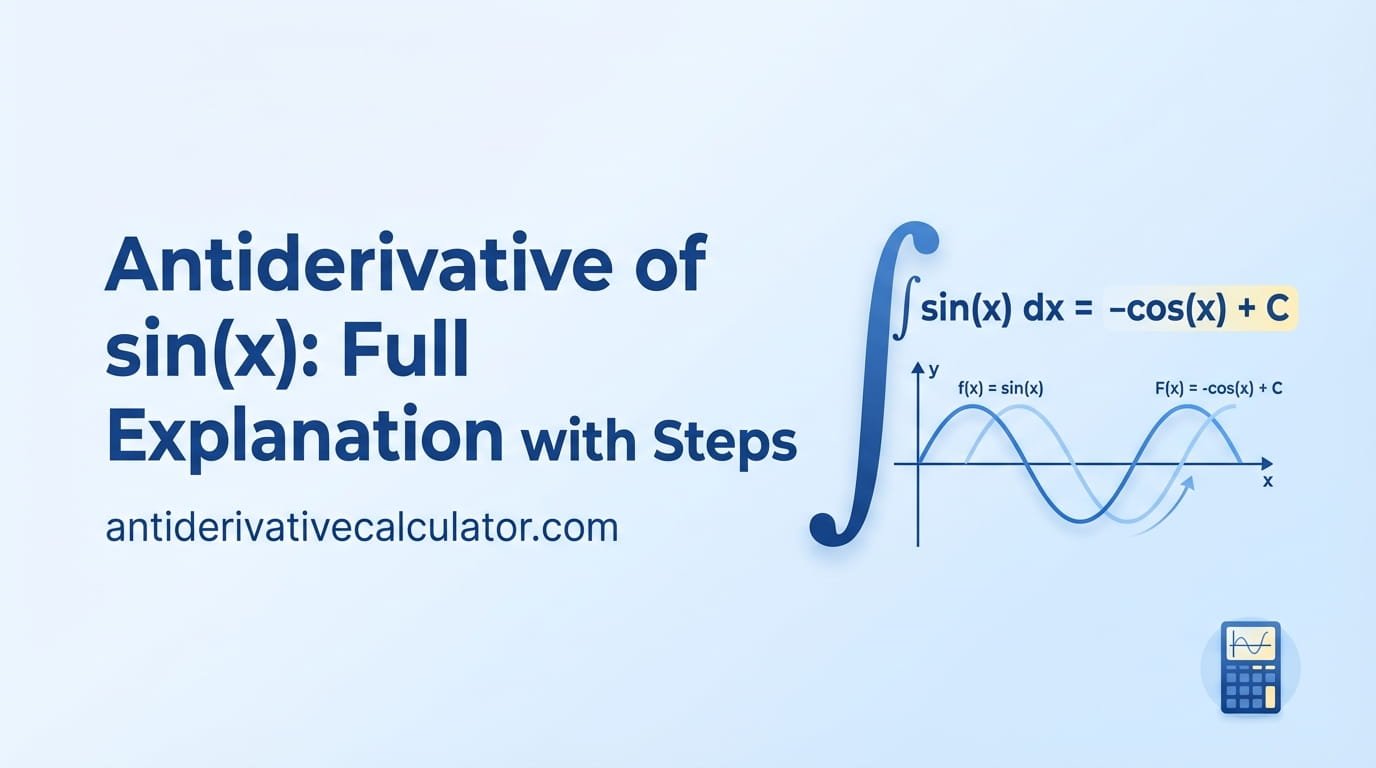
The antiderivative of \(\sin x\) is \(-\cos x + C\). In symbols, \(\int \sin x\,dx = -\cos x + C\). You can check it by differentiating: \(\frac{d}{dx}(-\cos x) = \sin x\).
This is one of the shortest answers in calculus, and also one of the easiest to get wrong. Many students write \(\cos x\) and forget the minus sign. Below you will see why the minus sign is there, a memory trick so you never lose it, and a table of the variations you will meet in homework, such as \(\sin 2x\), \(\sin^2 x\) and \(x\sin x\).
Why Is It \(-\cos x\) and Not \(\cos x\)?
An antiderivative is a function whose derivative gives you back what you started with. So the question is: what do you differentiate to get \(\sin x\)?
- \(\frac{d}{dx}\cos x = -\sin x\). Close, but the sign is wrong.
- \(\frac{d}{dx}(-\cos x) = -(-\sin x) = \sin x\). That is exactly what we want.
So \(-\cos x\) is an antiderivative of \(\sin x\). Adding any constant \(C\) still works, because the derivative of a constant is 0. That is why the full answer is \(-\cos x + C\). (More on that in why we add +C.)
A Memory Trick: The Derivative Circle
Write the four functions in a circle:
Each arrow to the right is one derivative. To find an antiderivative, take one step to the left. One step left of \(\sin x\) is \(-\cos x\). One step left of \(\cos x\) is \(\sin x\). The minus sign takes care of itself.
What About the Antiderivative of cos x?
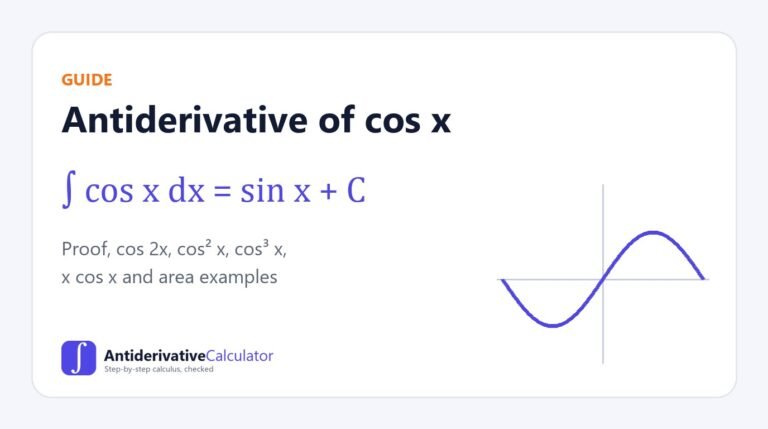
Going one step left from \(\cos x\) lands on \(\sin x\), so
\[\int \cos x\,dx = \sin x + C.\]
Notice the difference: sine gets a minus sign, cosine does not. Check: \(\frac{d}{dx}\sin x = \cos x\). ✓ For \(\cos 2x\), \(\cos^2 x\), \(x\cos x\) and more, see the full guide to the antiderivative of cos x.
Variations You Will See in Homework
| Integral | Answer | Method |
|---|---|---|
| \(\int 5\sin x\,dx\) | \(-5\cos x + C\) | Constant multiple rule |
| \(\int \sin 2x\,dx\) | \(-\frac12\cos 2x + C\) | Divide by the inside’s slope |
| \(\int \sin(3x+1)\,dx\) | \(-\frac13\cos(3x+1) + C\) | Same idea, \(u = 3x+1\) |
| \(\int \sin^2 x\,dx\) | \(\frac{x}{2} – \frac{\sin 2x}{4} + C\) | Half-angle identity |
| \(\int \sin^3 x\,dx\) | \(-\cos x + \frac{\cos^3 x}{3} + C\) | Pythagorean identity + substitution |
| \(\int \sin x\cos x\,dx\) | \(\frac{\sin^2 x}{2} + C\) | \(u = \sin x\) |
| \(\int x\sin x\,dx\) | \(-x\cos x + \sin x + C\) | Integration by parts |
Worked example: \(\int \sin 2x\,dx\)
Let \(u = 2x\), so \(du = 2\,dx\) and \(dx = \frac12\,du\).
\[\int \sin 2x\,dx = \frac12\int \sin u\,du = -\frac12\cos 2x + C.\]
The shortcut: for \(\sin(ax+b)\), divide by \(a\). This is u-substitution with a linear inside.
Worked example: \(\int \sin^2 x\,dx\)
There is no simple rule for a square, so rewrite it first with the half-angle identity \(\sin^2 x = \frac{1 – \cos 2x}{2}\):
\[\int \sin^2 x\,dx = \int \left(\frac12 – \frac12\cos 2x\right)dx = \frac{x}{2} – \frac{\sin 2x}{4} + C.\]
Worked example: \(\int x\sin x\,dx\)
This is a product, so use integration by parts with \(u = x\) and \(dv = \sin x\,dx\). Then \(du = dx\) and \(v = -\cos x\):
\[\int x\sin x\,dx = -x\cos x + \int \cos x\,dx = -x\cos x + \sin x + C.\]
What the Answer Means as an Area
The definite integral of \(\sin x\) from 0 to \(\pi\) gives the area under one hump of the sine wave:
\[\int_0^{\pi} \sin x\,dx = \Big[-\cos x\Big]_0^{\pi} = -\cos\pi + \cos 0 = 1 + 1 = 2.\]
So one arch of the sine curve has an area of exactly 2 square units. Over a full period, from 0 to \(2\pi\), the answer is 0, because the area below the axis cancels the area above it. You can see this with the graph in the definite integral calculator.
Common Mistakes
- Writing \(+\cos x\). Check by differentiating: \(\frac{d}{dx}\cos x = -\sin x\), not \(\sin x\).
- Forgetting to divide by the inside’s coefficient, as in \(\int\sin 2x\,dx \ne -\cos 2x\).
- Using degrees. These formulas only work when \(x\) is in radians.
Calculators for This Topic
Practice what you just read. Each tool shows full steps and checks its own answer.
- ∫Antiderivative Calculator – Find any antiderivative with full steps and a check.
- ∫ₐᵇDefinite Integral Calculator – Area under a curve between two limits, with a graph.
- d/dxDerivative Calculator – Product, quotient and chain rule steps for any function.
Frequently Asked Questions
What is the antiderivative of sin x?
It is \(-\cos x + C\), where \(C\) is any constant. The derivative of \(-\cos x\) is \(\sin x\), which confirms the answer.
What is the antiderivative of sin 2x?
It is \(-\frac12\cos 2x + C\). Because the inside is \(2x\), you divide by 2.
What is the antiderivative of sin squared x?
Use \(\sin^2 x = \frac{1-\cos 2x}{2}\). The answer is \(\frac{x}{2} – \frac{\sin 2x}{4} + C\).
Is the integral of sin x the same as its antiderivative?
The indefinite integral \(\int \sin x\,dx\) is the family of all antiderivatives, \(-\cos x + C\). A definite integral, like \(\int_0^\pi \sin x\,dx = 2\), is a number found from an antiderivative.
Why do I need radians?
The derivative rule \(\frac{d}{dx}\sin x = \cos x\) is only true in radians. In degrees, extra factors of \(\frac{\pi}{180}\) appear, so calculus always uses radians.