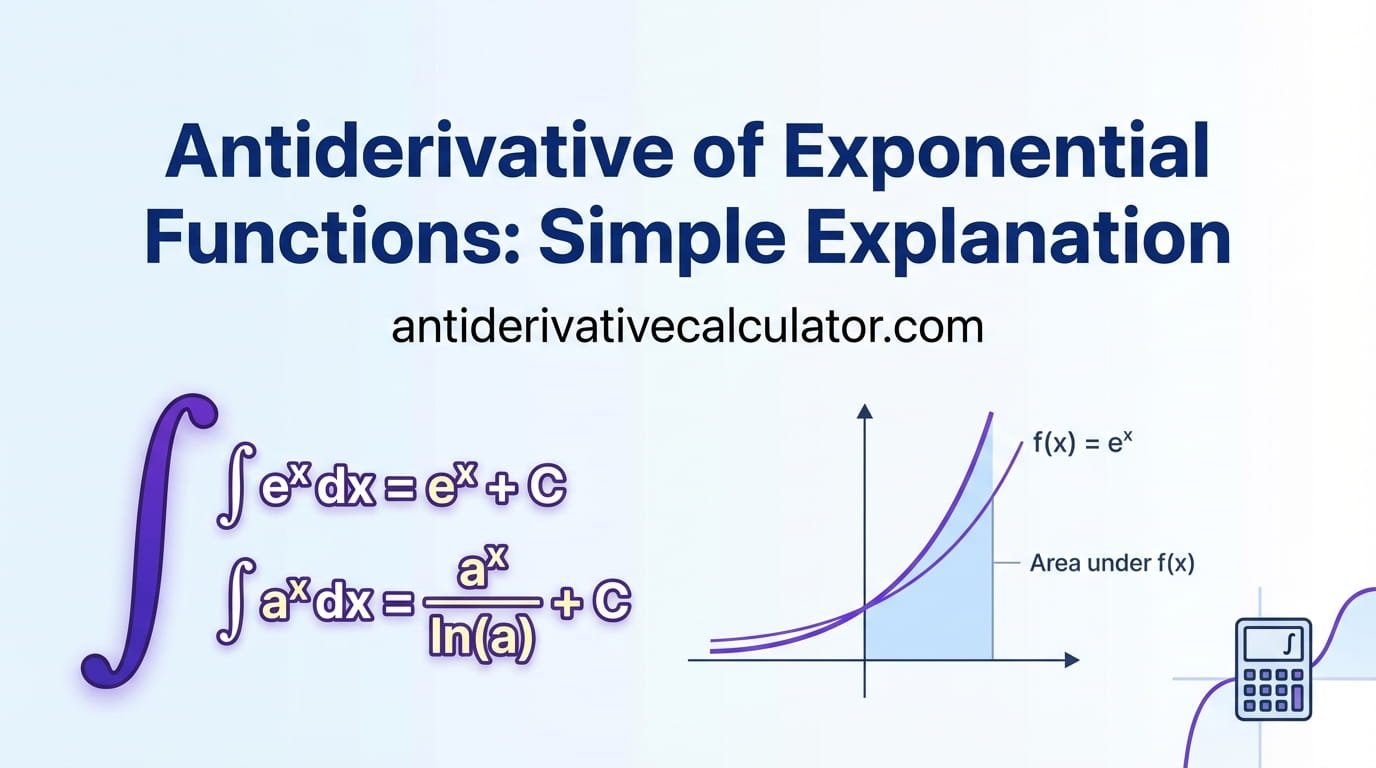
Antiderivative of Exponential Functions: Simple Explanation
If you have ever looked at a function like eˣ or 2ˣ and wondered how to integrate it, you are in the right place. Exponential functions show up constantly in calculus — and the great news is that their antiderivative rules are among the simplest and most satisfying in all of integration.
Unlike polynomial functions where you have to adjust exponents and divide, exponential functions follow very clean, predictable patterns. Once you learn those patterns, finding the antiderivative of exponential functions becomes one of the fastest and most straightforward tasks in calculus.
In this guide, you will learn every core rule for integrating exponential functions, understand exactly where each rule comes from, and work through real examples step by step. Whether you are brand new to this topic or just need a clear refresher, this post covers everything you need to know.
What Makes Exponential Functions Special in Calculus?
Before jumping into the rules, it helps to understand what makes exponential functions unique. An exponential function is any function where the variable appears in the exponent — like eˣ, e^(3x), or 5ˣ.
What makes these functions remarkable in calculus is a property that no other type of function shares: the function eˣ is its own derivative. Differentiate eˣ and you get eˣ back. That means integrating it returns the same result too — with just a + C added.
This unique property is why exponential functions are so important in mathematics, science, and engineering. They model real-world phenomena like population growth, radioactive decay, compound interest, and the behavior of electrical circuits. Knowing how to find the antiderivative of exponential functions is not just a classroom skill — it is a genuinely useful tool.
Rule 1: The Antiderivative of eˣ
This is the simplest and most beautiful rule in exponential integration. Because eˣ is its own derivative, it is also its own antiderivative:
∫ eˣ dx = eˣ + C
That is all there is to it. The function does not change — you simply add + C at the end. No adjustments, no new exponents, no dividing. Just eˣ + C.
This makes eˣ completely unique among all functions in calculus. Nothing else behaves this way. Every other function changes form when you differentiate or integrate it — but eˣ stays exactly the same.
You can verify this yourself: take the derivative of eˣ + C. The derivative of eˣ is eˣ, and the derivative of C is zero. So you get back eˣ — exactly what you started with. The rule checks out perfectly.
Rule 2: The Antiderivative of e^(ax) — Exponential with a Coefficient
Things get only slightly more involved when a constant is multiplied inside the exponent — like e^(3x) or e^(−2x). Here, you need to account for that inner constant using a simple adjustment.
∫ e^(ax) dx = (1/a) · e^(ax) + C
Where a is any non-zero constant.
In plain English: integrate e^(ax) the same way as eˣ, but divide the result by the constant a that is sitting inside the exponent.
Where does this rule come from? It is the reverse of the chain rule. When you differentiate (1/a) · e^(ax), the chain rule brings down the inner constant a, which then multiplies with (1/a) to give 1 — leaving you with just e^(ax). So dividing by a is exactly what is needed to reverse that chain rule effect.
You can also derive this result using u-substitution by letting u = ax. Both approaches give the same answer — use whichever makes more sense to you right now.
Rule 3: The Antiderivative of aˣ — Exponential with a Different Base
So far we have only looked at base e. But what about exponential functions with a different base — like 2ˣ, 3ˣ, or 10ˣ? These are called general exponential functions, and they have their own antiderivative rule.
∫ aˣ dx = aˣ / ln(a) + C
Where a is a positive constant and a ≠ 1.
The key ingredient here is ln(a) — the natural logarithm of the base. You divide the result by ln(a) in the same way you divide by the inner coefficient in the e^(ax) rule.
Notice what happens when a = e. Since ln(e) = 1, the formula becomes eˣ / 1 = eˣ. That is exactly Rule 1 — so Rule 1 is really just a special case of this more general rule. They are consistent with each other, which is a reassuring sign that the math all fits together neatly.
This rule comes up less often in beginner courses than the eˣ rules, but it appears regularly enough that knowing it will save you from being caught off guard on a test.
Quick Reference: All Three Exponential Antiderivative Rules
- ∫ eˣ dx = eˣ + C
- ∫ e^(ax) dx = (1/a) · e^(ax) + C
- ∫ aˣ dx = aˣ / ln(a) + C (where a > 0 and a ≠ 1)
Worked Examples: Antiderivative of Exponential Functions Step by Step
Step 1: Identify the function. This is the natural exponential function with no coefficient inside the exponent.
Step 2: Apply Rule 1 directly. The antiderivative of eˣ is eˣ.
Step 3: Add + C.
✅ Answer: eˣ + C
Check: The derivative of eˣ + C is eˣ. ✓
Step 1: Identify the function. This is e raised to 5x, so the inner coefficient is a = 5.
Step 2: Apply Rule 2. The antiderivative of e^(ax) is (1/a) · e^(ax).
Step 3: Substitute a = 5: (1/5) · e^(5x).
Step 4: Add + C.
✅ Answer: (1/5)e^(5x) + C
Check: Differentiate using the chain rule — (1/5) · e^(5x) · 5 = e^(5x). ✓
Step 1: The inner coefficient is a = −3. Negative values of a work exactly the same way.
Step 2: Apply Rule 2: (1/a) · e^(ax) = (1/−3) · e^(−3x).
Step 3: Simplify: −(1/3) · e^(−3x).
Step 4: Add + C.
✅ Answer: −(1/3)e^(−3x) + C
Check: Differentiate — −(1/3) · e^(−3x) · (−3) = e^(−3x). ✓
Step 1: Identify the function. This is a general exponential with base a = 4.
Step 2: Apply Rule 3: ∫ aˣ dx = aˣ / ln(a).
Step 3: Substitute a = 4: 4ˣ / ln(4).
Step 4: Add + C.
✅ Answer: 4ˣ / ln(4) + C
Check: Differentiate — (4ˣ · ln(4)) / ln(4) = 4ˣ. ✓
Step 1: Split into three separate terms using the sum and difference rule.
Step 2: Antiderivative of 3eˣ.
Rule 1 gives eˣ. Multiply by coefficient 3: 3eˣ.
Step 3: Antiderivative of 2e^(4x).
Rule 2 with a = 4: (1/4)e^(4x). Multiply by coefficient 2: (2/4)e^(4x) = (1/2)e^(4x).
Step 4: Antiderivative of 5ˣ.
Rule 3 with a = 5: 5ˣ / ln(5).
Step 5: Combine all three results and add + C.
✅ Answer: 3eˣ + (1/2)e^(4x) − 5ˣ/ln(5) + C
Check: Differentiate term by term — 3eˣ + 2e^(4x) − 5ˣ. ✓
Exponential Antiderivatives and U-Substitution
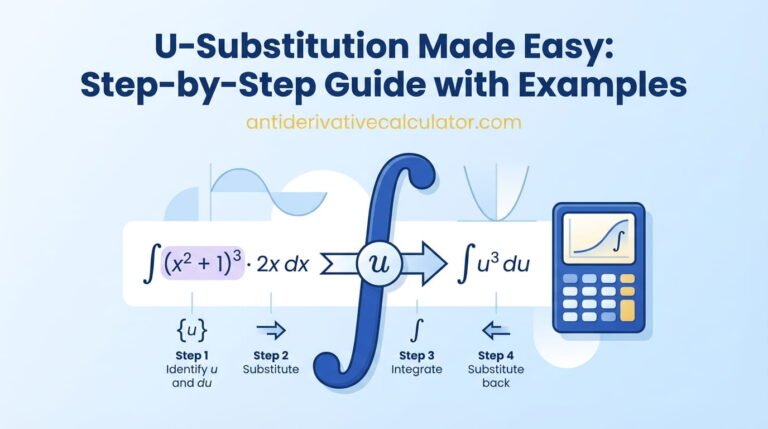
When the exponent of e is more complex than a simple constant — like e^(x²) or e^(sin x) — the basic rules alone are not enough. These situations call for u-substitution combined with the exponential rules.
The process works like this:
- Let u equal the entire exponent — the expression sitting on top of e.
- Differentiate u to find du, then solve for dx.
- Substitute u and the new dx into the integral.
- The integral should now look like ∫ eᵘ du or a simple multiple of it.
- Apply Rule 1: the antiderivative of eᵘ is eᵘ.
- Substitute back to replace u with the original expression.
- Add + C.
For example, to integrate 2x · e^(x²), let u = x². Then du = 2x dx, so the 2x dx in the integral matches du perfectly. The integral becomes ∫ eᵘ du = eᵘ = e^(x²) + C. Clean, fast, and elegant.
Common Mistakes to Avoid
Exponential antiderivatives are relatively straightforward, but a few specific errors trip up beginners regularly:
- Forgetting to divide by the inner coefficient: When integrating e^(ax), you must divide by a. Writing eˣ as the answer to ∫ e^(5x) dx is one of the most common mistakes in this topic.
- Confusing the base-a rule with the power rule: The power rule is for variables raised to a constant power — like x⁵. The exponential rule is for constants raised to a variable power — like 5ˣ. They look similar but work completely differently. Never apply the power rule to an exponential function.
- Forgetting ln(a) in the base-a rule: When integrating aˣ, the answer must include ln(a) in the denominator. Leaving it out produces an incorrect result.
- Forgetting + C: As with every indefinite integral in calculus, the constant of integration is always required in the final answer.
- Skipping the verification step: Always differentiate your answer to confirm it matches the original function. With exponential functions, this check is especially quick and easy to do.
Frequently Asked Questions
Why does the antiderivative of eˣ equal eˣ?
Because eˣ is its own derivative — a property unique to this function. Since differentiation and integration are exact opposites, a function that does not change when differentiated also does not change when integrated. The only addition is + C, which accounts for the constant that disappears during differentiation. No other function in mathematics shares this remarkable property.
What is the difference between integrating eˣ and integrating xⁿ?
These two rules work in completely different ways. For xⁿ, you use the power rule — add 1 to the exponent and divide by the new exponent. For eˣ, the function stays exactly the same and you simply add + C. The key difference is where the variable appears: in xⁿ the variable is the base, while in eˣ the variable is the exponent. Always identify which type you are dealing with before choosing a rule.
Can I use an antiderivative calculator to check exponential integration problems?
Absolutely — and it is a great habit to build. After working through a problem involving the antiderivative of exponential functions on your own, use the antiderivative calculator on this site to verify your answer instantly. Pay special attention to whether the inner coefficient was handled correctly and whether ln(a) appears where it should. Catching those small errors early is one of the fastest ways to improve your accuracy in calculus.
Conclusion
Finding the antiderivative of exponential functions is one of the most rewarding topics in calculus — the rules are clean, the patterns are logical, and the verification step is almost always quick and satisfying. Remember that eˣ integrates to itself, that e^(ax) requires dividing by the inner constant a, and that aˣ requires dividing by ln(a). Master those three rules, practice with a variety of problems, and always check your work by differentiating your answer. Ready to test your skills? Use the antiderivative calculator on this site to verify your exponential integration answers step by step and keep building your calculus confidence!
“`