
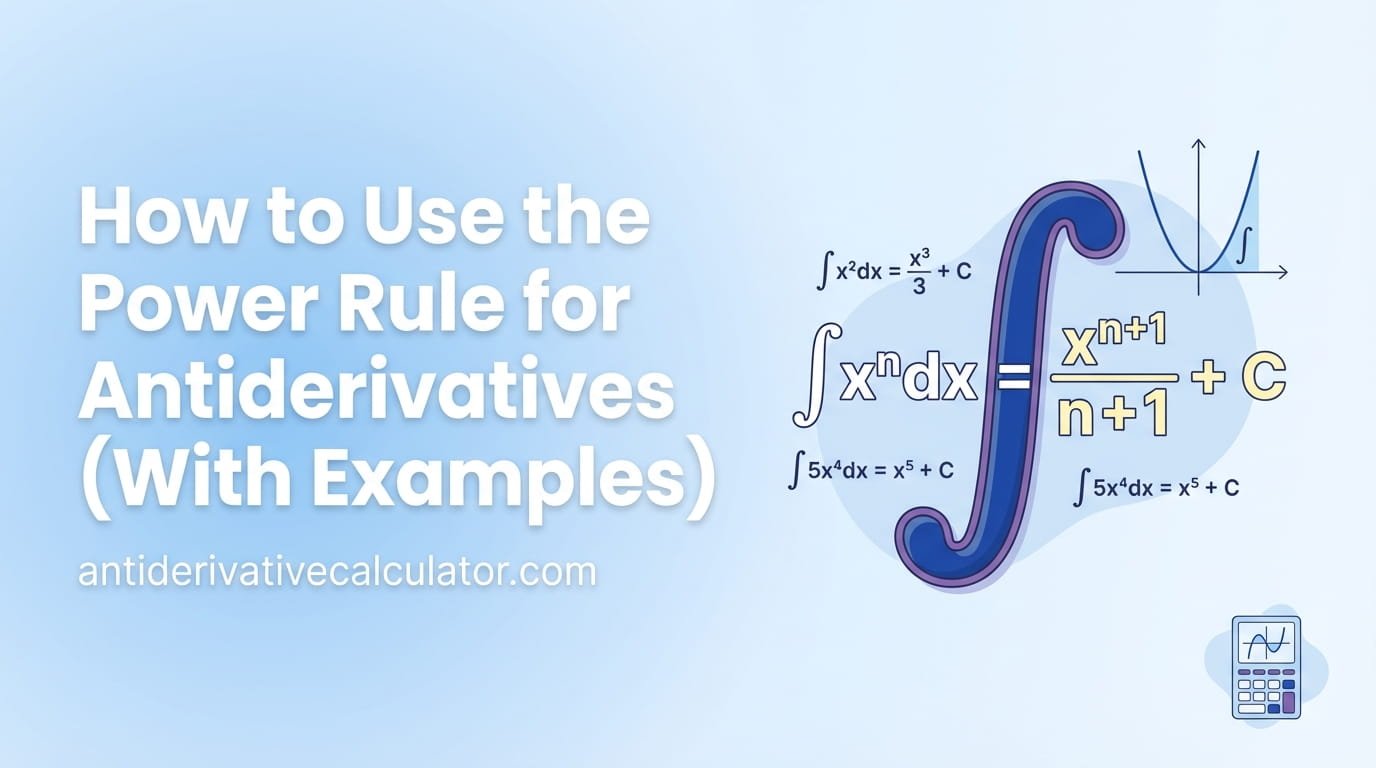
The power rule for integration says \(\int x^n\,dx = \frac{x^{n+1}}{n+1} + C\) for every number \(n\) except \(-1\). In words: add 1 to the exponent, then divide by the new exponent. Example: \(\int x^4\,dx = \frac{x^5}{5} + C\).
The power rule is the first integration rule you learn and the one you will use most. It is simple, but it hides a few traps: negative exponents, square roots, fractions and the one exponent where it fails. This guide teaches it as five levels. Each level adds one new skill, with examples and a quick practice set.
Why the Rule Works
It is the derivative power rule in reverse. The derivative rule takes the exponent down and subtracts 1: \(\frac{d}{dx}x^5 = 5x^4\). To undo that, add 1 to the exponent and divide by the new exponent:
\[\frac{d}{dx}\left(\frac{x^{n+1}}{n+1}\right) = \frac{(n+1)x^{n}}{n+1} = x^n. \;✓\]
The division by \(n + 1\) is exactly what cancels the number the derivative brings down.
Level 1: Positive Whole-Number Powers
- \(\int x^2\,dx = \frac{x^3}{3} + C\)
- \(\int x^7\,dx = \frac{x^8}{8} + C\)
- \(\int x\,dx = \frac{x^2}{2} + C\) (because \(x = x^1\))
- \(\int 1\,dx = x + C\) (because \(1 = x^0\))
Level 2: Numbers in Front
A coefficient just comes along for the ride (the constant multiple rule). Integrate the power, then multiply.
- \(\int 6x^2\,dx = 6\cdot\frac{x^3}{3} = 2x^3 + C\)
- \(\int 10x^4\,dx = 2x^5 + C\)
- \(\int \frac{x^3}{2}\,dx = \frac{x^4}{8} + C\)
Quick answers: the ones students search most
| Antiderivative of | Answer |
|---|---|
| \(x\) | \(\frac{x^2}{2} + C\) |
| \(2x\) | \(x^2 + C\) |
| \(4x\) | \(2x^2 + C\) |
| \(8x\) | \(4x^2 + C\) |
| \(10x\) | \(5x^2 + C\) |
| \(x^4\) | \(\frac{x^5}{5} + C\) |
| \(3\) (any constant \(k\)) | \(3x + C\) (in general \(kx + C\)) |
Constants follow the same rule, since \(k = kx^0\). More on that in the integral of a constant.
Level 3: Negative Powers
The rule works the same way, but be careful with the signs. Adding 1 to \(-3\) gives \(-2\), not \(-4\).
- \(\int x^{-3}\,dx = \frac{x^{-2}}{-2} + C = -\frac{1}{2x^2} + C\)
- \(\int x^{-2}\,dx = \frac{x^{-1}}{-1} + C = -\frac{1}{x} + C\)
Level 4: Roots and Fraction Powers
Turn every root into a fraction power first: \(\sqrt{x} = x^{1/2}\), \(\sqrt[3]{x} = x^{1/3}\), \(\sqrt{x^3} = x^{3/2}\). Dividing by a fraction is the same as multiplying by its flip.
- \(\int \sqrt{x}\,dx = \int x^{1/2}\,dx = \frac{x^{3/2}}{3/2} = \frac23x^{3/2} + C\)
- \(\int \sqrt[3]{x}\,dx = \frac{x^{4/3}}{4/3} = \frac34x^{4/3} + C\)
- \(\int \frac{1}{\sqrt{x}}\,dx = \int x^{-1/2}\,dx = 2x^{1/2} = 2\sqrt{x} + C\)
Level 5: Rewrite First, Then Integrate
Many problems are power-rule problems in disguise. The rule is: never integrate a fraction or a product of powers directly. Rewrite until every term is a single power of \(x\).
| Original | Rewritten | Answer |
|---|---|---|
| \(\int \frac{4}{x^3}\,dx\) | \(\int 4x^{-3}\,dx\) | \(-\frac{2}{x^2} + C\) |
| \(\int x\sqrt{x}\,dx\) | \(\int x^{3/2}\,dx\) | \(\frac25x^{5/2} + C\) |
| \(\int \frac{x^2 + 1}{\sqrt{x}}\,dx\) | \(\int \left(x^{3/2} + x^{-1/2}\right)dx\) | \(\frac25x^{5/2} + 2x^{1/2} + C\) |
| \(\int (x + 2)^2\,dx\) | \(\int \left(x^2 + 4x + 4\right)dx\) | \(\frac{x^3}{3} + 2x^2 + 4x + C\) |
Putting It Together: Polynomials
With the sum rule, a whole polynomial is just Level 2 repeated:
\[\int \left(5x^4 – 3x^2 + 8x – 2\right)dx = x^5 – x^3 + 4x^2 – 2x + C.\]
Notice there is only one \(+C\) at the end, not one per term.
The Exception: \(n = -1\)
For \(\int x^{-1}\,dx = \int \frac{1}{x}\,dx\), the rule would divide by \(-1 + 1 = 0\). That is impossible, so this case has its own answer: \(\int \frac1x\,dx = \ln|x| + C\). Read why the answer is ln|x|.
What the Power Rule Cannot Do
- Exponentials: \(\int 2^x\,dx\) is not \(\frac{2^{x+1}}{x+1}\). The variable is in the exponent, so it needs the exponential rule.
- Powers of an inside function: \(\int (3x+1)^5\,dx\) needs a quick substitution: \(\frac{(3x+1)^6}{18} + C\). Do not forget to divide by the 3.
- Products of different functions: \(\int x^2\sin x\,dx\) needs integration by parts.
Practice: One Problem per Level
Level 1: \(\int x^9\,dx\)
\(\frac{x^{10}}{10} + C\)
Level 2: \(\int 12x^5\,dx\)
\(2x^6 + C\)
Level 3: \(\int x^{-4}\,dx\)
\(-\frac{1}{3x^3} + C\)
Level 4: \(\int x^{2/3}\,dx\)
\(\frac35x^{5/3} + C\)
Level 5: \(\int \frac{x^3 – 2}{x^2}\,dx\)
\(\int \left(x – 2x^{-2}\right)dx = \frac{x^2}{2} + \frac{2}{x} + C\)
Check any answer with the antiderivative calculator. It names the power rule at every step.
Calculators for This Topic
Practice what you just read. Each tool shows full steps and checks its own answer.
- ∫Antiderivative Calculator – Find any antiderivative with full steps and a check.
- ∫Integral Calculator – Solve indefinite and definite integrals step by step.
- =Simplify Calculator – Simplified, expanded and factored forms.
Frequently Asked Questions
What is the power rule for integration?
\(\int x^n\,dx = \frac{x^{n+1}}{n+1} + C\) for any real \(n\) except \(-1\). Add one to the exponent and divide by the new exponent.
Does the power rule work for negative exponents?
Yes, as long as the exponent is not \(-1\). For example, \(\int x^{-2}\,dx = -x^{-1} + C = -\frac1x + C\).
How do I use the power rule with square roots?
Rewrite the root as a fraction power first, like \(\sqrt{x} = x^{1/2}\). Then add 1 and divide: \(\int x^{1/2}\,dx = \frac23x^{3/2} + C\).
What is the reverse power rule?
It is another name for the power rule for integration, because it undoes the power rule for derivatives.
Why can’t I use the power rule for 1/x?
Because \(\frac1x = x^{-1}\) and the rule would divide by zero. The antiderivative of \(\frac1x\) is \(\ln|x| + C\) instead.
1 thought on “Power Rule for Integration: 5 Levels From Easy to Tricky”