
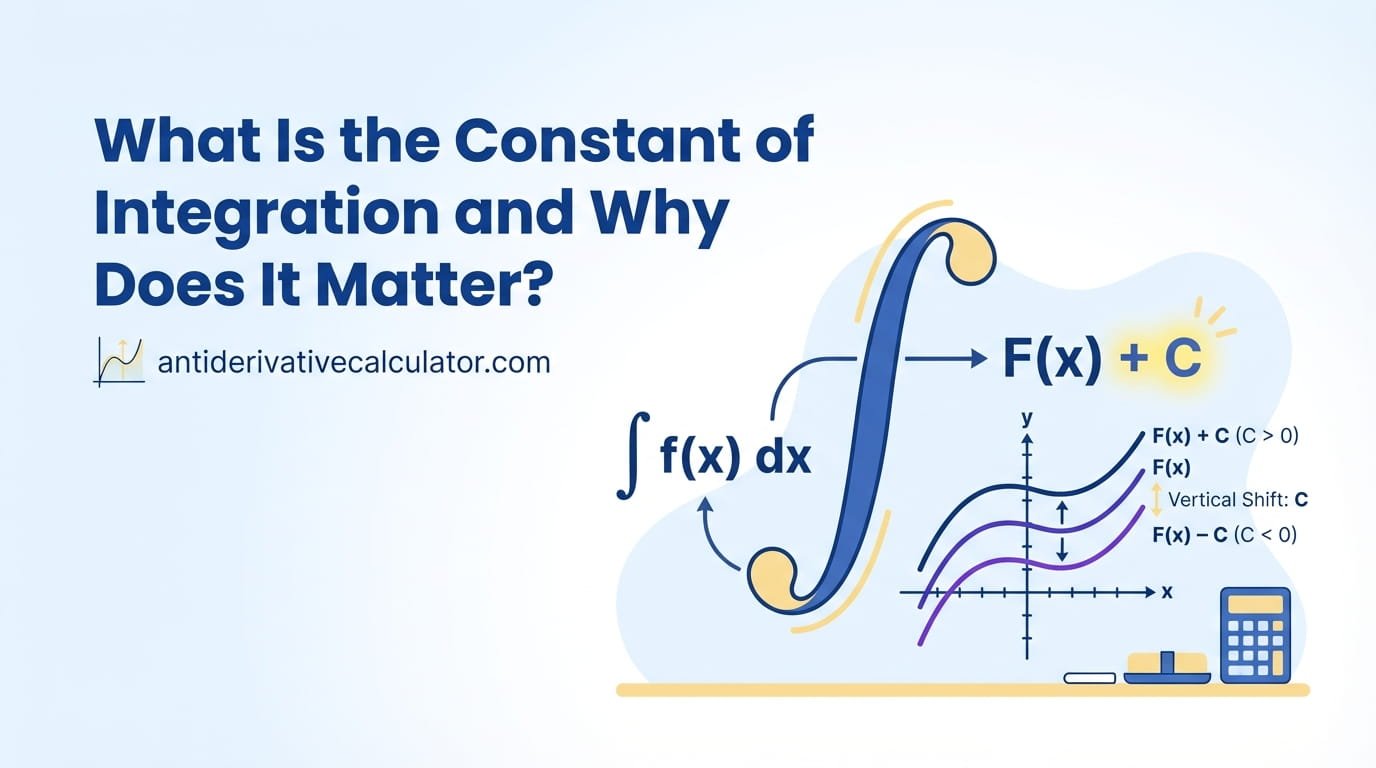
In integration, \(C\) is the constant of integration: the “\(+C\)” added to every indefinite integral. It is there because the derivative of any constant is 0, so many functions share the same derivative. For example, \(x^2\), \(x^2 + 1\) and \(x^2 – 7\) all have derivative \(2x\), so \(\int 2x\,dx = x^2 + C\). An extra fact, like a starting value, tells you the exact value of \(C\).
A Puzzle: Three Students, Three Different Answers
A teacher asks the class to find \(\int 2\sin x\cos x\,dx\). Three students hand in three different answers:
- Ana uses \(u = \sin x\) and gets \(\sin^2 x + C\).
- Ben uses \(u = \cos x\) and gets \(-\cos^2 x + C\).
- Chloe uses \(2\sin x\cos x = \sin 2x\) and gets \(-\frac12\cos 2x + C\).
Who is right? All three. Using \(\sin^2 x + \cos^2 x = 1\) and \(\cos 2x = 1 – 2\sin^2 x\):
\[-\cos^2 x = \sin^2 x – 1, \qquad -\tfrac12\cos 2x = \sin^2 x – \tfrac12.\]
The three answers differ only by a constant (\(-1\) and \(-\frac12\)). The \(+C\) in each answer soaks up that difference. This is exactly why the constant of integration exists, and why checking by differentiating beats comparing answers to the back of the book.
Where the + C Comes From
Differentiation throws away constants: \(\frac{d}{dx}(x^2 + 5) = 2x\) and \(\frac{d}{dx}(x^2 – 3) = 2x\). When you go backward from \(2x\), you cannot know which constant was thrown away. So the answer has to include all the possibilities:
On a graph, \(x^2 + C\) is an infinite stack of parabolas, each one a vertical shift of the others. At any given \(x\), they all have the same slope.
Integral of a Constant: What Is \(\int k\,dx\)?
People often mix up two different ideas: integrating a constant and the constant of integration. Here is the first one. The integral of any constant \(k\) is \(k\) times \(x\), plus the constant of integration:
It works because \(\frac{d}{dx}(kx) = k\). A few examples:
| Integral | Answer |
|---|---|
| \(\int 1\,dx\) (often written \(\int dx\)) | \(x + C\) |
| \(\int 3\,dx\) | \(3x + C\) |
| \(\int 7\,dx\) | \(7x + C\) |
| \(\int \pi\,dx\) | \(\pi x + C\) |
| \(\int 0\,dx\) | \(C\) |
The last row is the whole story of \(+C\) in one line: the functions whose derivative is 0 are exactly the constants.
What happens to a constant when you integrate?
It depends on where the constant sits:
- A constant term gains an \(x\): in \(\int (2x + 5)\,dx = x^2 + 5x + C\), the 5 becomes \(5x\).
- A constant factor just stays in front: \(\int 5\cos x\,dx = 5\int \cos x\,dx = 5\sin x + C\). This is the constant multiple rule from the antiderivative rules.
- A constant in a definite integral gives a rectangle’s area: \(\int_0^4 3\,dx = 3 \cdot 4 = 12\).
Finding the Exact Value of C (the Particular Antiderivative)
Textbooks often say: “find the particular antiderivative that satisfies the following conditions.” That means: find the one antiderivative with a specific value of \(C\). If you know one point on the curve, only one member of the family passes through it. That point is called an initial condition, and the problem is an initial value problem.
- Integrate. Find the general antiderivative with \(+C\).
- Plug in the known point. Substitute the given \(x\) and \(y\).
- Solve for C. Then write the final function without \(C\).
Example 1: a curve through a point
Find \(f(x)\) if \(f'(x) = 6x – 4\) and \(f(1) = 3\).
Integrate: \(f(x) = 3x^2 – 4x + C\). Plug in \(x = 1\): \(3 – 4 + C = 3\), so \(C = 4\).
\[f(x) = 3x^2 – 4x + 4.\]
Example 2: position from velocity
A drone’s velocity is \(v(t) = 3t^2 + 2\) meters per second. At \(t = 0\) it is 5 meters above the ground. Find its height \(h(t)\).
Integrate: \(h(t) = t^3 + 2t + C\). At \(t = 0\), \(h = 5\), so \(C = 5\).
\[h(t) = t^3 + 2t + 5.\]
Here \(C\) has a real meaning: the starting height. In motion problems, the constant of integration is usually the starting position or starting speed.
Example 3: two constants
If you integrate twice, you get two constants. Find \(f\) if \(f”(x) = 6\), \(f'(0) = 1\) and \(f(0) = 2\).
First: \(f'(x) = 6x + C_1\), and \(f'(0) = 1\) gives \(C_1 = 1\). Second: \(f(x) = 3x^2 + x + C_2\), and \(f(0) = 2\) gives \(C_2 = 2\). So \(f(x) = 3x^2 + x + 2\). Second-order problems like this are what the differential equation solver handles.
The Constant Can Wear a Disguise
Because \(C\) can be any number, it can be written in many forms. All of these are correct:
- \(\ln|x| + C\) is the same as \(\ln|kx|\), because \(\ln|kx| = \ln|x| + \ln k\) and \(\ln k\) is just another constant.
- \(e^{x + C} = e^C e^x\), which is often written \(Ae^x\).
- \(2C\), \(C + 5\) or \(-C\) are still “some constant”, so we usually just write \(C\) again.
When You Do NOT Need + C
In a definite integral, the constant cancels:
\[\int_1^3 2x\,dx = \Big[x^2 + C\Big]_1^3 = (9 + C) – (1 + C) = 8.\]
So \(+C\) belongs on indefinite integrals only. See definite vs indefinite integrals.
Does Forgetting + C Really Matter?
Yes, for two reasons. First, most teachers take off points, because without \(C\) the answer names just one antiderivative instead of all of them. Second, in initial value problems, forgetting \(C\) gives the wrong function. In Example 2, leaving out \(C\) would put the drone on the ground at the start instead of 5 meters up.
Calculators for This Topic
Practice what you just read. Each tool shows full steps and checks its own answer.
- ∫Antiderivative Calculator – Find any antiderivative with full steps and a check.
- y′Differential Equation Solver – Linear, separable and second-order equations, with a check.
- ∫ₐᵇDefinite Integral Calculator – Area under a curve between two limits, with a graph.
Frequently Asked Questions
What is C in integration?
\(C\) is the constant of integration. It is an arbitrary constant added to an indefinite integral, and it represents all the constants that could have disappeared when the original function was differentiated.
What is the integration of a constant equal to?
The integral of a constant \(k\) is \(kx + C\). For example, \(\int 4\,dx = 4x + C\) and \(\int 1\,dx = x + C\).
Why do we add C when integrating?
Because the derivative of a constant is zero, infinitely many functions have the same derivative. Adding \(C\) includes all of them in the answer.
How do you find the value of C?
Use an extra piece of information, such as \(f(0) = 5\). Substitute that point into the general antiderivative and solve the equation for \(C\).
Can the constant of integration be negative or zero?
Yes. \(C\) can be any real number: positive, negative or zero.
Why do two correct answers look different?
They often differ only by a constant, which \(+C\) absorbs. To compare them, differentiate both. If the derivatives match, both are correct.



1 thought on “Constant of Integration: What Is C in Integration (and How to Find It)”