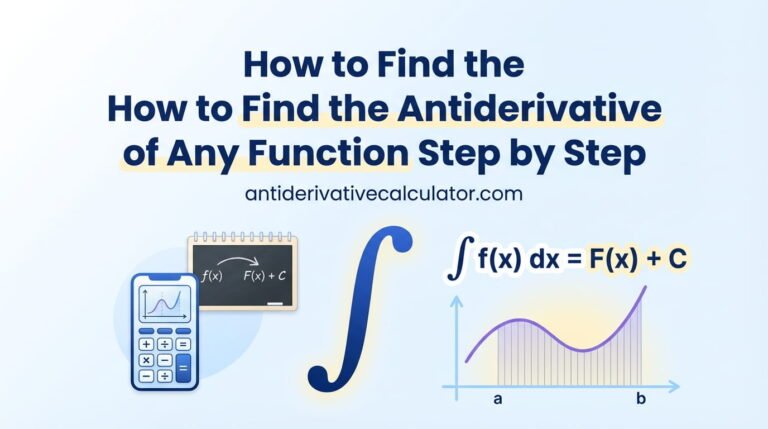
An antiderivative of a function \(f(x)\) is a function \(F(x)\) whose derivative is \(f(x)\). For example, \(x^2\) is an antiderivative of \(2x\), because the derivative of \(x^2\) is \(2x\). Since constants vanish when you differentiate, every antiderivative can have any constant added, so we write \(\int 2x\,dx = x^2 + C\).
If derivatives answer the question “how fast is this changing?”, antiderivatives answer the reverse question: “what was changing to give me this?” This beginner guide explains the idea with an everyday picture, a few easy examples, the meaning of \(+C\), and a short quiz to test yourself.
The Idea in One Picture: Pressing Undo
Think of taking a derivative as pressing a button that turns one function into another: \(x^3\) becomes \(3x^2\). Finding an antiderivative is pressing undo. You are given \(3x^2\) and asked which function went in.
| Start with \(F(x)\) | Derivative \(F'(x)\) | So an antiderivative of the right column is… |
|---|---|---|
| \(x^2\) | \(2x\) | \(x^2\) |
| \(x^3\) | \(3x^2\) | \(x^3\) |
| \(\sin x\) | \(\cos x\) | \(\sin x\) |
| \(e^x\) | \(e^x\) | \(e^x\) |
| \(\ln x\) | \(\frac1x\) | \(\ln x\) |
Every derivative fact you already know is also an antiderivative fact, read from right to left.
A Real-Life Version
Your phone’s speedometer app records your speed every second during a bike ride. The speed is the derivative of your distance. If you only had the speed readings, could you work out how far you went? Yes: that is finding an antiderivative. Calculus uses this to turn speed into distance, a growth rate into a population, or a flow rate into the total amount of water in a tank.
Why Is There Always a + C?
Look at these three functions:
\[x^2, \qquad x^2 + 5, \qquad x^2 – 3.\]
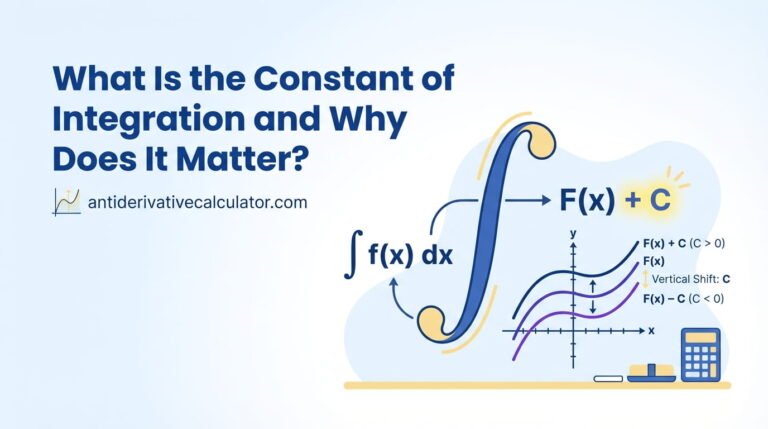
All three have the same derivative, \(2x\), because the derivative of a constant is 0. So when you undo the derivative of \(2x\), you cannot tell which one you started with. The honest answer is “\(x^2\) plus some constant”, written \(x^2 + C\).
On a graph, \(x^2 + C\) is a whole stack of identical parabolas, each shifted up or down. They all have exactly the same slope at every \(x\). If you are also told one point the curve passes through, you can pick out the exact one. Read more in the constant of integration.
How to Read the Notation
\[\int 2x\,dx = x^2 + C\]
- \(\int\) means “find the antiderivative of”.
- \(2x\) is the function you start with (the integrand).
- \(dx\) says the variable is \(x\).
- \(x^2 + C\) is the answer, called the general antiderivative or indefinite integral.
Your First Three Antiderivatives
Example 1: \(\int 4x^3\,dx\)
Ask: what has a derivative of \(4x^3\)? Since \(\frac{d}{dx}x^4 = 4x^3\), the answer is \(x^4 + C\).
Example 2: \(\int 7\,dx\)
What has a derivative of 7? A straight line with slope 7: \(7x + C\).
Example 3: \(\int x^2\,dx\)
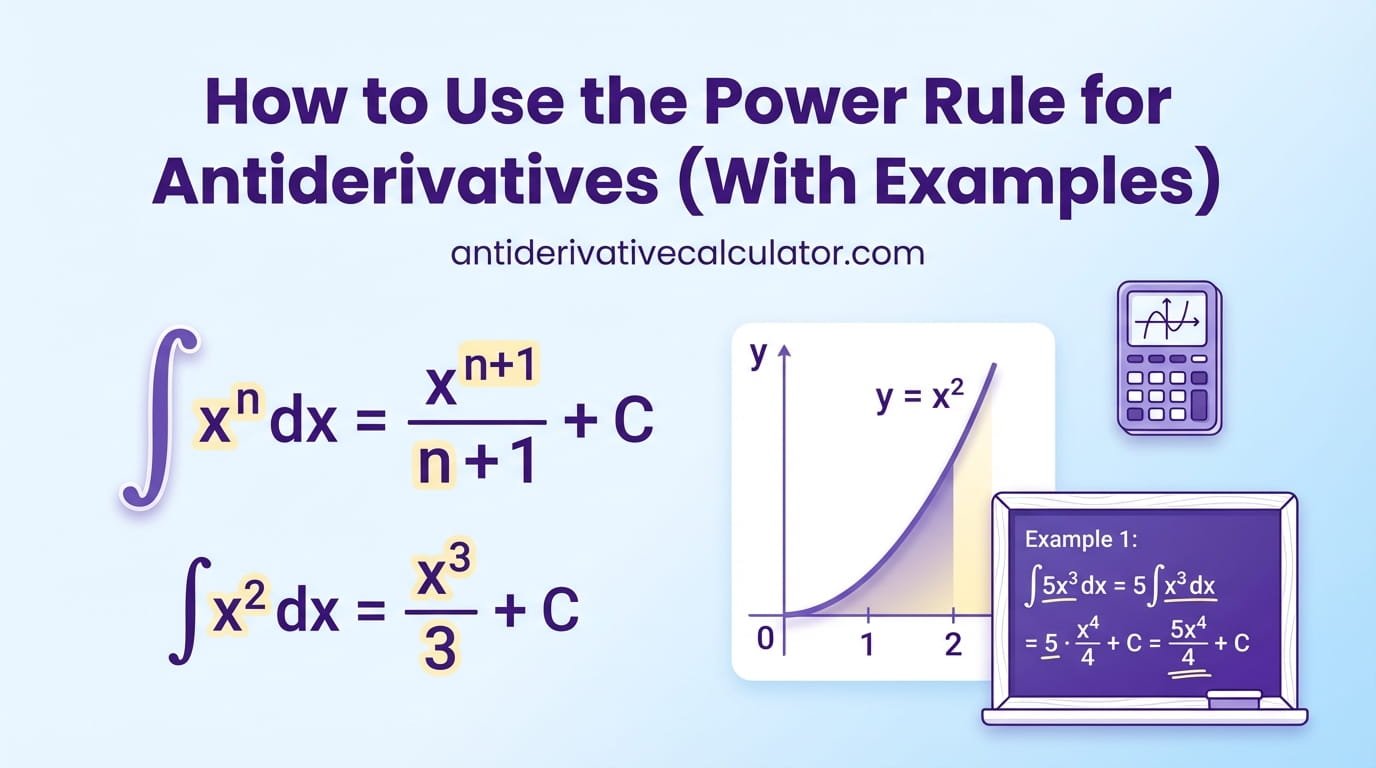
\(x^3\) is close, but its derivative is \(3x^2\), three times too big. Divide by 3: \(\frac{x^3}{3}\) has derivative \(x^2\). So the answer is \(\frac{x^3}{3} + C\). This “raise the power, then divide” idea is the power rule.
Antiderivative vs. Integral: Are They the Same?
Almost. An indefinite integral \(\int f(x)\,dx\) means the family of all antiderivatives, \(F(x) + C\). A definite integral \(\int_a^b f(x)\,dx\) is a number, the area under the curve, which you compute using an antiderivative: \(F(b) – F(a)\). The full comparison is in definite vs indefinite integrals.
How to Check Any Antiderivative
This is the best part: checking is easy even when finding is hard. Differentiate your answer. If you get the original function, you are right. For \(\frac{x^3}{3} + C\): \(\frac{d}{dx}\left(\frac{x^3}{3} + C\right) = x^2\). ✓ The free antiderivative calculator does this check for you on every problem.
Quick Quiz
1. Is \(x^5\) an antiderivative of \(5x^4\)?
Yes, because \(\frac{d}{dx}x^5 = 5x^4\).
2. Find \(\int 6x\,dx\).
\(3x^2 + C\), because \(\frac{d}{dx}3x^2 = 6x\).
3. Find \(\int \cos x\,dx\).
\(\sin x + C\).
4. A function has derivative \(2x\) and passes through \((0, 4)\). What is it?
\(x^2 + C\) with \(C = 4\), so \(x^2 + 4\).
Calculators for This Topic
Practice what you just read. Each tool shows full steps and checks its own answer.
- ∫Antiderivative Calculator – Find any antiderivative with full steps and a check.
- d/dxDerivative Calculator – Product, quotient and chain rule steps for any function.
- ∫Integral Calculator – Solve indefinite and definite integrals step by step.
Frequently Asked Questions
What is an antiderivative in simple words?
It is the function you would have to differentiate to get the function you are given. It undoes a derivative.
What does the C mean in an antiderivative?
\(C\) stands for any constant. Because constants disappear when you take a derivative, you cannot know which constant was there, so \(+C\) covers all of them.
Does every function have an antiderivative?
Every continuous function has one, but some, like \(e^{x^2}\), cannot be written with ordinary formulas.
Is an antiderivative unique?
No. If \(F(x)\) is an antiderivative, so is \(F(x) + C\) for every constant \(C\). They all differ only by a constant.
What is the antiderivative of x?
\(\int x\,dx = \frac{x^2}{2} + C\).