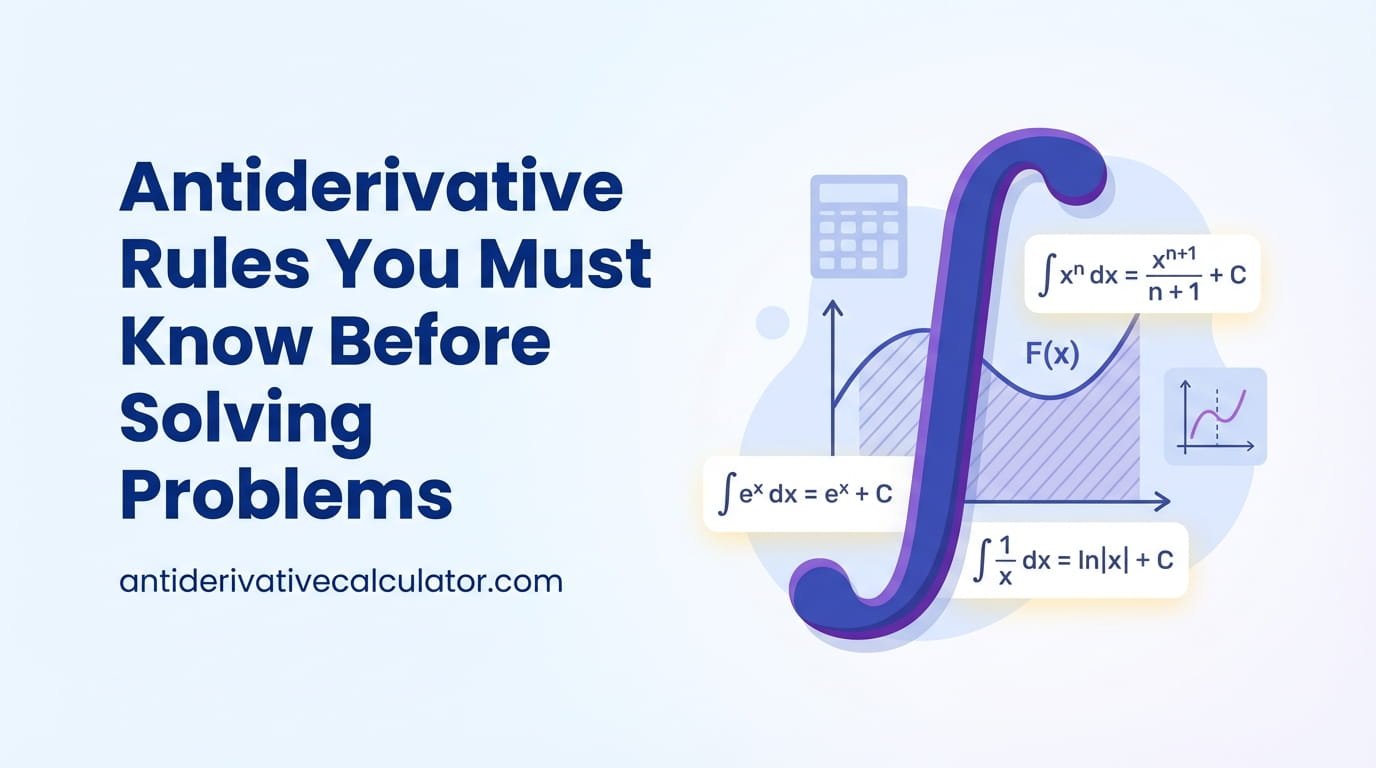
Antiderivative Rules You Must Know Before Solving Problems
Before you can confidently solve any integration problem in calculus, there is one thing you absolutely need: a solid understanding of the core antiderivative rules. Without them, every problem feels like a guessing game. With them, most problems become very manageable — even for beginners.
Think of these rules like a toolkit. Each one handles a specific type of function. Once you know which tool to reach for, finding an antiderivative becomes a clear, step-by-step process rather than a confusing puzzle.
In this guide, you will learn every essential antiderivative rule you need to know, see how each one works, and practice with real examples. By the end, you will have a reliable reference you can come back to again and again throughout your calculus journey.
Why Learning Antiderivative Rules Matters
Some students try to memorize answers without understanding the rules behind them. That approach falls apart fast — especially on exams where the functions look slightly different from what you practiced.
Learning the rules properly means you can handle any variation of a problem, not just the ones you have seen before. The rules for integration are consistent and reliable. Once they click, they stick.
Here is another reason these rules matter: they are the foundation for more advanced calculus topics like substitution, integration by parts, and definite integrals. Getting comfortable with the basics now saves you a lot of struggle later.
Rule 1: The Power Rule
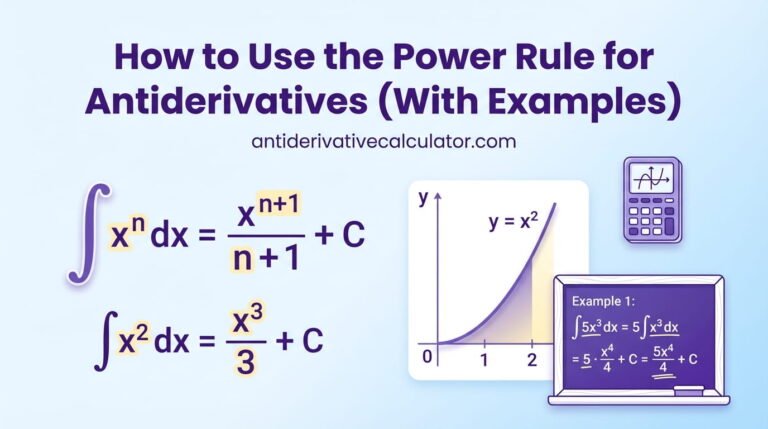
This is the single most important rule in all of basic integration. The power rule works for any variable raised to a numeric exponent — and you will use it in almost every problem you encounter.
Here is how it works:
- Add 1 to the exponent.
- Divide the term by that new exponent.
- Add + C.
In formula form: ∫ xⁿ dx = x^(n+1) / (n+1) + C — as long as n ≠ −1.
This rule works for whole numbers, fractions, and even negative exponents. The only exception is when n = −1, which we cover separately below.
Step 1: Add 1 to the exponent: 6 + 1 = 7.
Step 2: Divide by the new exponent: x⁷ ÷ 7 = x⁷/7.
Step 3: Add + C.
✅ Answer: x⁷/7 + C
Check: The derivative of x⁷/7 is 7x⁶/7 = x⁶. ✓
Rule 2: The Constant Rule
The constant rule is beautifully simple. If you are integrating a plain number — with no variable attached — the answer is just that number multiplied by x.
Formula: ∫ k dx = kx + C — where k is any constant number.
So the antiderivative of 9 is 9x + C. The antiderivative of −3 is −3x + C. Easy as that.
Why does this work? Think of a constant like 9 as 9 × x⁰ (since x⁰ = 1). Apply the power rule to x⁰, and you get x¹ ÷ 1 = x. Multiply by 9, and you get 9x. The constant rule is really just the power rule in disguise.
Rule 3: The Constant Multiple Rule
What if there is a number multiplied in front of your function — like 5x³ or 12x? You do not need to let that number complicate things. The constant multiple rule lets you pull it out of the integral entirely.
Formula: ∫ k · f(x) dx = k · ∫ f(x) dx
In plain English: if a constant is being multiplied by a function, just set the constant aside, integrate the function on its own, then multiply the constant back in at the end.
Step 1: Pull out the constant: 10 · ∫ x⁴ dx.
Step 2: Apply the power rule to x⁴: x⁵/5.
Step 3: Multiply by 10: 10 × x⁵/5 = 2x⁵.
Step 4: Add + C.
✅ Answer: 2x⁵ + C
Rule 4: The Sum and Difference Rule
Most real calculus problems do not give you just one term — they give you a whole expression with multiple parts. The sum and difference rule makes this easy to handle.
Formula: ∫ [f(x) ± g(x)] dx = ∫ f(x) dx ± ∫ g(x) dx
Simply put: you can split the integral across addition and subtraction, integrate each piece separately, combine all the results, and add a single + C at the very end.
Step 1: Split into three parts: ∫ 4x³ dx, ∫ 6x dx, ∫ 2 dx.
Step 2: Antiderivative of 4x³ → 4 × (x⁴/4) = x⁴.
Step 3: Antiderivative of 6x → 6 × (x²/2) = 3x².
Step 4: Antiderivative of 2 → 2x.
Step 5: Combine and add + C.
✅ Answer: x⁴ − 3x² + 2x + C
Check: Differentiate — you get 4x³ − 6x + 2. ✓
Rule 5: The Natural Logarithm Rule
Earlier we mentioned that the power rule breaks down when the exponent is −1. That is because applying the formula would mean dividing by zero — which is impossible in math.
Instead, there is a special rule just for this case:
Formula: ∫ (1/x) dx = ln|x| + C
The answer is the natural logarithm of the absolute value of x. The absolute value signs are important — they make sure the answer is valid for both positive and negative values of x.
You will not need this rule in every problem, but it appears often enough that memorizing it early is well worth the effort.
Rule 6: The Exponential Rule
Exponential functions — those involving e raised to a power — have one of the most satisfying antiderivative rules in all of calculus.
Formula: ∫ eˣ dx = eˣ + C
That is right — the antiderivative of eˣ is simply eˣ itself. The function does not change at all. This happens because eˣ is its own derivative too, which makes it a very special function in mathematics.
For a slightly more complex version, if you have a constant multiplied in the exponent:
Formula: ∫ e^(ax) dx = e^(ax) / a + C
Rule 7: Basic Trigonometric Antiderivative Rules
Trigonometry and calculus go hand in hand. Here are the essential antiderivative rules for the most common trig functions you will meet as a beginner:
- ∫ sin(x) dx = −cos(x) + C
- ∫ cos(x) dx = sin(x) + C
- ∫ sec²(x) dx = tan(x) + C
Notice that the antiderivative of sin(x) is negative cos(x) — that negative sign matters and is easy to forget under pressure. A quick way to remember it: differentiating −cos(x) gives you sin(x), so the reverse must be true.
Step 1: Split into two parts: ∫ cos(x) dx and ∫ 3x² dx.
Step 2: Antiderivative of cos(x) → sin(x).
Step 3: Antiderivative of 3x² → 3 × (x³/3) = x³.
Step 4: Combine and add + C.
✅ Answer: sin(x) + x³ + C
Quick Reference: All the Rules at a Glance
- Power Rule: ∫ xⁿ dx = x^(n+1) / (n+1) + C (n ≠ −1)
- Constant Rule: ∫ k dx = kx + C
- Constant Multiple Rule: ∫ k·f(x) dx = k · ∫ f(x) dx
- Sum / Difference Rule: ∫ [f(x) ± g(x)] dx = ∫ f(x) dx ± ∫ g(x) dx
- Natural Log Rule: ∫ (1/x) dx = ln|x| + C
- Exponential Rule: ∫ eˣ dx = eˣ + C
- Sine Rule: ∫ sin(x) dx = −cos(x) + C
- Cosine Rule: ∫ cos(x) dx = sin(x) + C
- Secant Squared Rule: ∫ sec²(x) dx = tan(x) + C
Frequently Asked Questions
Which antiderivative rule should I use first when solving a problem?
Start by identifying the type of function in front of you. If it has a variable with an exponent, reach for the power rule first — it handles the majority of beginner problems. If the function has multiple terms, apply the sum and difference rule to split it up before using the power rule on each piece individually.
Are antiderivative rules the same as integration rules?
Yes — they are exactly the same thing. Integration and finding an antiderivative refer to the same process. The rules have the same names and work the same way whether your textbook calls them antiderivative rules or integration rules. The terminology varies, but the math is identical.
Do I need to memorize all these rules for a calculus exam?
Yes, the core rules — especially the power rule, constant rule, sum rule, and basic trig rules — are almost always expected from memory in a calculus course. The good news is that with enough practice, they become second nature very quickly. Using an antiderivative calculator to check your work as you study is a great way to reinforce each rule until it sticks.
Conclusion
Knowing your antiderivative rules is the single most important step you can take before diving into integration problems. Each rule is a reliable tool — learn when to use it, practice applying it step by step, and always remember your + C. The more problems you work through, the faster these rules become automatic. Bookmark this page as your go-to reference, and whenever you want to double-check your answers, use the antiderivative calculator on this site to confirm your work instantly and keep your calculus skills sharp!
“`