How to Find the Antiderivative of Any Function Step by Step
One of the most common questions students ask in calculus is: “How do I actually find the antiderivative?” It feels confusing at first — but the truth is, once you learn a few simple rules, it becomes one of the most satisfying parts of math.
Finding an antiderivative is really just working backwards. Instead of breaking a function down like you do with derivatives, you are rebuilding it. And there is a clear, reliable process you can follow every single time.
In this guide, you will learn exactly how to find the antiderivative of different types of functions — step by step, with real worked examples. No shortcuts skipped. No steps left out. Let’s get into it.
What Does “Finding an Antiderivative” Actually Mean?
Before jumping into rules, let us make sure the core idea is solid. When you find the antiderivative of a function, you are answering this question:
“What function, when differentiated, gives me back this one?”
For example, if someone gives you 4x³ and asks for the antiderivative, you need to think: what function has 4x³ as its derivative? The answer is x⁴ + C.
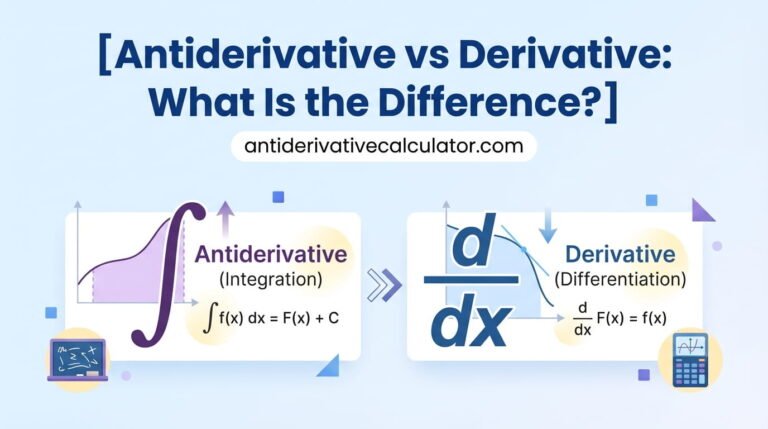
This process is also called integration, and it is one of the two big pillars of calculus. The symbol used for it is ∫ — called the integral sign. So when you see ∫ 4x³ dx, it is just asking you to find the antiderivative of 4x³.
The Most Important Rule: The Power Rule for Integration
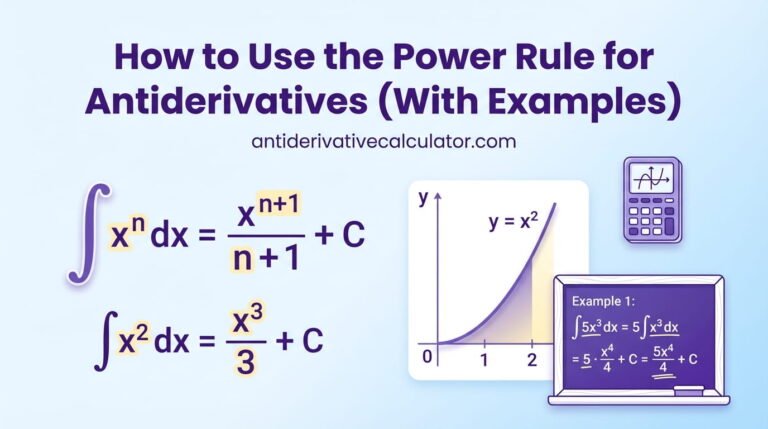
The power rule is the foundation of finding antiderivatives. You will use it more than any other rule, so it is worth learning well.
Here is how it works for any term with a variable raised to a power:
- Add 1 to the exponent.
- Divide the whole term by that new exponent.
- Add + C at the end.
In formula form, it looks like this: ∫ xⁿ dx = x^(n+1) / (n+1) + C
This works for any value of n — as long as n is not equal to −1. We will cover that special case a little later.
A Quick Tip on Coefficients
If there is a number in front of the variable (called a coefficient), do not panic. Just carry it along through the steps and simplify at the end. For example, with 6x², you apply the power rule to x² and then multiply by 6.
Step-by-Step Process to Find the Antiderivative
Here is a clear, repeatable process you can follow for most beginner-level functions:
- Look at the type of function — is it a polynomial, a constant, a trig function? Identify it first.
- Apply the matching rule — use the power rule for polynomials, the constant rule for plain numbers, and so on.
- Simplify your answer — clean up fractions and combine like terms where possible.
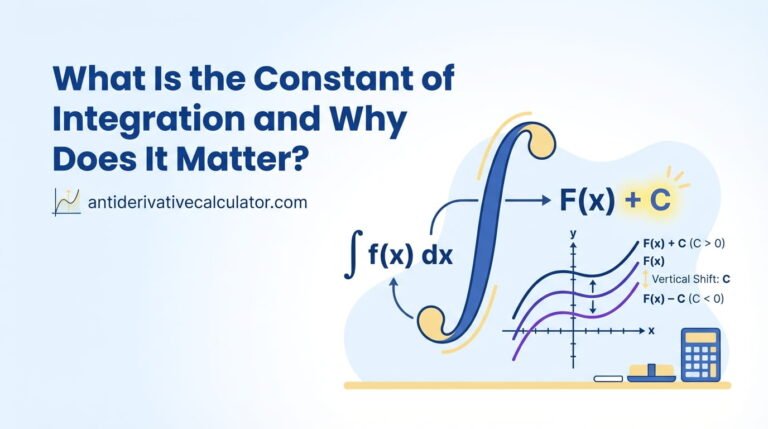
- Add + C — always, without exception.
- Check your work — take the derivative of your answer. If you get back the original function, you got it right.
That last step is really powerful. Differentiation and integration are opposites, so differentiating your answer is the perfect way to verify it.
Common Antiderivative Rules You Need to Know
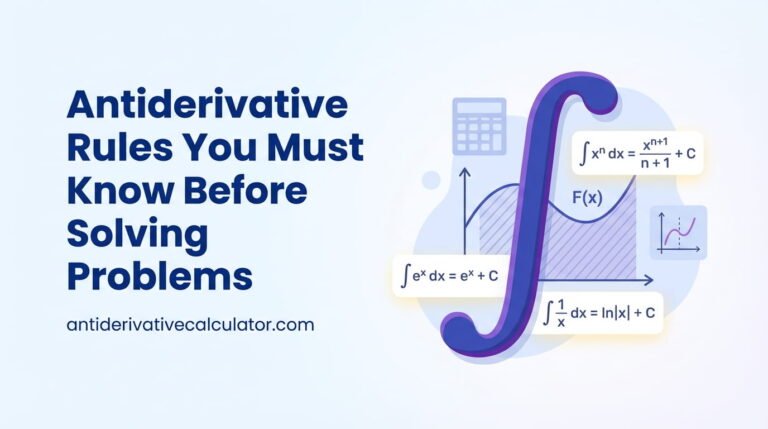
Beyond the power rule, there are a few other rules that come up regularly in calculus. Here is a quick overview of each one:
The Constant Rule
The antiderivative of any plain number is that number multiplied by x. So ∫ 7 dx = 7x + C. Simple and straightforward.
The Constant Multiple Rule
If a constant is multiplied by a function, you can pull it out of the integral and deal with the function separately. For example, ∫ 5x³ dx = 5 · ∫ x³ dx. Then apply the power rule to x³ and multiply by 5 at the end.
The Sum and Difference Rule
If your function has multiple terms added or subtracted, you can split them up and integrate each one on its own. So ∫ (3x² + 2x − 5) dx means you find the antiderivative of 3x², then 2x, then 5 — separately — and combine the results.
The Natural Log Rule (Special Case)
Remember when we said the power rule does not work when n = −1? That is because dividing by zero is impossible. Instead, the antiderivative of x⁻¹ (which is the same as 1/x) is the natural logarithm: ln|x| + C.
Basic Trigonometric Antiderivatives
Here are two trig rules worth memorizing early:
- ∫ sin(x) dx = −cos(x) + C
- ∫ cos(x) dx = sin(x) + C
Worked Examples: Finding the Antiderivative Step by Step
Step 1: Identify the type. This is a simple power function with n = 5.
Step 2: Apply the power rule. Add 1 to the exponent: 5 + 1 = 6. So x⁵ becomes x⁶.
Step 3: Divide by the new exponent: x⁶ ÷ 6 = x⁶/6.
Step 4: Add + C.
✅ Answer: x⁶/6 + C
Check: The derivative of x⁶/6 is (6x⁵)/6 = x⁵. ✓
Step 1: Split into three separate parts using the sum/difference rule: 8x³, 3x, and 7.
Step 2: Antiderivative of 8x³
Add 1 to exponent: 3 + 1 = 4. Divide: 8 × (x⁴/4) = 2x⁴.
Step 3: Antiderivative of 3x
Add 1 to exponent: 1 + 1 = 2. Divide: 3 × (x²/2) = 3x²/2.
Step 4: Antiderivative of 7
Using the constant rule: 7x.
Step 5: Combine all parts and add + C.
✅ Answer: 2x⁴ + 3x²/2 − 7x + C
Check: Differentiate the answer — you get 8x³ + 3x − 7. ✓
Step 1: Split into two parts: cos(x) and 6.
Step 2: Antiderivative of cos(x)
Using the trig rule: ∫ cos(x) dx = sin(x).
Step 3: Antiderivative of 6
Using the constant rule: 6x.
Step 4: Combine and add + C.
✅ Answer: sin(x) + 6x + C
Check: The derivative of sin(x) + 6x is cos(x) + 6. ✓
Most Common Mistakes to Avoid
Even when you know the rules, small errors can creep in. Watch out for these:
- Forgetting + C: This is the number one mistake. Always add it — no exceptions for indefinite integrals.
- Not dividing by the new exponent: After adding 1 to the exponent, students sometimes forget to divide. Both steps must happen together.
- Using the power rule on 1/x: Remember — the power rule breaks down at n = −1. Use ln|x| + C instead.
- Skipping the check: Always differentiate your answer to confirm it is correct. It takes ten seconds and saves you from losing marks.
Frequently Asked Questions
What is the first step to find the antiderivative of any function?
The first step is to identify what type of function you are working with — polynomial, constant, trigonometric, and so on. Once you know the type, you pick the matching rule. For most beginner problems, the power rule is your starting point.
Why do we always add + C when we find the antiderivative?
Because constants disappear when you differentiate. So when reversing the process through integration, there could have been any constant in the original function. Writing + C accounts for all those possibilities. It is a required part of every indefinite integral answer.
Can I use an antiderivative calculator to check my answers?
Absolutely — and it is a great habit! After you work through a problem step by step on your own, an antiderivative calculator can instantly verify whether your answer is correct. It is one of the best tools for building confidence while learning calculus.
Conclusion
Now you know exactly how to find the antiderivative of a function — step by step and with confidence. Start with the power rule, apply it carefully, never forget + C, and always check your work by differentiating your answer. The more problems you practice, the faster and more natural it becomes. Feeling ready to test yourself? Try using the antiderivative calculator on this site to check your solutions instantly and keep building your calculus skills one step at a time!
“`