
What Is the Constant of Integration and Why Does It Matter?
If you have ever worked through an antiderivative problem, you have seen it at the end of every answer: + C. Maybe your teacher told you to always write it. Maybe you have been writing it without fully understanding why. Either way, that small letter carries a big meaning in calculus.
The constant of integration is not just a rule to memorize and move on. It actually tells you something important about the nature of antiderivatives — and leaving it out means your answer is technically incomplete, no matter how perfectly you did everything else.
In this post, you will learn exactly what the constant of integration is, where it comes from, why it matters, and how to use it correctly. Step by step, in plain English — no confusing textbook language required.
What Is the Constant of Integration?
The constant of integration is the + C you write at the end of every indefinite integral (antiderivative). It represents an unknown constant value that could have been part of the original function before differentiation.
Here is the key reason it exists:
When you differentiate a constant — any fixed number like 3, 10, or 500 — it completely disappears. The derivative of a constant is always zero. So when you reverse the process and find an antiderivative, you have no way of knowing whether a constant was there originally or not.
Writing + C is your way of saying: “There might have been a constant here. I just do not know its value.”
Where Does the + C Actually Come From?
To really understand the constant of integration, it helps to see what happens during differentiation and then work backwards.
Look at these three different functions:
- f(x) = x² + 1
- f(x) = x² + 7
- f(x) = x² − 4
Now take the derivative of all three. What do you get? Every single one gives you 2x. The constants — 1, 7, and −4 — all vanish during differentiation.
So now ask yourself the reverse question: what is the antiderivative of 2x? Is it x² + 1? Or x² + 7? Or x² − 4? The honest answer is: it could be any of them.
That is exactly why we write x² + C instead of picking one specific constant. The + C captures the entire family of possible answers all at once. In calculus, this is called the general antiderivative or general solution.
The Family of Antiderivatives — Visualizing + C
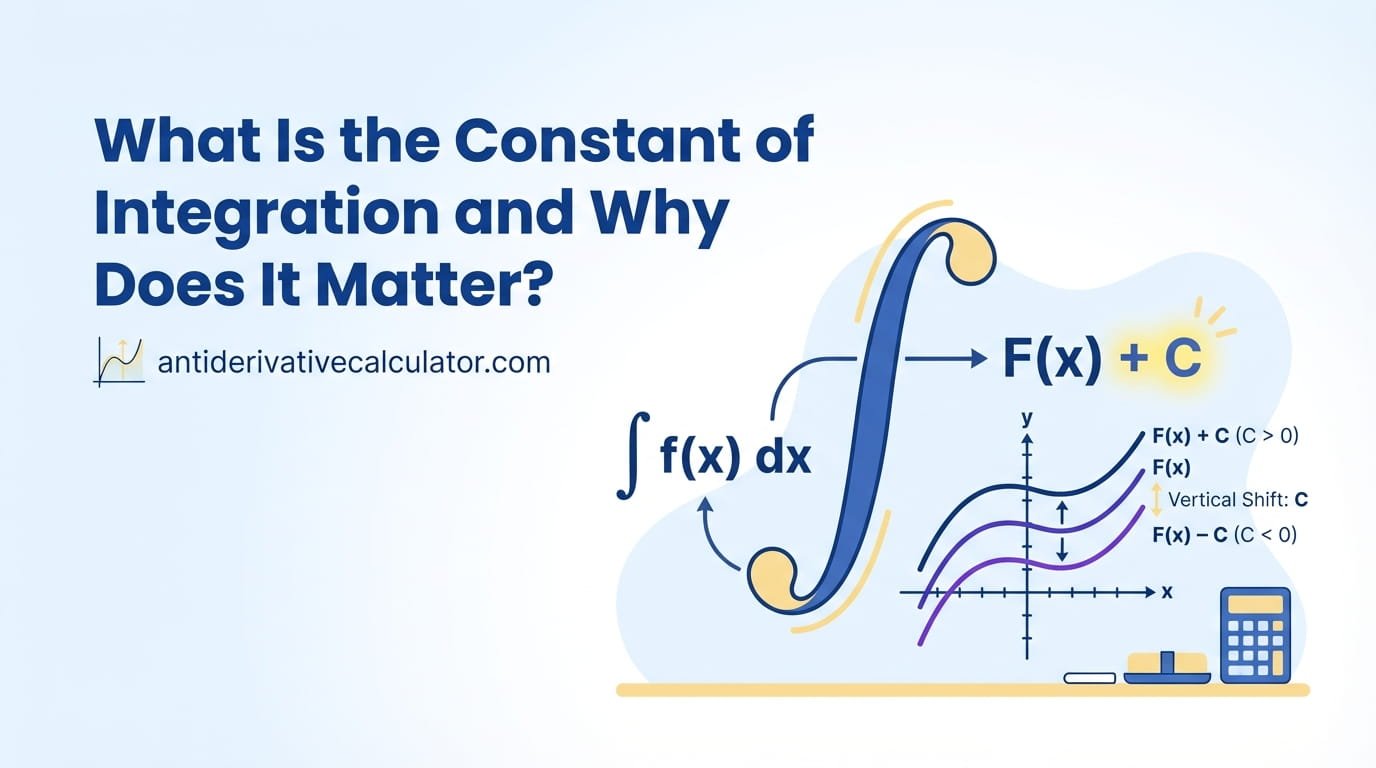
Here is a beautiful way to think about it. Every antiderivative is not just one function — it is a whole family of curves.
If you graphed x² + 1, x² + 5, and x² − 3, you would get three parabolas that look identical in shape. The only difference is that each one sits at a different height on the graph. They are all shifted up or down, but they all have the exact same slope at every point.
The + C controls that vertical shift. Changing C just moves the curve up or down — it does not change its shape or slope at all.
This means that when you write x² + C, you are not describing one curve. You are describing an infinite collection of curves — one for every possible value of C. That is the full, complete answer to an indefinite integral.
When Does C Get a Specific Value?
There are situations in calculus where you actually can figure out what C is. This happens when you are given extra information about the original function — usually called an initial condition.
An initial condition is simply a known point on the function. For example, you might be told that f(0) = 5 — meaning when x = 0, the function equals 5.
Here is how it works step by step:
- Find the general antiderivative as usual, including + C.
- Plug in the x and y values from the initial condition.
- Solve the equation for C.
- Write the final answer with the specific value of C filled in.
Once you find the exact value of C, your answer changes from a general solution (a whole family of curves) to a particular solution (one specific curve). This is a very common task in calculus courses and in real-world applications like physics and engineering.
Why Does the Constant of Integration Actually Matter?
Some students think + C is just a technicality — a small detail that teachers are fussy about. But it actually carries real mathematical meaning. Here is why it genuinely matters:
It Makes Your Answer Mathematically Complete
Without + C, your antiderivative is not fully correct. You have found one possible answer, but not the complete set of answers. In math, an incomplete answer is a wrong answer — even if the rest of your work is perfect.
It Is Essential in Real-World Problems
In physics, engineering, and economics, antiderivatives are used to model real situations. The value of C often represents a real starting condition — like an object’s initial position, a bank account’s starting balance, or a system’s baseline temperature. Without identifying C using an initial condition, the model is unfinished and cannot make accurate predictions.
It Connects to Definite Integrals
When you move from indefinite integrals to definite integrals in calculus, you will notice something interesting — the C values cancel out during the calculation. But understanding why they cancel only makes sense if you first understand what C means. A strong grasp of the constant of integration now will make definite integrals much easier later.
Worked Examples: The Constant of Integration in Action
Find the antiderivative of f(x) = 5x⁴.
Step 1: Apply the power rule. Add 1 to the exponent: 4 + 1 = 5.
Step 2: Divide by the new exponent: 5 × (x⁵/5) = x⁵.
Step 3: Add + C.
✅ Answer: F(x) = x⁵ + C
This represents every function of the form x⁵ + any constant — an entire family of curves.
Find the antiderivative of f(x) = 6x, given that F(0) = 4.
Step 1: Find the general antiderivative of 6x.
Add 1 to the exponent: 1 + 1 = 2. Multiply: 6 × (x²/2) = 3x².
General answer: F(x) = 3x² + C
Step 2: Use the initial condition F(0) = 4. Plug in x = 0 and F = 4.
4 = 3(0)² + C → 4 = 0 + C → C = 4
Step 3: Write the particular solution.
✅ Answer: F(x) = 3x² + 4
Now C has a specific value, so we have one exact curve — not a whole family.
Frequently Asked Questions
Do I always need to write + C after every antiderivative?
Yes — but only for indefinite integrals. When you are finding a general antiderivative without any specific limits or initial conditions, + C is always required. For definite integrals (where you evaluate between two specific values), the C cancels out and does not appear in the final answer.
Can C be a negative number or zero?
Absolutely. The constant of integration C can be any real number — positive, negative, or zero. That is the whole point. It represents every possible constant value, so it covers all three cases. When you solve for C using an initial condition, you may very well get a negative number or zero as your answer.
What happens if I forget to write + C?
Your answer will be marked as incomplete or incorrect in most calculus courses. Forgetting + C means you have only found one specific antiderivative instead of the complete general solution. It is a small detail, but it reflects a real gap in the mathematical accuracy of your answer. Always double-check before writing your final solution.
Conclusion
The constant of integration is far more than just a “+ C” tacked onto the end of an answer. It represents an entire family of functions, captures the uncertainty left behind when constants vanish during differentiation, and plays a vital role in finding real-world solutions through initial conditions. Understanding it deeply will make every antiderivative and integration problem you encounter much clearer. Ready to put it into practice? Use the antiderivative calculator on this site to work through problems step by step and see exactly how + C fits into every solution!
“`