
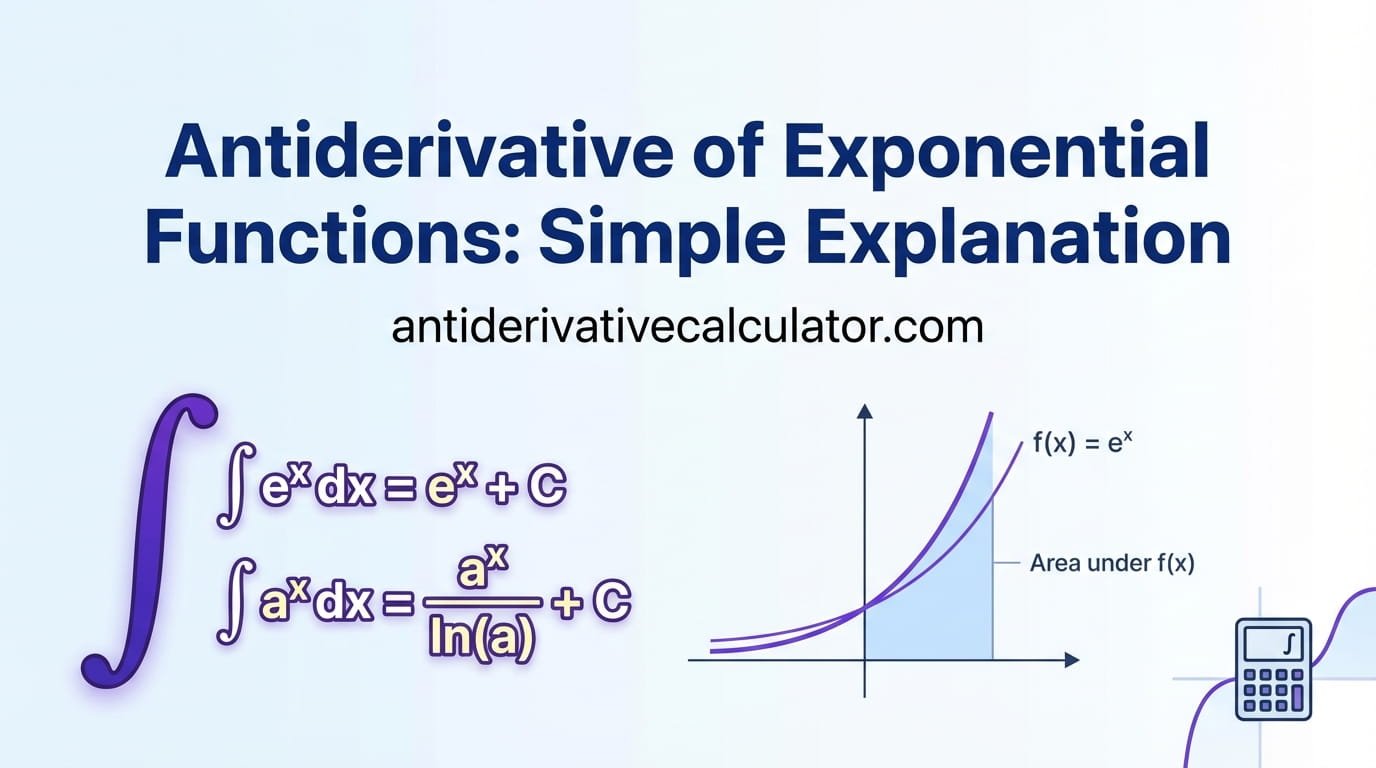
For any base \(a > 0\), \(a \ne 1\): \(\int a^x\,dx = \frac{a^x}{\ln a} + C\). For base \(e\), \(\ln e = 1\), so \(\int e^x\,dx = e^x + C\). For example, \(\int 2^x\,dx = \frac{2^x}{\ln 2} + C\), and \(\int e^{kx}\,dx = \frac1k e^{kx} + C\).
An exponential function has the variable in the exponent, like \(2^x\), \(10^x\) or \(e^{3x}\). They all follow one rule with a small twist: you divide by the natural log of the base. This guide shows where that \(\ln a\) comes from, works through the common bases one by one, and finishes with a real growth problem.
The General Rule
Where Does the \(\ln a\) Come From?
Every exponential can be rewritten with base \(e\), because \(a = e^{\ln a}\). So
\[a^x = \left(e^{\ln a}\right)^x = e^{(\ln a)x}.\]
That is \(e^{kx}\) with \(k = \ln a\), and we already know \(\int e^{kx}\,dx = \frac1k e^{kx} + C\). Put \(k = \ln a\) back in:
\[\int a^x\,dx = \frac{1}{\ln a}e^{(\ln a)x} + C = \frac{a^x}{\ln a} + C.\]
Check by differentiating: \(\frac{d}{dx}\frac{a^x}{\ln a} = \frac{a^x\ln a}{\ln a} = a^x\). ✓
Base by Base
| Function | Antiderivative | Decimal form |
|---|---|---|
| \(e^x\) | \(e^x + C\) | (\(\ln e = 1\)) |
| \(2^x\) | \(\frac{2^x}{\ln 2} + C\) | \(\approx 1.443\cdot 2^x + C\) |
| \(3^x\) | \(\frac{3^x}{\ln 3} + C\) | \(\approx 0.910\cdot 3^x + C\) |
| \(10^x\) | \(\frac{10^x}{\ln 10} + C\) | \(\approx 0.434\cdot 10^x + C\) |
| \(\left(\frac12\right)^x\) | \(-\frac{(1/2)^x}{\ln 2} + C\) | \(\ln\frac12 = -\ln 2\) |
Notice the last row: when the base is between 0 and 1, \(\ln a\) is negative, so a minus sign appears. Bases above 1 give growth; bases below 1 give decay.
Exponents That Are Not Just x
A number times x: \(\int a^{kx}\,dx\)
Divide by both \(k\) and \(\ln a\):
\[\int a^{kx}\,dx = \frac{a^{kx}}{k\ln a} + C.\]
Example: \(\int 5^{2x}\,dx = \frac{5^{2x}}{2\ln 5} + C\).
A straight line: \(\int e^{3x – 2}\,dx\)
Only the slope matters: \(\int e^{3x-2}\,dx = \frac13e^{3x-2} + C\).
A curve: \(\int x\,3^{x^2}\,dx\)
Let \(u = x^2\), so \(x\,dx = \frac12du\):
\[\frac12\int 3^u\,du = \frac{3^{x^2}}{2\ln 3} + C.\]
This only works because the \(x\) in front matches the derivative of \(x^2\). See u-substitution.
Products With Exponentials
When an exponential is multiplied by a polynomial, use integration by parts with the polynomial as \(u\).
Example: \(\int x\,2^x\,dx\). Let \(u = x\) and \(dv = 2^x\,dx\), so \(v = \frac{2^x}{\ln 2}\):
\[\int x\,2^x\,dx = \frac{x\,2^x}{\ln 2} – \int \frac{2^x}{\ln 2}\,dx = \frac{x\,2^x}{\ln 2} – \frac{2^x}{(\ln 2)^2} + C.\]
A product of two exponentials is simpler than it looks, because the bases multiply: \(\int 2^x\,3^x\,dx = \int 6^x\,dx = \frac{6^x}{\ln 6} + C\).
Real-World Problem: Total Growth
A colony of bacteria grows at a rate of \(r(t) = 200\cdot 2^{t}\) new cells per hour. How many new cells appear in the first 3 hours?
Total growth is the definite integral of the rate:
\[\int_0^3 200\cdot 2^t\,dt = \frac{200}{\ln 2}\Big[2^t\Big]_0^3 = \frac{200}{\ln 2}(8 – 1) = \frac{1400}{\ln 2} \approx 2{,}020 \text{ cells}.\]
Want to model growth or decay with your own numbers? Use the exponential growth calculator.
Common Mistakes
- Using the power rule. \(\int 2^x\,dx \ne \frac{2^{x+1}}{x+1}\). The power rule is for \(x^n\), where the variable is in the base, not the exponent.
- Forgetting \(\ln a\). Only base \(e\) skips the division, because \(\ln e = 1\).
- Using \(\log_{10}\) instead of \(\ln\). The rule needs the natural log.
Calculators for This Topic
Practice what you just read. Each tool shows full steps and checks its own answer.
- ∫Antiderivative Calculator – Find any antiderivative with full steps and a check.
- eˣExponential Growth Calculator – Growth and decay, doubling time and a value table.
- ∫Integral Calculator – Solve indefinite and definite integrals step by step.
Frequently Asked Questions
What is the antiderivative of a^x?
It is \(\frac{a^x}{\ln a} + C\) for any positive base \(a\) other than 1.
What is the antiderivative of 2^x?
It is \(\frac{2^x}{\ln 2} + C\), which is about \(1.443\cdot 2^x + C\).
Why is e special?
Because \(\ln e = 1\), so \(e^x\) is its own antiderivative with no extra factor. That is why calculus prefers base \(e\). See the antiderivative of e^x.
What is the antiderivative of e^(kx)?
It is \(\frac1k e^{kx} + C\). For example, \(\int e^{-0.5x}\,dx = -2e^{-0.5x} + C\).
What is the antiderivative of x^x?
\(x^x\) has no antiderivative made of ordinary functions. Its definite integrals have to be found numerically.
1 thought on “Antiderivative of Exponential Functions: a^x, 2^x, 10^x and More”