How to Use the Power Rule for Antiderivatives (With Examples)
If there is one rule in calculus that every beginner absolutely must know, it is the power rule for antiderivatives. It is the most used, most tested, and most fundamental rule in all of basic integration. Once you understand it, a huge portion of calculus problems become straightforward to solve.
The good news is that this rule is not complicated at all. It follows a simple, repeatable pattern — and once that pattern clicks in your head, you can apply it to hundreds of different problems with confidence.
In this guide, you will learn exactly what the power rule for antiderivatives is, how to use it step by step, what mistakes to watch out for, and how it works across different types of functions. Plenty of worked examples are included along the way so nothing feels abstract.
What Is the Power Rule for Antiderivatives?
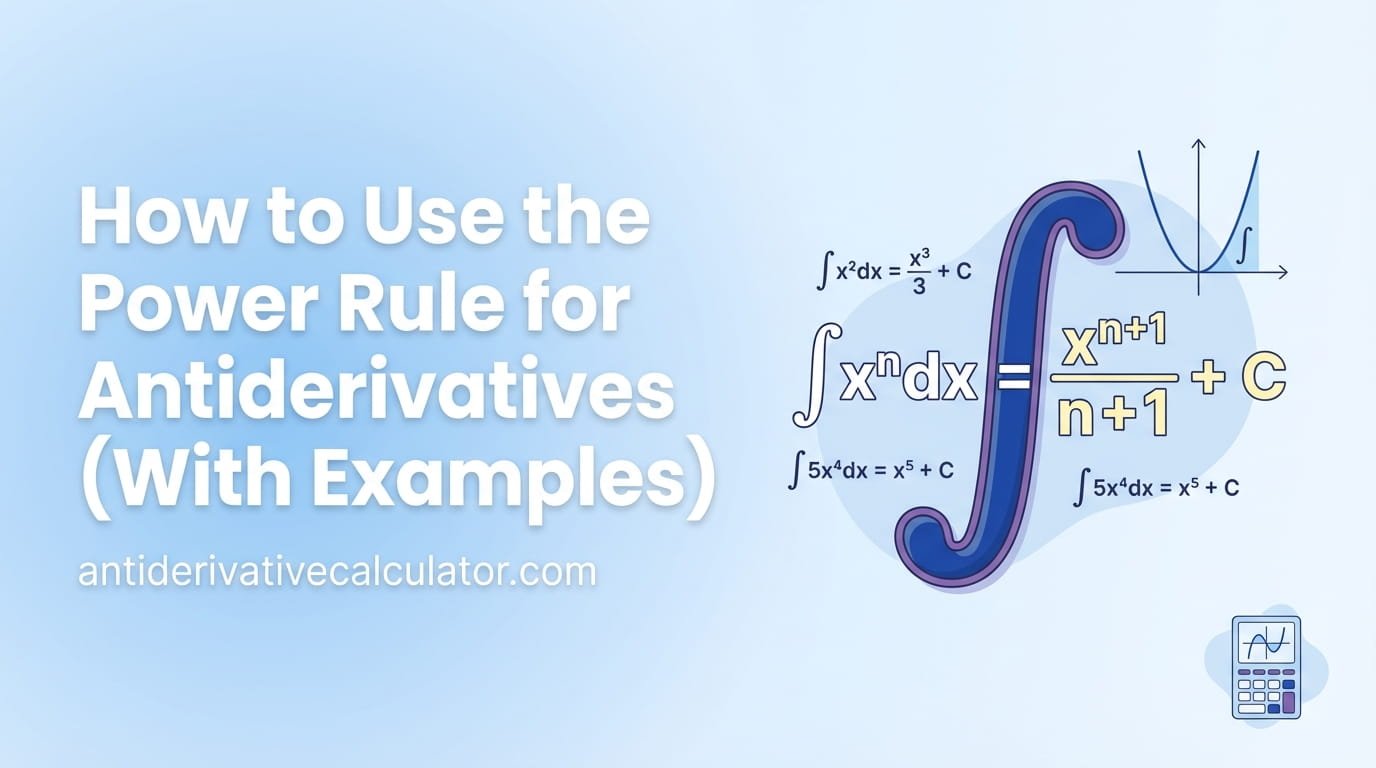
The power rule for antiderivatives is a formula that tells you how to integrate any variable raised to a numeric exponent. In calculus, this type of term is called a power function — something like x², x⁵, or x⁸.
Here is the formula:
∫ xⁿ dx = x^(n+1) / (n+1) + C
Where n is any number except −1.
In plain English, the rule says:
- Add 1 to the exponent.
- Divide the whole term by that new exponent.
- Add + C at the end.
That is the entire rule. Three steps, applied the same way every single time. The formula looks a little intimidating when written out in math notation, but the actual process is very simple once you walk through it a few times.
Why Does the Power Rule Work?
Understanding why a rule works always helps you remember it better. So let us take a quick look at the logic behind the power rule for antiderivatives.
Remember that finding an antiderivative is the reverse of finding a derivative. The power rule for derivatives says: multiply by the exponent, then subtract 1 from the exponent. So the antiderivative rule simply does the opposite — it adds 1 to the exponent and divides by the new exponent to undo that multiplication.
Here is a quick side-by-side comparison to make it clear:
- Derivative of x⁵: Multiply by 5, subtract 1 from exponent → 5x⁴
- Antiderivative of x⁴: Add 1 to exponent, divide by 5 → x⁵/5 + C
See how one perfectly undoes the other? That is the core relationship between differentiation and integration — and the power rule sits right at the center of it.
Applying the Power Rule Step by Step
Let us slow things right down and walk through the power rule process in full detail. Here is a clear method you can follow every time:
- Identify the exponent on the variable. For x⁷, the exponent is 7.
- Add 1 to the exponent. So 7 becomes 8, and x⁷ becomes x⁸.
- Divide the entire term by the new exponent. So x⁸ becomes x⁸/8.
- Handle the coefficient — the number in front of x. Multiply it by the result from step 3 and simplify if possible.
- Write + C at the end of your answer.
- Check your answer by differentiating it to confirm you get back the original function.
Follow these six steps on every problem and you will rarely go wrong. The most common mistakes — like forgetting to divide or dropping the + C — are eliminated when you work through the steps in order every time.
Power Rule Examples: Simple to Complex
Now let us put this rule into action with a range of worked examples. These go from very basic to slightly more challenging so you can see how the rule scales across different types of problems.
Basic Examples
Step 1: The exponent is 3.
Step 2: Add 1 to the exponent: 3 + 1 = 4. So x³ becomes x⁴.
Step 3: Divide by the new exponent: x⁴ ÷ 4 = x⁴/4.
Step 4: No coefficient to handle — the number in front is 1.
Step 5: Add + C.
✅ Answer: x⁴/4 + C
Check: The derivative of x⁴/4 is 4x³/4 = x³. ✓
Step 1: The exponent is 2. The coefficient is 9.
Step 2: Add 1 to the exponent: 2 + 1 = 3. So x² becomes x³.
Step 3: Divide by the new exponent: x³ ÷ 3 = x³/3.
Step 4: Multiply by the coefficient: 9 × x³/3 = 3x³.
Step 5: Add + C.
✅ Answer: 3x³ + C
Check: The derivative of 3x³ is 9x². ✓
Using the Power Rule with Negative Exponents
The power rule also works when the exponent is a negative number — as long as it is not −1. Negative exponents appear when you have a variable in the denominator, like 1/x³, which is the same as x⁻³.
Step 1: The exponent is −3.
Step 2: Add 1 to the exponent: −3 + 1 = −2. So x⁻³ becomes x⁻².
Step 3: Divide by the new exponent: x⁻² ÷ (−2) = −x⁻²/2.
Step 4: No coefficient to handle.
Step 5: Add + C.
✅ Answer: −x⁻²/2 + C (also written as −1/(2x²) + C)
Check: The derivative of −x⁻²/2 is −2x⁻³/(−2) · (−1) = x⁻³. ✓
Using the Power Rule with Fractional Exponents
Fractional exponents show up when you have square roots or cube roots. For example, √x is the same as x^(1/2). The power rule handles these just as smoothly — the only extra step is dealing with fraction arithmetic.
Step 1: The exponent is 1/2.
Step 2: Add 1 to the exponent: 1/2 + 1 = 1/2 + 2/2 = 3/2. So x^(1/2) becomes x^(3/2).
Step 3: Divide by the new exponent: x^(3/2) ÷ (3/2) = x^(3/2) × 2/3 = (2/3)x^(3/2).
Step 4: No coefficient to handle.
Step 5: Add + C.
✅ Answer: (2/3)x^(3/2) + C
Check: The derivative of (2/3)x^(3/2) is (2/3) × (3/2)x^(1/2) = x^(1/2). ✓
Using the Power Rule on a Multi-Term Expression
Step 1: Split using the sum/difference rule: four separate terms.
Step 2: Antiderivative of 5x⁴ → 5 × (x⁵/5) = x⁵.
Step 3: Antiderivative of 3x² → 3 × (x³/3) = x³.
Step 4: Antiderivative of 8x → 8 × (x²/2) = 4x².
Step 5: Antiderivative of 1 → 1x = x.
Step 6: Combine all terms and add + C.
✅ Answer: x⁵ + x³ − 4x² + x + C
Check: Differentiate — you get 5x⁴ + 3x² − 8x + 1. ✓
When the Power Rule Does NOT Apply
The power rule is powerful — but it has one important limitation. It does not work when the exponent is −1.
Why? Because applying the formula would mean dividing by zero (since −1 + 1 = 0), and dividing by zero is undefined in math. This would make the formula completely break down.
For this special case — ∫ x⁻¹ dx, which is the same as ∫ (1/x) dx — the answer is the natural logarithm:
∫ (1/x) dx = ln|x| + C
This is one of the key antiderivative rules worth memorizing separately. Every other exponent follows the power rule perfectly — just watch out for this one exception.
Most Common Mistakes When Using the Power Rule
Even students who understand the rule can lose marks through small, avoidable errors. Here are the mistakes that come up most often:
- Adding 1 to the exponent but forgetting to divide: Both steps must happen together. Adding without dividing gives a completely wrong answer.
- Forgetting + C: This is still the most frequent mistake in integration overall. Every indefinite integral needs it.
- Not converting roots to exponents first: If you see √x or ∛x, rewrite them as x^(1/2) or x^(1/3) before applying the rule.
- Not converting fractions to negative exponents: If you see 1/x⁴, rewrite it as x⁻⁴ before applying the rule — otherwise the steps get very confusing.
- Trying to apply the rule when n = −1: Remember, that case needs the natural log rule instead.
Frequently Asked Questions
Does the power rule for antiderivatives work for all exponents?
It works for almost all numeric exponents — whole numbers, negative numbers, and fractions — with one exception. When the exponent is −1, the power rule breaks down because it would require dividing by zero. In that case, you use the natural log rule instead: ∫ (1/x) dx = ln|x| + C. For every other exponent, the power rule for antiderivatives applies reliably.
How is the power rule for antiderivatives different from the power rule for derivatives?
They are opposites of each other. The derivative power rule says: multiply by the exponent, then subtract 1. The antiderivative power rule says: add 1 to the exponent, then divide by that new number. One undoes the other — which is why differentiating your antiderivative answer always gives you back the original function, making it a perfect self-check.
Can I use an antiderivative calculator to practice the power rule?
Absolutely — and it is one of the best ways to build confidence. Work through a problem step by step on your own first, then use the antiderivative calculator to check whether your answer matches. If it does not, you can compare the steps and find exactly where things went off track. That kind of immediate feedback makes learning the power rule much faster.
Conclusion
The power rule for antiderivatives is the cornerstone of integration in calculus — and now you know exactly how to use it. Add 1 to the exponent, divide by the new exponent, and always write + C. Practice it with simple terms first, then work up to negative and fractional exponents as your confidence grows. Remember to convert roots and fractions before applying the rule, and always check your answer by differentiating it. When you are ready to test your skills, use the antiderivative calculator on this site to verify your solutions instantly and keep building your calculus knowledge one problem at a time!
“`