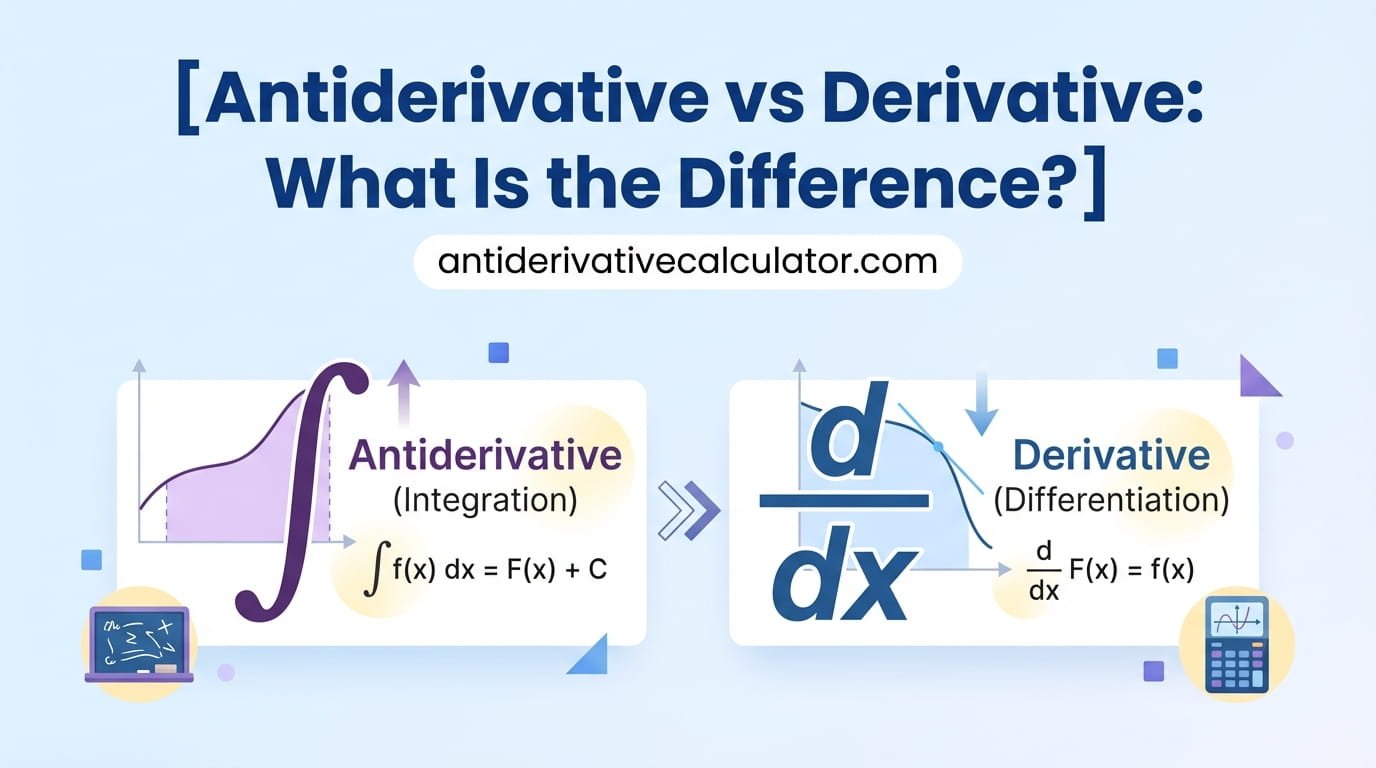
Antiderivative vs Derivative: What Is the Difference?
If you are learning calculus, two words probably keep coming up: derivative and antiderivative. They sound similar, and they are related — but they do very different things. Mixing them up is one of the most common mistakes beginners make.
The good news? Once you see them side by side, the difference becomes crystal clear. This guide will walk you through both concepts in plain English, show you real examples, and help you understand exactly when to use each one.
By the end of this post, you will know the difference between antiderivative vs derivative — and you will actually understand why that difference matters in calculus.
What Is a Derivative?
A derivative tells you how fast something is changing at any given moment. In math, it measures the rate of change of a function.
Think of it like driving a car. Your position changes as you drive. The derivative of your position is your speed — it tells you how quickly your position is changing right now.
Here is the basic idea in math terms:
- Start with a function, like f(x) = x³.
- Take the derivative, and you get f'(x) = 3x².
- That new function, 3x², tells you the rate of change of x³ at any point.
The process of finding a derivative is called differentiation. It is one of the two main ideas in all of calculus.
The Power Rule for Derivatives
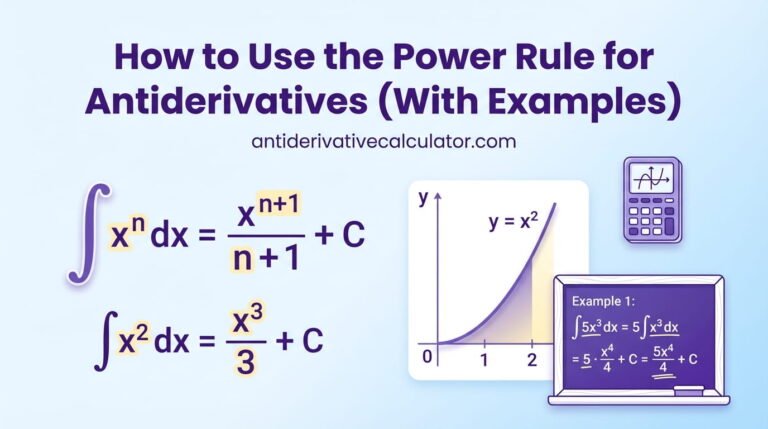
For most beginner problems, you will use the power rule. It works like this:
- Multiply the coefficient (the number in front) by the exponent.
- Then subtract 1 from the exponent.
So for x⁴, the derivative is 4x³. Simple as that.
What Is an Antiderivative?
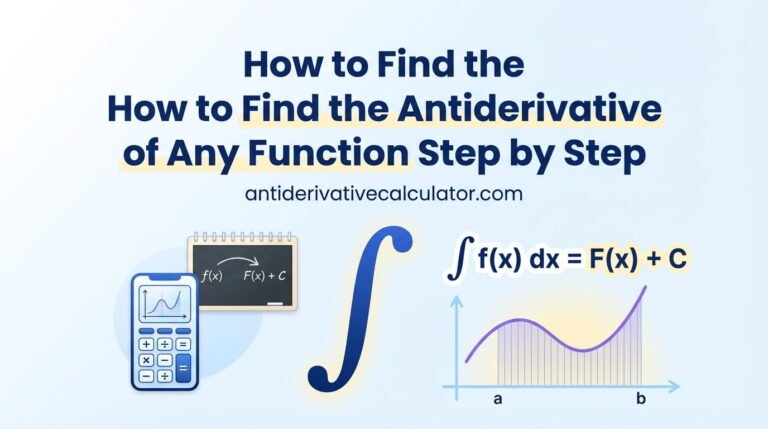
An antiderivative is the exact opposite of a derivative. Instead of breaking a function down, you are building it back up. You are asking: “What function, when differentiated, gives me this?”
Using the same car example — if your speed is the derivative of your position, then the antiderivative of your speed gives you back your position. You are reversing the process.
In math terms:
- Start with a function, like f(x) = 3x².
- Find the antiderivative, and you get F(x) = x³ + C.
- That + C is always there because a constant disappears when you differentiate — so we have to account for it when going backwards.
The process of finding an antiderivative is called integration. It is the second big idea in calculus — and the natural partner of differentiation.
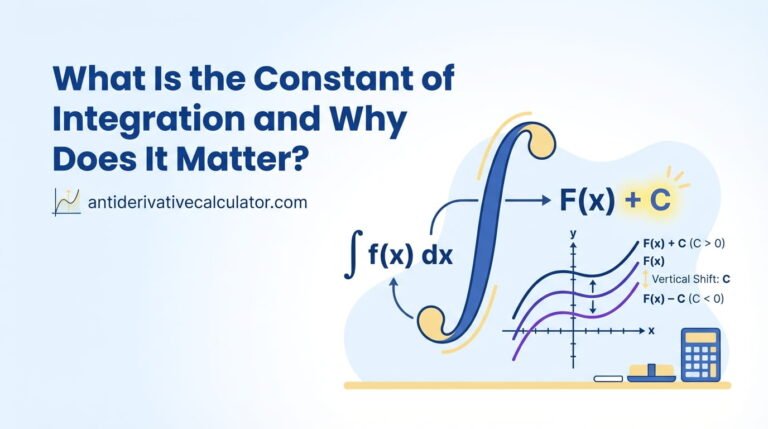
Why the + C Matters
When you differentiate any constant number — like 7 or 200 — it becomes zero and disappears. So when you reverse the process, you cannot know what constant was there originally.
That is why every antiderivative ends with + C. It is a way of saying, “there might be a constant here, but we do not know its value yet.” Never leave it out — most teachers will take marks off if you do!
Antiderivative vs Derivative: The Key Differences
Now let us look at both concepts side by side. This is where things really start to click.
- Direction: A derivative moves forward — it breaks a function down into its rate of change. An antiderivative moves backward — it rebuilds the original function.
- Process name: Finding a derivative is called differentiation. Finding an antiderivative is called integration.
- Result: A derivative gives you a new, simpler function. An antiderivative gives you a more complex function — plus a + C.
- Symbol: Derivatives are written as f'(x) or dy/dx. Antiderivatives (indefinite integrals) are written with the ∫ symbol.
- Purpose: Derivatives find slopes and rates of change. Antiderivatives find areas, distances, and accumulated totals.
A simple way to remember it: differentiation and integration are opposites, just like multiplication and division are opposites.
How They Work Together: The Fundamental Theorem of Calculus
Here is something really cool — derivatives and antiderivatives are not just opposites. They are deeply connected by one of the most important ideas in all of mathematics: the Fundamental Theorem of Calculus.
In plain English, this theorem says:
If you differentiate an antiderivative, you get back the original function. And if you integrate a derivative, you get back the original function too.
They undo each other perfectly — like pressing play and then rewind. This connection is what makes calculus so powerful and so useful in science, engineering, and everyday problem-solving.
Real-Life Examples of Each
Sometimes the best way to understand a math idea is to see it in the real world. Here are two quick examples:
Derivative in Real Life
Imagine a ball is thrown into the air. Its height at any time is described by a function. The derivative of that height function gives you the ball’s velocity — how fast it is moving up or down at each second. That is differentiation in action.
Antiderivative in Real Life
Now flip it around. If you know the ball’s velocity at every second, the antiderivative of the velocity function gives you back the height. You are using integration to recover the original information. This is exactly how physicists and engineers solve real problems every day.
Worked Examples: Derivative vs Antiderivative Side by Side
Finding the Derivative:
Step 1: Use the power rule — multiply the exponent by the coefficient: 4 × 1 = 4.
Step 2: Subtract 1 from the exponent: 4 − 1 = 3.
✅ Derivative: f'(x) = 4x³
Finding the Antiderivative:
Step 1: Add 1 to the exponent: 4 + 1 = 5. So x⁴ becomes x⁵.
Step 2: Divide by the new exponent: x⁵ ÷ 5 = x⁵/5.
Step 3: Add + C.
✅ Antiderivative: F(x) = x⁵/5 + C
Finding the Derivative:
Step 1: Multiply coefficient by exponent: 6 × 2 = 12.
Step 2: Subtract 1 from the exponent: 2 − 1 = 1.
✅ Derivative: f'(x) = 12x
Finding the Antiderivative:
Step 1: Add 1 to the exponent: 2 + 1 = 3. So x² becomes x³.
Step 2: Divide by the new exponent: 6 × (x³/3) = 2x³.
Step 3: Add + C.
✅ Antiderivative: F(x) = 2x³ + C
Quick check: The derivative of 2x³ is 6x² — exactly what we started with. ✓
Frequently Asked Questions
Is an antiderivative the same as an integral?
For beginners, yes — they are essentially the same thing. An indefinite integral is just another name for an antiderivative. As you go further in calculus, you will also learn about definite integrals, which give a specific number (like an area) instead of a function.
Can a function have more than one antiderivative?
Yes! That is exactly why we write + C. A function has an infinite number of antiderivatives — each one differs only by a constant. For example, x² + 1, x² + 5, and x² − 3 are all antiderivatives of 2x. The + C covers all of them at once.
How do I know when to use a derivative vs an antiderivative?
Ask yourself what the problem is asking. If it says “find the rate of change,” “find the slope,” or “differentiate” — use a derivative. If it says “find the original function,” “integrate,” or “find the area under a curve” — use an antiderivative. The wording usually gives it away.
Conclusion
The difference between antiderivative vs derivative really comes down to direction — one goes forward, the other goes backward. Derivatives find rates of change by breaking functions down. Antiderivatives reverse that process through integration, rebuilding the original function. Both are essential tools in calculus, and understanding how they work together will make everything else so much easier. Ready to practice? Use the antiderivative calculator on this site to check your answers step by step and build real confidence in your skills!
“`