Antiderivative of e^x: The Easiest Function to Integrate
Of all the functions you will encounter in calculus, there is one that stands completely apart from the rest — not because it is hard, but because it is remarkably, almost unexpectedly simple. That function is eˣ. And the reason it is so special comes down to one extraordinary property that no other function in mathematics shares.
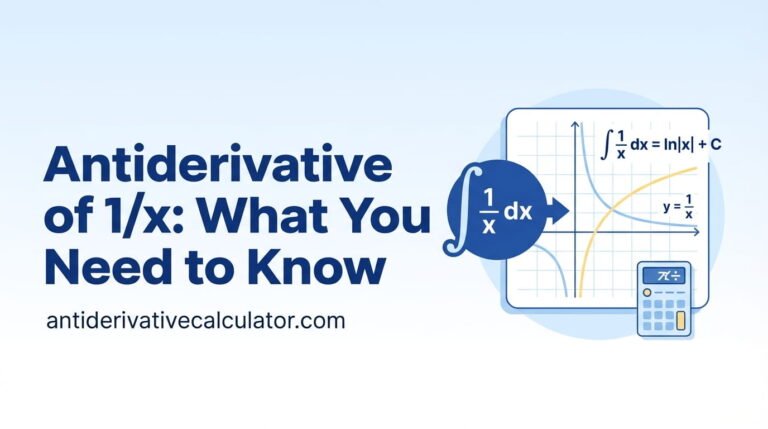
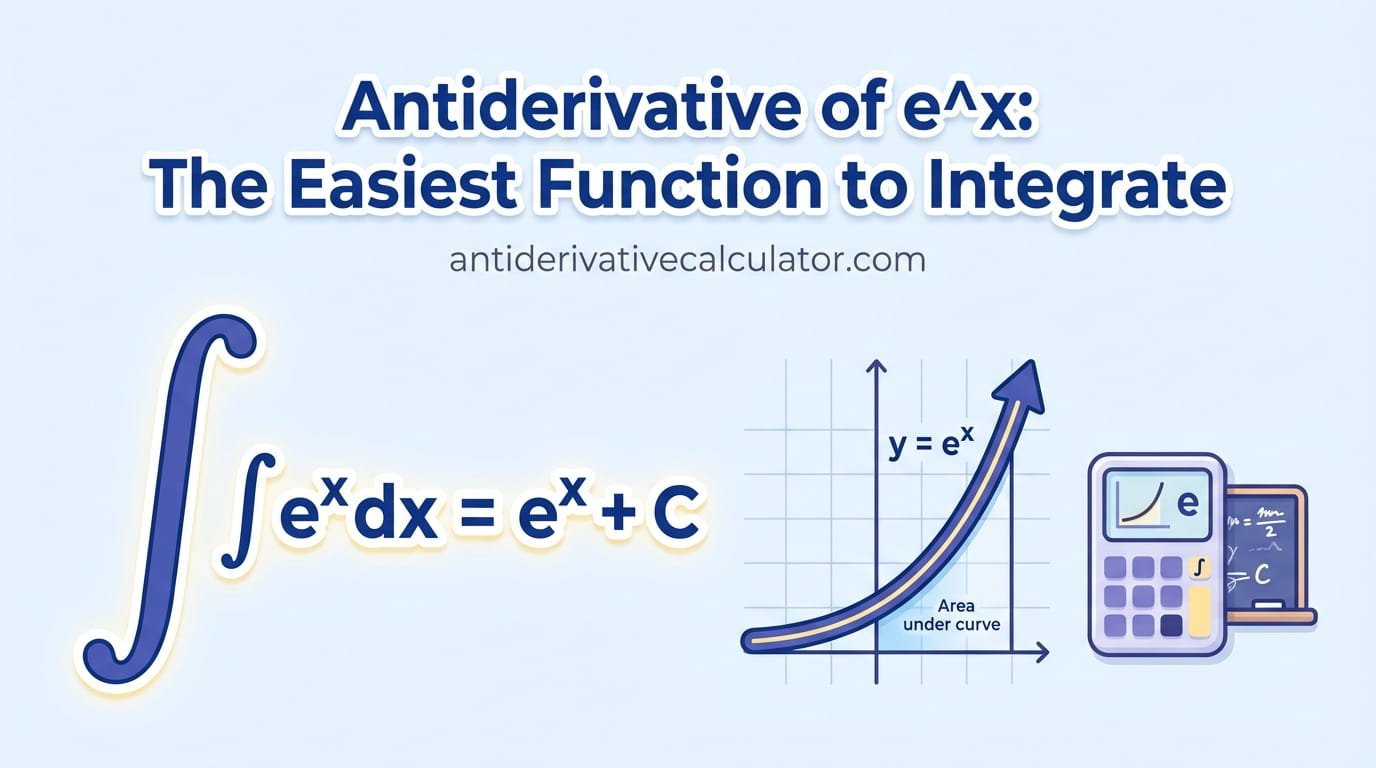
The antiderivative of eˣ is eˣ itself. The function does not change when you integrate it. You add + C, and that is the entire answer. No exponent adjustment, no division, no rule to reverse — just eˣ + C.
In this guide, you will learn exactly why this is true, where this remarkable property comes from, how to apply it step by step, and how it extends to more complex exponential expressions. Worked examples are included throughout so every variation feels completely manageable by the time you finish reading.
What Is the Antiderivative of eˣ?
The antiderivative — also called the indefinite integral — of eˣ is:
∫ eˣ dx = eˣ + C
Where e is Euler’s number (approximately 2.718), x is the variable, and C is the constant of integration.
That is the complete rule. Nothing changes — the function integrates to itself, plus the constant of integration. It is the shortest antiderivative rule in all of basic calculus, and it is also one of the most frequently used.
Two things are worth noting straight away:
- The e is a constant, not a variable: The letter e represents Euler’s number — a fixed mathematical constant approximately equal to 2.718. It is not a variable. The variable is x, which sits in the exponent.
- The + C is still required: Even though the function itself does not change, every indefinite integral must end with + C. The constant of integration is always part of a complete answer — no exceptions.
Why Does eˣ Integrate to Itself?
Understanding why this rule works makes it completely unforgettable. The explanation is rooted in one of the most important facts in all of mathematics.
The function eˣ has a property shared by no other function: it is its own derivative. Differentiate eˣ and you get eˣ back — unchanged. This is the defining characteristic of the natural exponential function, and it is what makes e such a special and important number in calculus.
Now remember that finding an antiderivative is the exact reverse of finding a derivative. If the derivative of eˣ is eˣ, then running that process in reverse — integrating eˣ — must also give eˣ. The function is its own antiderivative for exactly the same reason it is its own derivative.
There is no other elementary function in mathematics that behaves this way. Sine becomes cosine when differentiated. Polynomials lose a degree. Logarithms transform into rational functions. Only eˣ returns to itself — in both directions.
Verifying the Rule by Differentiating
The fastest and most reliable way to confirm any antiderivative is to differentiate the result and check that it gives back the original function. For eˣ, this verification is almost instant.
Claim: ∫ eˣ dx = eˣ + C
Verification: Differentiate eˣ + C.
- The derivative of eˣ is eˣ.
- The derivative of C is 0.
- Combined result: eˣ + 0 = eˣ.
The derivative of our answer is eˣ — exactly the original function. The rule is confirmed perfectly. This verification step works for every integration result, and doing it consistently is one of the best habits you can develop throughout your calculus studies.
Rule 2: The Antiderivative of e^(ax) — With a Coefficient in the Exponent
The basic rule handles eˣ cleanly. But what happens when a constant is multiplied inside the exponent — like e^(3x), e^(−2x), or e^(0.5x)? These functions appear constantly in calculus and require a small but important adjustment.
∫ e^(ax) dx = (1/a) · e^(ax) + C
Where a is any non-zero constant.
In plain English: integrate e^(ax) exactly like eˣ, but divide the result by the constant a that is sitting inside the exponent.
The reason for dividing by a comes from the chain rule. When you differentiate (1/a) · e^(ax), the chain rule brings down the inner constant a, which multiplies with (1/a) to produce 1 — leaving just e^(ax). So dividing by a in the antiderivative is precisely what reverses the chain rule multiplication that would occur during differentiation.
You can also arrive at this result using u-substitution by letting u = ax. Both methods give the same answer — use whichever feels more natural to you at this stage of your learning.
Rule 3: The Antiderivative of k · eˣ — With a Coefficient Outside
When a constant is multiplied in front of eˣ — like 5eˣ or −3eˣ — the constant multiple rule makes this completely straightforward.
Pull the constant outside the integral, integrate eˣ using the core rule, then multiply back:
∫ k · eˣ dx = k · ∫ eˣ dx = k · eˣ + C
So the antiderivative of 7eˣ is 7eˣ + C. The antiderivative of −4eˣ is −4eˣ + C. The coefficient simply stays attached to the function throughout — no adjustment needed because it is outside the exponent, not inside it.
Comparing eˣ to Other Exponential Functions
Students sometimes confuse the rule for eˣ with the rule for other exponential functions like 2ˣ or 10ˣ. It is worth seeing clearly how they differ.
For a general exponential function aˣ — where a is a positive constant other than e — the antiderivative is:
∫ aˣ dx = aˣ / ln(a) + C
Notice that ln(a) appears in the denominator. This is because differentiation of aˣ introduces a factor of ln(a), and reversing that process through integration requires dividing by it.
For eˣ specifically, a = e, and ln(e) = 1. So the formula becomes eˣ / 1 = eˣ — which is exactly the core rule. The general formula confirms that eˣ integrating to itself is not a coincidence. It is a direct consequence of the fact that ln(e) = 1, which eliminates the denominator entirely.
This also explains why eˣ is far more convenient to work with in calculus than any other exponential base — the absence of a ln factor keeps everything clean and simple.
Worked Examples: Antiderivative of eˣ Step by Step
Step 1: Identify the function. This is eˣ with no coefficient inside or outside the exponent.
Step 2: Apply the core rule: ∫ eˣ dx = eˣ.
Step 3: Add + C.
✅ Answer: eˣ + C
Check: Differentiate eˣ + C → eˣ + 0 = eˣ. ✓
Step 1: Identify the function. This is e raised to 4x, so the inner coefficient is a = 4.
Step 2: Apply the extended rule: divide the result by a.
Step 3: Result: (1/4) · e^(4x).
Step 4: Add + C.
✅ Answer: (1/4)e^(4x) + C
Check: Differentiate using the chain rule → (1/4) · e^(4x) · 4 = e^(4x). ✓
Step 1: The inner coefficient is a = −5. Negative values work exactly the same way.
Step 2: Apply the extended rule: (1/(−5)) · e^(−5x) = −(1/5) · e^(−5x).
Step 3: Add + C.
✅ Answer: −(1/5)e^(−5x) + C
Check: Differentiate → −(1/5) · e^(−5x) · (−5) = e^(−5x). ✓
Step 1: Split into three separate terms using the sum and difference rule.
Step 2: Antiderivative of 6eˣ.
Constant multiple rule: 6 · ∫ eˣ dx = 6eˣ.
Step 3: Antiderivative of 3x².
Power rule: 3 · (x³/3) = x³.
Step 4: Antiderivative of 2.
Constant rule: 2x.
Step 5: Combine all terms and add + C.
✅ Answer: 6eˣ + x³ − 2x + C
Check: Differentiate → 6eˣ + 3x² − 2. ✓
Step 1: Notice that 2x is the derivative of x². This signals that u-substitution will work cleanly.
Step 2: Let u = x².
Step 3: Differentiate: du/dx = 2x, so du = 2x dx.
Step 4: Substitute: ∫ eᵘ · du = ∫ eᵘ du.
Step 5: Apply the core rule: eᵘ.
Step 6: Substitute back: replace u with x².
Step 7: Add + C.
✅ Answer: e^(x²) + C
Check: Differentiate using the chain rule → e^(x²) · 2x = 2x · e^(x²). ✓
When eˣ Appears with Other Functions — Integration by Parts
Sometimes eˣ appears multiplied by another type of function — like x · eˣ or x² · eˣ. The basic rule alone is not enough for these cases. They require integration by parts.
When applying integration by parts to a product involving eˣ, the LIATE rule tells you to make eˣ the dv choice — because exponential functions come last in the LIATE order and integrate beautifully without changing form. The other function — usually a polynomial — becomes u and simplifies when differentiated.
For example, to integrate x · eˣ:
- Set u = x and dv = eˣ dx.
- Then du = dx and v = eˣ.
- Apply the formula: x · eˣ − ∫ eˣ dx = x · eˣ − eˣ + C = eˣ(x − 1) + C.
The fact that eˣ integrates to itself is what makes it such a natural fit for the dv slot in integration by parts — the v term stays clean and simple throughout the entire calculation.
Common Mistakes When Finding the Antiderivative of eˣ
The rules for eˣ are among the simplest in calculus — but a few specific errors still appear regularly. Here is what to watch out for:
- Treating e as a variable instead of a constant: e is a fixed number — approximately 2.718. It is not a variable. The power rule does not apply to eˣ because the variable is in the exponent, not the base. Always use the exponential rule for eˣ.
- Forgetting to divide by the inner coefficient: When integrating e^(ax), you must divide the result by a. Writing e^(3x) + C instead of (1/3)e^(3x) + C is one of the most common errors with this function — especially under exam pressure.
- Applying the power rule to eˣ: The power rule is for xⁿ — a variable base raised to a constant exponent. eˣ has a constant base and a variable exponent. These are completely different structures and require completely different rules. Never apply the power rule to an exponential function.
- Forgetting + C: Even though the function itself stays the same, the constant of integration is still required in every indefinite integral answer.
- Skipping the verification step: Differentiating eˣ + C to confirm it gives back eˣ takes literally two seconds. Make it a habit — it confirms correct answers and catches errors instantly.
Frequently Asked Questions
Why is the antiderivative of eˣ just eˣ and not something different?
Because eˣ is its own derivative — a property unique to this function. Since integration and differentiation are exact opposites, a function that does not change when differentiated also does not change when integrated. The only addition is + C, which accounts for the constant that disappears during differentiation. This self-referential property is what makes eˣ the most special and most convenient exponential function in all of calculus.
What is the difference between integrating eˣ and integrating e^(ax)?
For eˣ with no inner coefficient, the antiderivative is simply eˣ + C — the function does not change at all. For e^(ax) where a constant a is multiplied inside the exponent, the antiderivative is (1/a) · e^(ax) + C — you divide by the inner coefficient to reverse the chain rule effect that differentiation would introduce. The core function still does not change shape, but the (1/a) factor is required to make the result mathematically correct.
Can I use an antiderivative calculator to check eˣ integration problems?
Absolutely — and it is especially useful for verifying that the inner coefficient was handled correctly in e^(ax) problems. After working through the problem yourself, enter the function into the antiderivative calculator on this site to confirm your answer instantly. Pay close attention to whether the (1/a) factor appears correctly in your result. Then differentiate the answer yourself as a final check — for eˣ problems, that verification step is particularly fast and satisfying.
Conclusion
The antiderivative of eˣ is the simplest and most elegant result in all of basic calculus — the function integrates to itself, plus + C, with nothing else to do. That simplicity comes directly from eˣ being its own derivative, a property rooted in the unique mathematical nature of Euler’s number e. For e^(ax), remember to divide by the inner coefficient a. For products involving eˣ and another function, use integration by parts with eˣ as the dv choice. And always verify your answer by differentiating — for eˣ, that check is almost instantaneous. Ready to practice? Use the antiderivative calculator on this site to verify your exponential integration answers step by step and keep building your calculus skills with confidence!
“`