10 Antiderivative Practice Problems with Full Solutions
Knowing the rules for finding antiderivatives is one thing. Being able to apply them confidently under pressure — on homework, quizzes, and exams — is something else entirely. That gap between knowing and doing is closed by one thing and one thing only: practice.
This guide gives you 10 carefully chosen antiderivative practice problems, each one fully solved with every step shown and explained. The problems start simple and gradually build in complexity, covering the most important rules and techniques you need to master in basic calculus.
Work through each problem yourself before reading the solution. That attempt — even an imperfect one — is where the real learning happens. Then compare your answer to the full solution, understand any differences, and use the antiderivative calculator on this site to verify your results. By the time you finish all ten, your integration skills will be noticeably sharper.
How to Use This Practice Guide
To get the maximum benefit from these antiderivative practice problems, follow this approach for every single question:
- Read the problem and identify which rule applies — power rule, trig rule, exponential rule, u-substitution, or integration by parts.
- Attempt the problem fully on paper — write every step, apply the rule, and write a complete answer including + C.
- Check your answer by differentiating — the derivative of your antiderivative should equal the original function.
- Compare to the full solution below — if your answer differs, find the exact step where your working diverged.
- Use the antiderivative calculator to verify — enter the original function and confirm the result matches.
Following these five steps on every problem turns a simple answer-checking exercise into a genuine learning session. Do not skip the attempt. That is where the growth happens.
Problem 1 — Basic Power Rule
Find the antiderivative of: x⁵
Rule to use: Power rule — ∫ xⁿ dx = x^(n+1) / (n+1) + C.
Step 1: Identify the exponent: n = 5.
Step 2: Add 1 to the exponent: 5 + 1 = 6. So x⁵ becomes x⁶.
Step 3: Divide by the new exponent: x⁶ / 6.
Step 4: Add + C.
✅ Answer: x⁶/6 + C
Check: Differentiate x⁶/6 + C → (6x⁵)/6 = x⁵. ✓
Problem 2 — Power Rule with a Coefficient
Find the antiderivative of: 8x³
Rule to use: Power rule combined with the constant multiple rule.
Step 1: Identify the exponent: n = 3. Coefficient: 8.
Step 2: Add 1 to the exponent: 3 + 1 = 4. So x³ becomes x⁴.
Step 3: Divide by the new exponent: x⁴ / 4.
Step 4: Multiply by the coefficient: 8 × (x⁴/4) = 2x⁴.
Step 5: Add + C.
✅ Answer: 2x⁴ + C
Check: Differentiate 2x⁴ + C → 8x³. ✓
Problem 3 — Multi-Term Polynomial
Find the antiderivative of: 6x² − 4x + 7
Rule to use: Sum and difference rule — integrate each term separately, then combine.
Step 1: Split into three terms: 6x², 4x, and 7.
Step 2: Antiderivative of 6x².
Add 1 to exponent: 2 + 1 = 3. Divide: x³/3. Multiply by 6: 6 × (x³/3) = 2x³.
Step 3: Antiderivative of 4x.
Add 1 to exponent: 1 + 1 = 2. Divide: x²/2. Multiply by 4: 4 × (x²/2) = 2x².
Step 4: Antiderivative of 7.
Constant rule: 7x.
Step 5: Combine all terms, apply subtraction, and add + C.
✅ Answer: 2x³ − 2x² + 7x + C
Check: Differentiate → 6x² − 4x + 7. ✓
Problem 4 — Negative Exponent
Find the antiderivative of: x⁻⁴
Rule to use: Power rule — works for all exponents except n = −1.
Step 1: Identify the exponent: n = −4.
Step 2: Add 1 to the exponent: −4 + 1 = −3. So x⁻⁴ becomes x⁻³.
Step 3: Divide by the new exponent: x⁻³ / (−3) = −(1/3)x⁻³.
Step 4: Add + C.
Step 5 (optional simplification): Rewrite x⁻³ as 1/x³: −1/(3x³).
✅ Answer: −(1/3)x⁻³ + C or equivalently −1/(3x³) + C
Check: Differentiate −(1/3)x⁻³ + C → −(1/3) · (−3x⁻⁴) = x⁻⁴. ✓
Problem 5 — Fractional Exponent (Square Root)
Find the antiderivative of: √x
Rule to use: Power rule — first rewrite √x as a fractional exponent.
Step 1: Rewrite √x as x^(1/2).
Step 2: Identify the exponent: n = 1/2.
Step 3: Add 1 to the exponent: 1/2 + 1 = 1/2 + 2/2 = 3/2. So x^(1/2) becomes x^(3/2).
Step 4: Divide by the new exponent: x^(3/2) ÷ (3/2) = x^(3/2) × (2/3) = (2/3)x^(3/2).
Step 5: Add + C.
✅ Answer: (2/3)x^(3/2) + C
Check: Differentiate → (2/3) · (3/2)x^(1/2) = x^(1/2) = √x. ✓
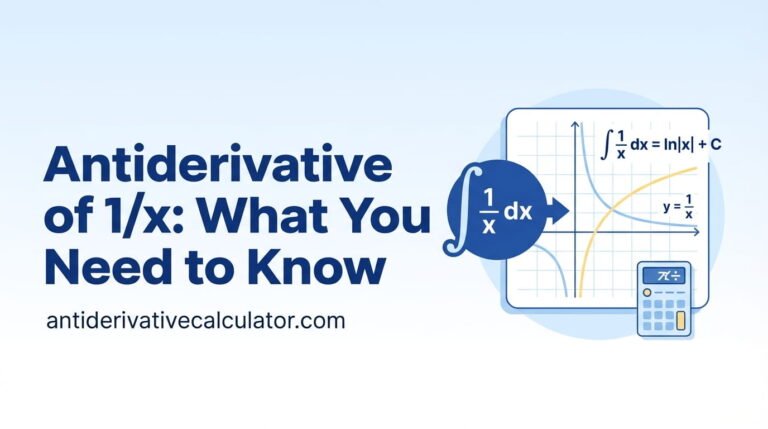
Problem 6 — Natural Logarithm Rule
Find the antiderivative of: 1/x
Rule to use: Natural logarithm rule — the power rule breaks down at n = −1.
Step 1: Recognize that 1/x = x⁻¹, which means n = −1. The power rule cannot be used.
Step 2: Apply the natural log rule: ∫ (1/x) dx = ln|x|.
Step 3: Add + C.
✅ Answer: ln|x| + C
Check: Differentiate ln|x| + C → 1/x. ✓
Note: The absolute value bars in ln|x| are essential — they extend the validity of the result to negative values of x as well as positive ones.
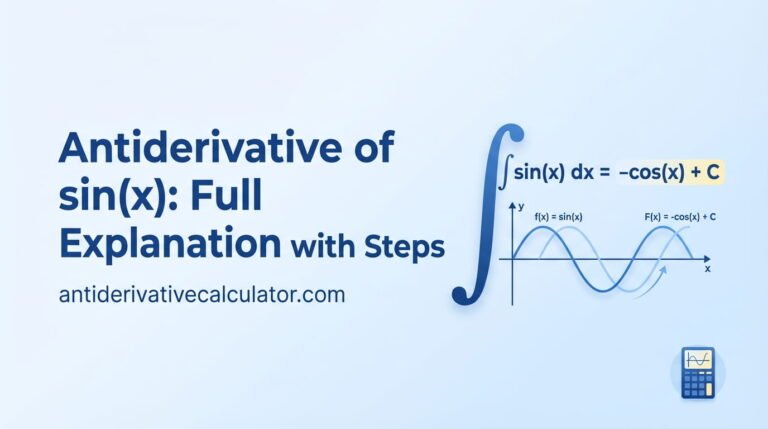
Problem 7 — Trigonometric Function
Find the antiderivative of: 3cos(x) − 2sin(x)
Rule to use: Trig antiderivative rules combined with the sum/difference and constant multiple rules.
Step 1: Split into two separate terms: 3cos(x) and 2sin(x).
Step 2: Antiderivative of 3cos(x).
∫ cos(x) dx = sin(x). Multiply by 3: 3sin(x).
Step 3: Antiderivative of 2sin(x).
∫ sin(x) dx = −cos(x). Multiply by 2: −2cos(x).
Step 4: Combine both results, apply subtraction, and add + C.
3sin(x) − (−2cos(x)) = 3sin(x) + 2cos(x).
✅ Answer: 3sin(x) + 2cos(x) + C
Check: Differentiate → 3cos(x) + 2(−sin(x)) = 3cos(x) − 2sin(x). ✓
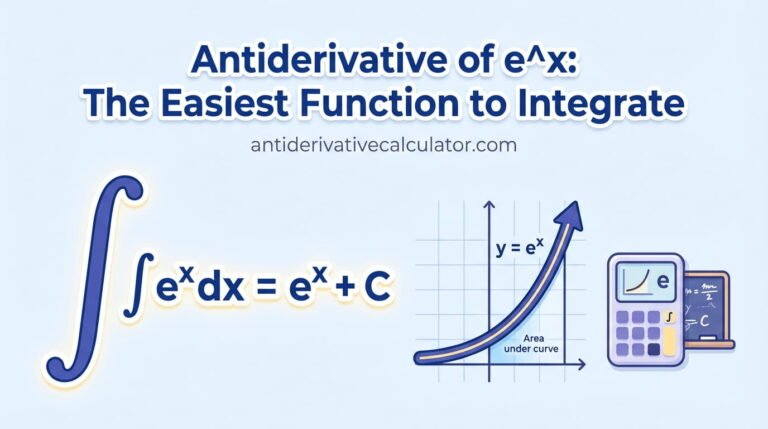
Problem 8 — Exponential Function
Find the antiderivative of: 5e^(2x)
Rule to use: Exponential rule for e^(ax) combined with the constant multiple rule.
Step 1: Identify the inner coefficient: a = 2. Outer coefficient: 5.
Step 2: Apply the exponential rule: ∫ e^(ax) dx = (1/a) · e^(ax).
Step 3: Substitute a = 2: (1/2) · e^(2x).
Step 4: Multiply by the outer coefficient 5: 5 × (1/2) · e^(2x) = (5/2)e^(2x).
Step 5: Add + C.
✅ Answer: (5/2)e^(2x) + C
Check: Differentiate using the chain rule → (5/2) · e^(2x) · 2 = 5e^(2x). ✓
Problem 9 — U-Substitution
Find the antiderivative of: 6x(x² + 1)²
Rule to use: U-substitution — look for a function and something close to its derivative in the same integral.
Step 1: Spot the pattern. The inner function is x² + 1. Its derivative is 2x. The integral contains 6x, which is 3 times 2x — so the derivative is present up to a constant factor. U-substitution will work.
Step 2: Choose u. Let u = x² + 1.
Step 3: Find du. du/dx = 2x, so du = 2x dx. This means x dx = du/2.
Step 4: Substitute.
∫ 6x · (x² + 1)² dx = ∫ 6 · u² · x dx = ∫ 6u² · (du/2) = ∫ 3u² du.
Step 5: Integrate.
Apply the power rule to u²: 3 · (u³/3) = u³.
Step 6: Substitute back. Replace u with x² + 1: (x² + 1)³.
Step 7: Add + C.
✅ Answer: (x² + 1)³ + C
Check: Differentiate using the chain rule → 3(x² + 1)² · 2x = 6x(x² + 1)². ✓
Problem 10 — Integration by Parts
Find the antiderivative of: x · e^x
Rule to use: Integration by parts — formula: ∫ u · dv = u · v − ∫ v · du.
Step 1: Identify the structure. This is a product of two different function types — algebraic (x) and exponential (eˣ). Integration by parts applies.
Step 2: Choose u and dv using LIATE.
Algebraic comes before Exponential in LIATE:
u = x and dv = eˣ dx.
Step 3: Find du.
Differentiate u = x: du = dx.
Step 4: Find v.
Integrate dv = eˣ dx: v = eˣ.
Step 5: Apply the formula.
∫ x · eˣ dx = x · eˣ − ∫ eˣ · dx.
Step 6: Solve the remaining integral.
∫ eˣ dx = eˣ.
Step 7: Combine and add + C.
x · eˣ − eˣ + C = eˣ(x − 1) + C.
✅ Answer: eˣ(x − 1) + C
Check: Differentiate using the product rule → eˣ(x − 1) + eˣ · 1 = eˣ · x − eˣ + eˣ = xeˣ. ✓
Summary: Rules Used Across All 10 Problems
- Problems 1 and 2: Power rule — ∫ xⁿ dx = x^(n+1)/(n+1) + C.
- Problem 3: Sum and difference rule — integrate each term separately.
- Problem 4: Power rule with negative exponents.
- Problem 5: Power rule with fractional exponents — rewrite roots first.
- Problem 6: Natural logarithm rule — ∫ (1/x) dx = ln|x| + C.
- Problem 7: Trig antiderivative rules — ∫ cos(x) dx = sin(x) + C and ∫ sin(x) dx = −cos(x) + C.
- Problem 8: Exponential rule — ∫ e^(ax) dx = (1/a) · e^(ax) + C.
- Problem 9: U-substitution — substitute inner function, cancel, integrate, substitute back.
- Problem 10: Integration by parts — ∫ u · dv = u · v − ∫ v · du using LIATE.
Frequently Asked Questions
How do I know which rule to use for each antiderivative problem?
Start by identifying the type of function in front of you. If it is a variable with an exponent, reach for the power rule first. If it is 1/x, use the natural log rule. If it is a trig function, apply the matching trig antiderivative rule. If it is eˣ or e^(ax), use the exponential rule. If two different function types are multiplied together, try u-substitution if one is the derivative of the other — or use integration by parts if not. With practice, recognizing the right rule becomes fast and instinctive.
What should I do if my answer looks different from the solution?
Do not immediately assume you are wrong. Two antiderivative expressions can look different but still both be correct if they differ only by a constant. The most reliable test is to differentiate both versions. If both give back the original function, both answers are valid. If your version does not differentiate back to the original function, go through your working line by line to find the exact step where the error occurred — that investigation is where the deepest learning happens.
Can I use an antiderivative calculator to check my answers to these practice problems?
Yes — and it is strongly encouraged as part of your practice routine. After attempting each problem and checking by differentiation, enter the original function into the antiderivative calculator on this site for a final verification. If your answer matches, your understanding of the rule is solid. If it does not, compare the two answers carefully and trace back through your steps to identify the difference. Using the calculator this way turns each practice problem into a complete learning cycle — attempt, verify by hand, confirm with the tool, investigate any differences.
Conclusion
These 10 antiderivative practice problems cover the full range of rules you need to master basic integration — from simple polynomials and trig functions all the way through to u-substitution and integration by parts. Work through every problem with a genuine attempt before reading the solution, check every answer by differentiating, and use the antiderivative calculator on this site to verify your results and catch any remaining errors. Consistent practice with these habits is what turns calculus knowledge into calculus skill — and skill is what gets you the marks when it counts most. Keep going, keep checking, and keep building!
“`