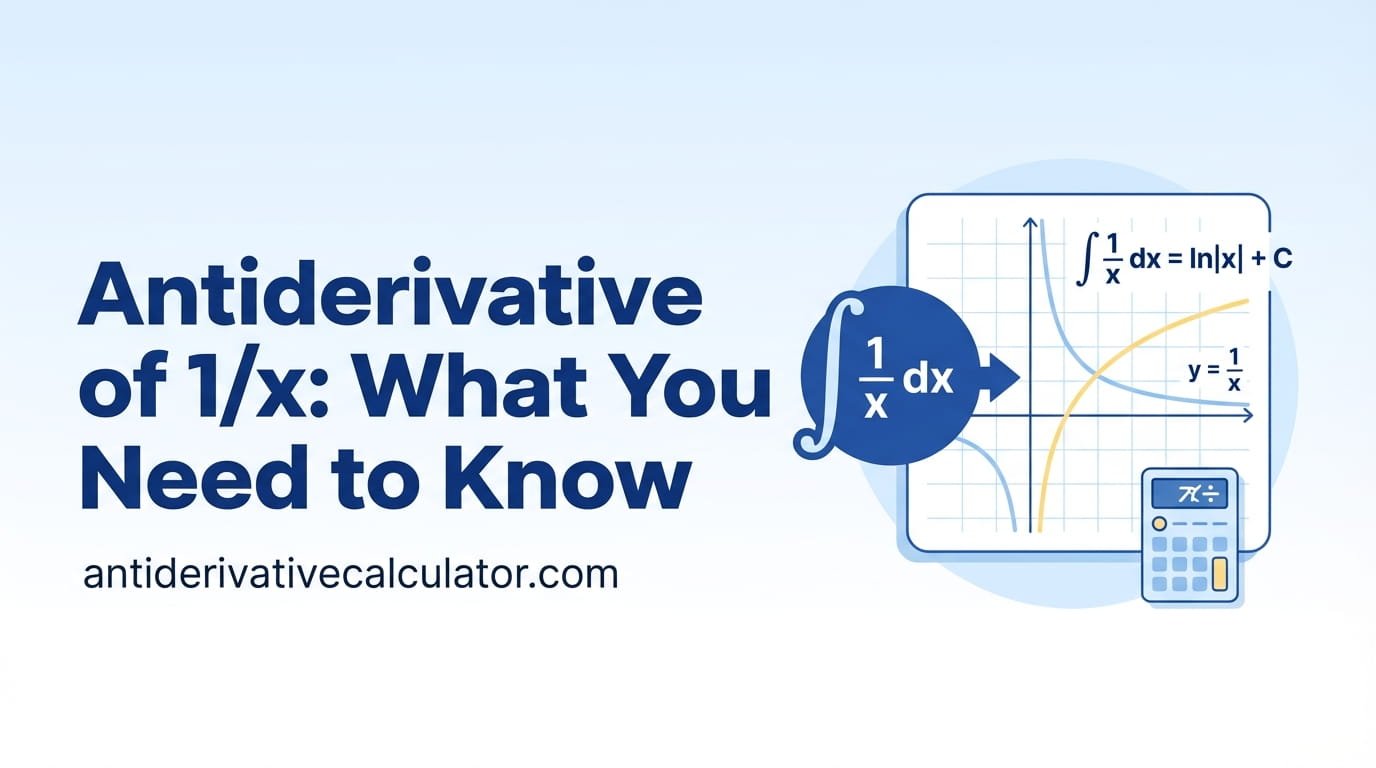
Antiderivative of 1/x: What You Need to Know
Most antiderivative rules in calculus follow a clean, predictable pattern. The power rule handles almost every polynomial you will ever encounter — just add 1 to the exponent and divide. But there is one function that breaks that pattern completely, and it is one of the most important functions in all of mathematics: 1/x.
The antiderivative of 1/x is not what the power rule would suggest. In fact, applying the power rule here leads to a mathematical impossibility — division by zero. So this function gets its own special rule, and that rule introduces one of the most significant results in calculus: the natural logarithm.
In this guide, you will learn exactly what the antiderivative of 1/x is, why the power rule fails for this function, where the natural logarithm answer comes from, why the absolute value signs matter, and how to apply the rule confidently across a range of problems. Every step is explained clearly so nothing feels confusing by the end.
What Is the Antiderivative of 1/x?
The antiderivative — also called the indefinite integral — of 1/x is:
∫ (1/x) dx = ln|x| + C
Where ln denotes the natural logarithm, |x| denotes the absolute value of x, and C is the constant of integration.
Three things in this result deserve careful attention right away:
- The natural logarithm: The answer involves ln — the natural log with base e. This is not log base 10. It is the logarithm that arises naturally in calculus and appears throughout mathematics, science, and engineering.
- The absolute value signs: The result is ln|x|, not just ln(x). Those vertical bars around x are essential and have real mathematical meaning. They are not decoration — they extend the validity of the rule beyond just positive values of x.
- The + C: As always in indefinite integration, the constant of integration is required in every complete answer.
Why the Power Rule Fails for 1/x
To understand why 1/x gets its own special rule, you first need to understand why the standard power rule breaks down here.
The function 1/x can be rewritten as x⁻¹ — that is, x raised to the power of −1. In that form, it looks like a perfectly ordinary power function that the power rule should handle.
The power rule for antiderivatives says: add 1 to the exponent, then divide by the new exponent. Applied to x⁻¹:
- Add 1 to the exponent: −1 + 1 = 0.
- The new exponent is 0, so the result would be x⁰ / 0.
- But x⁰ = 1, which means the result is 1/0 — and division by zero is undefined in mathematics.
The power rule completely breaks down at n = −1. There is no way to rescue it or work around it. This is not a gap in the rule — it is a fundamental mathematical wall. And that wall is precisely why 1/x requires a completely different approach.
Where Does ln|x| Come From?
The connection between 1/x and the natural logarithm is one of the most beautiful results in all of calculus. Understanding where it comes from makes the rule feel inevitable rather than arbitrary.
The starting point is a derivative you may already know: the derivative of ln(x) — for positive x — is 1/x.
Since finding an antiderivative reverses differentiation, it follows directly that the antiderivative of 1/x must be ln(x) — at least for positive values of x.
But what about negative values of x? The function 1/x is defined for all x except zero — both positive and negative values are valid inputs. The natural log ln(x), however, is only defined for positive x. So if we wrote the antiderivative as just ln(x) + C, it would only be valid half the time.
Here is where absolute value saves the day. Consider the function ln|x| for negative values of x. When x is negative, |x| = −x, so ln|x| = ln(−x). Differentiating ln(−x) using the chain rule:
- Derivative of ln(−x) = (1/(−x)) · (−1) = 1/x.
The derivative of ln(−x) is also 1/x — the same result as for positive x. This means ln|x| works as an antiderivative of 1/x for both positive and negative values of x. Writing the absolute value in the answer is what makes the rule complete and universally valid.
Verifying the Rule by Differentiating
The most reliable check for any antiderivative is to differentiate the result and confirm it gives back the original function. Here is that verification for both cases.
For x > 0:
Differentiate ln(x) + C:
- Derivative of ln(x) = 1/x.
- Derivative of C = 0.
- Result: 1/x. ✓
For x < 0:
Differentiate ln(−x) + C using the chain rule:
- Derivative of ln(−x) = (1/(−x)) · (−1) = 1/x.
- Derivative of C = 0.
- Result: 1/x. ✓
In both cases, the derivative of ln|x| + C equals 1/x. The rule is fully verified for all non-zero values of x.
The Antiderivative of 1/(ax) — With a Coefficient Inside
Once you are confident with the basic rule, the next step is handling variations where a constant appears in the denominator alongside x — like 1/(3x) or 1/(−2x).
These are straightforward to handle using the constant multiple rule. Since 1/(ax) = (1/a) · (1/x), you can pull the constant factor outside the integral:
∫ 1/(ax) dx = (1/a) · ∫ (1/x) dx = (1/a) · ln|x| + C
So the antiderivative of 1/(3x) is (1/3) ln|x| + C. The antiderivative of 1/(5x) is (1/5) ln|x| + C. The process is consistent — factor out the constant, apply the core rule, and add + C.
The Antiderivative of 1/(x + a) — Shifted Denominator
Another very common variation is when the denominator is not just x but a shifted version — like 1/(x + 3) or 1/(x − 7). These require u-substitution to handle correctly.
The method is clean and quick:
- Let u equal the entire denominator expression — for example, u = x + 3.
- Differentiate: du/dx = 1, so du = dx.
- Substitute into the integral: ∫ 1/u du.
- Apply the core rule: ∫ 1/u du = ln|u| + C.
- Substitute back: replace u with the original expression.
- Add + C.
So the antiderivative of 1/(x + 3) is ln|x + 3| + C. The antiderivative of 1/(x − 7) is ln|x − 7| + C. The substitution makes the connection to the core rule immediate and clean.
For slightly more complex denominators — like 1/(2x + 5) — the same substitution applies but you also divide by the coefficient of x, following the same logic as the extended rule for sin(ax) or e^(ax):
∫ 1/(2x + 5) dx = (1/2) ln|2x + 5| + C
Worked Examples: Antiderivative of 1/x Step by Step
Step 1: Identify the function. This is 1/x — the exact form covered by the natural log rule.
Step 2: Apply the rule directly: ∫ (1/x) dx = ln|x|.
Step 3: Add + C.
✅ Answer: ln|x| + C
Check: Differentiate ln|x| + C → 1/x + 0 = 1/x. ✓
Step 1: Rewrite as 5 · (1/x).
Step 2: Pull the constant outside the integral: 5 · ∫ (1/x) dx.
Step 3: Apply the rule: 5 · ln|x|.
Step 4: Add + C.
✅ Answer: 5ln|x| + C
Check: Differentiate 5ln|x| + C → 5 · (1/x) = 5/x. ✓
Step 1: Let u = x + 4.
Step 2: Differentiate: du = dx.
Step 3: Substitute: ∫ 1/u du.
Step 4: Apply the rule: ln|u|.
Step 5: Substitute back: ln|x + 4|.
Step 6: Add + C.
✅ Answer: ln|x + 4| + C
Check: Differentiate using the chain rule → 1/(x + 4) · 1 = 1/(x + 4). ✓
Step 1: Let u = 3x − 2.
Step 2: Differentiate: du/dx = 3, so du = 3 dx, which means dx = du/3.
Step 3: Substitute: ∫ (1/u) · (du/3) = (1/3) ∫ (1/u) du.
Step 4: Apply the rule: (1/3) · ln|u|.
Step 5: Substitute back: (1/3) ln|3x − 2|.
Step 6: Add + C.
✅ Answer: (1/3)ln|3x − 2| + C
Check: Differentiate using the chain rule → (1/3) · 3/(3x − 2) = 1/(3x − 2). ✓
Step 1: Split into three separate terms: ∫ x² dx, ∫ (1/x) dx, and ∫ 3 dx.
Step 2: Antiderivative of x².
Power rule: x³/3.
Step 3: Antiderivative of 1/x.
Natural log rule: ln|x|.
Step 4: Antiderivative of 3.
Constant rule: 3x.
Step 5: Combine all three results and add + C.
✅ Answer: x³/3 + ln|x| − 3x + C
Check: Differentiate → x² + 1/x − 3. ✓
Common Mistakes When Finding the Antiderivative of 1/x
A handful of specific errors appear consistently with this topic. Here is what to watch out for:
- Trying to apply the power rule to x⁻¹: The power rule does not work when the exponent is −1. It leads to division by zero and must never be used for 1/x. Always switch to the natural log rule for this specific case.
- Writing ln(x) instead of ln|x|: Omitting the absolute value signs makes the answer incomplete. Without them, the rule only holds for positive x. With real numbers, x can be negative, so the absolute value is always required in a fully correct answer.
- Confusing ln with log base 10: In calculus, ln always means the natural logarithm — logarithm base e. Log base 10 is a different function entirely. Using log instead of ln gives the wrong answer.
- Forgetting to divide by the inner coefficient: When integrating 1/(ax + b), remember to divide the ln result by a. This is the same chain rule adjustment required in other antiderivative rules with inner coefficients.
- Forgetting + C: Every indefinite integral requires the constant of integration. It is always part of a complete answer.
Frequently Asked Questions
Why is the antiderivative of 1/x equal to ln|x| and not just ln(x)?
Because 1/x is defined for both positive and negative values of x — everything except zero. The natural log ln(x) is only defined for positive x, so writing just ln(x) would give an answer that is invalid for negative inputs. The absolute value in ln|x| extends the rule to cover all non-zero values of x, making it a complete and mathematically correct answer. For most beginner problems where x is assumed positive, ln(x) and ln|x| give the same result — but the absolute value should always be included for full correctness.
Does the power rule ever work for negative exponents?
Yes — the power rule works for all negative exponents except −1. For example, the antiderivative of x⁻² is x⁻¹/(−1) = −1/x + C, and the antiderivative of x⁻³ is x⁻²/(−2) = −1/(2x²) + C. Both of these use the standard power rule without any issue. The only special case is x⁻¹ — which is 1/x — where the power rule breaks down and the natural log rule must be used instead. Every other negative exponent is handled by the power rule in the normal way.
Can I use an antiderivative calculator to check 1/x integration problems?
Absolutely — and it is a useful check for this particular function because the absolute value signs are easy to overlook. After working through the problem yourself, enter 1/x into the antiderivative calculator on this site to verify your answer. Make sure your result shows ln|x| + C with the absolute value bars included. Then differentiate the result yourself to confirm it gives back 1/x — that two-step verification gives you complete confidence in your answer every time.
Conclusion
The antiderivative of 1/x is ln|x| + C — a result that stands apart from the power rule and connects one of the most fundamental functions in calculus directly to the natural logarithm. Remember that the power rule fails at n = −1 because it leads to division by zero, that the absolute value signs in ln|x| are always required for a complete answer, and that every variation involving a shifted or scaled denominator can be handled cleanly with u-substitution. Verify every result by differentiating, keep the absolute value bars in place, and never forget your + C. Ready to test your understanding? Use the antiderivative calculator on this site to check your 1/x integration answers instantly and keep building your calculus confidence one problem at a time!
“`