Antiderivative of ln(x): How to Solve It Easily
At first glance, ln(x) looks like it should be one of the simpler functions to integrate. It is just a logarithm, after all. But when students sit down to find the antiderivative of ln(x) for the first time, many of them hit an unexpected wall — none of the basic antiderivative rules seem to apply directly.
There is no exponent to work with for the power rule. It is not a trig function. It is not an exponential. So what do you do? The answer involves a technique you may have already learned — integration by parts — applied in a clever way that turns a seemingly tricky problem into a surprisingly clean result.
In this guide, you will get a complete, step-by-step explanation of how to find the antiderivative of ln(x), why the method works, what the result means, and how to apply the same approach to related logarithmic functions. Worked examples are included throughout so the process feels fully clear before you finish reading.
What Is the Antiderivative of ln(x)?
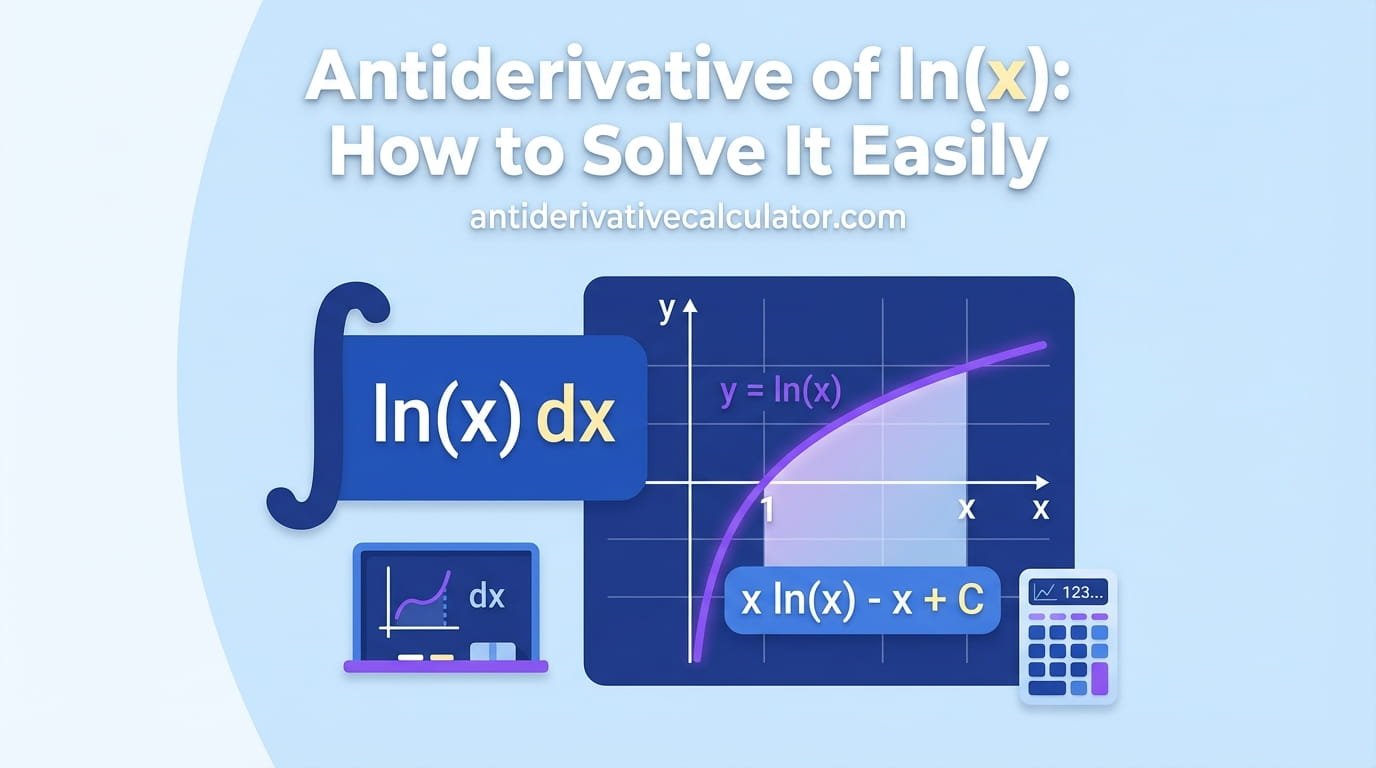
The antiderivative — also called the indefinite integral — of ln(x) is:
∫ ln(x) dx = x · ln(x) − x + C
Where C is the constant of integration and x > 0.
This result has a structure that surprises many beginners — the answer involves both ln(x) and a plain x term, combined together. It does not look like the output of a simple rule, and that is because it is not. It comes from applying integration by parts, one of the most important techniques in all of calculus.
Before jumping into the method, there is one important condition worth noting: ln(x) is only defined for positive values of x. So this antiderivative is valid when x > 0. In more advanced work you may see ln|x| used to extend the result to negative values, but for all beginner-level problems, treating x as positive is the standard approach.
Why the Basic Rules Do Not Work for ln(x)
It helps to understand why the straightforward rules fall short here before learning the method that does work.
The power rule for antiderivatives requires a variable raised to a numeric exponent — like x³ or x^(1/2). The natural logarithm ln(x) is not in that form at all, so the power rule simply does not apply.
The exponential rule handles functions like eˣ or aˣ — again, a completely different structure from a logarithm.
There is no standard trig antiderivative rule that covers ln(x) either. And u-substitution alone — without a matching derivative present somewhere else in the integral — does not produce a clean simplification.
That leaves integration by parts as the tool for this job. And once you see how it is applied to ln(x), the logic is elegant and easy to follow.
∫ u · dv = u · v − ∫ v · du
You choose u and dv from the original integral, differentiate u to get du, integrate dv to get v, then plug everything into the formula.
How to Find the Antiderivative of ln(x) Using Integration by Parts
Here is the key insight that makes this problem work: even though ln(x) looks like a single function, you can rewrite it as a product — ln(x) · 1. That gives you two pieces to work with, which is exactly what integration by parts needs.
Once you see ln(x) written as ln(x) times 1, the method flows naturally from there.
Choosing u and dv
Using the LIATE rule — Logarithms, Inverse trig, Algebraic, Trigonometric, Exponential — logarithms come first. So ln(x) becomes u, and the remaining piece — which is just 1 dx — becomes dv.
- u = ln(x)
- dv = 1 dx = dx
This choice is the right one because differentiating ln(x) gives the much simpler 1/x — which makes the remaining integral very easy to solve. If you made the choices the other way around, the problem would get more complicated, not less.
Finding du and v
- Differentiate u: The derivative of ln(x) is 1/x. So du = (1/x) dx.
- Integrate dv: The antiderivative of 1 dx is x. So v = x.
Applying the Formula
Now plug u, v, and du into the integration by parts formula:
∫ ln(x) dx = u · v − ∫ v · du
= ln(x) · x − ∫ x · (1/x) dx
= x · ln(x) − ∫ (x/x) dx
= x · ln(x) − ∫ 1 dx
Notice how x/x simplifies to 1 — that cancellation is the elegant core of why this method works so cleanly for ln(x).
Solving the Remaining Integral
∫ 1 dx = x
So the full expression becomes:
x · ln(x) − x
Adding + C
The complete antiderivative is:
∫ ln(x) dx = x · ln(x) − x + C
Verifying the Answer by Differentiating
The most reliable way to confirm any antiderivative is to differentiate the result and check that it gives back the original function. Let us do that now.
Differentiate x · ln(x) − x + C:
The first term x · ln(x) is a product of two functions, so the product rule applies:
- Derivative of x · ln(x) = (1) · ln(x) + x · (1/x) = ln(x) + 1.
The second term −x differentiates to −1.
The constant C differentiates to 0.
Combined result: ln(x) + 1 − 1 + 0 = ln(x).
The derivative of our answer is ln(x) — exactly the original function. The rule is fully confirmed.
Worked Examples: Antiderivative of ln(x) and Related Functions
Step 1: Rewrite as ∫ ln(x) · 1 dx.
Step 2: Choose u = ln(x) and dv = dx.
Step 3: Find du = (1/x) dx and v = x.
Step 4: Apply the formula: x · ln(x) − ∫ x · (1/x) dx = x · ln(x) − ∫ 1 dx.
Step 5: Solve: x · ln(x) − x.
Step 6: Add + C.
✅ Answer: x · ln(x) − x + C
Check: Differentiate → ln(x) + 1 − 1 = ln(x). ✓
Step 1: Pull the constant outside the integral using the constant multiple rule: 3 · ∫ ln(x) dx.
Step 2: Apply the core result: ∫ ln(x) dx = x · ln(x) − x.
Step 3: Multiply by 3: 3(x · ln(x) − x) = 3x · ln(x) − 3x.
Step 4: Add + C.
✅ Answer: 3x · ln(x) − 3x + C
Check: Differentiate using the product rule on 3x · ln(x) → 3ln(x) + 3 − 3 = 3ln(x). ✓
This is a product of two functions — algebraic times logarithm — so integration by parts applies again. Using LIATE, ln(x) comes before x, so:
Step 1: Choose u = ln(x) and dv = x dx.
Step 2: Find du = (1/x) dx and v = x²/2.
Step 3: Apply the formula:
∫ x · ln(x) dx = (x²/2) · ln(x) − ∫ (x²/2) · (1/x) dx
= (x²/2) · ln(x) − ∫ (x/2) dx.
Step 4: Solve the remaining integral: ∫ (x/2) dx = x²/4.
Step 5: Combine: (x²/2) · ln(x) − x²/4.
Step 6: Add + C.
✅ Answer: (x²/2) · ln(x) − x²/4 + C
Check: Differentiate using the product rule → x · ln(x) + x/2 − x/2 = x · ln(x). ✓
Step 1: Split into two separate terms using the sum rule: ∫ ln(x) dx and ∫ x² dx.
Step 2: Antiderivative of ln(x).
Using the core result: x · ln(x) − x.
Step 3: Antiderivative of x².
Using the power rule: x³/3.
Step 4: Combine both results and add + C.
✅ Answer: x · ln(x) − x + x³/3 + C
Check: Differentiate → ln(x) + 1 − 1 + x² = ln(x) + x². ✓
The Antiderivative of ln(ax) — Logarithm with a Coefficient Inside
What happens when the argument of the natural log includes a constant multiplier — like ln(3x) or ln(5x)? You can handle these using a logarithm property before integrating.
The key property is: ln(ax) = ln(a) + ln(x).
Using this, you can split ln(ax) into two separate terms before integrating:
∫ ln(ax) dx = ∫ [ln(a) + ln(x)] dx = ∫ ln(a) dx + ∫ ln(x) dx
Since ln(a) is a constant, ∫ ln(a) dx = x · ln(a). And ∫ ln(x) dx = x · ln(x) − x. Combining:
= x · ln(a) + x · ln(x) − x + C = x · [ln(a) + ln(x)] − x + C = x · ln(ax) − x + C
So the antiderivative of ln(ax) is x · ln(ax) − x + C — the same structural form as the basic rule, just with ax inside the logarithm instead of x alone. This is a clean, satisfying result that shows the consistency of the method.
Common Mistakes When Finding the Antiderivative of ln(x)
A few specific errors appear again and again with this topic. Knowing them in advance helps you avoid them:
- Trying to apply the power rule directly to ln(x): The power rule does not apply here. ln(x) is not a variable raised to an exponent — it is a logarithmic function. Using the power rule on it produces a completely wrong result.
- Choosing u and dv the wrong way around: If you set u = 1 and dv = ln(x) dx, you immediately run into the problem of needing to integrate ln(x) to find v — which is the original problem you were trying to solve. Always set u = ln(x) so you differentiate it rather than integrate it.
- Forgetting the −x term in the answer: The full result is x · ln(x) − x + C. Leaving out the −x makes the answer incorrect. This is a very common mistake — always write both terms.
- Forgetting + C: As with every indefinite integral, the constant of integration must always appear in the final answer.
- Skipping the verification step: Differentiating x · ln(x) − x + C and confirming it gives back ln(x) takes under a minute and catches every one of the above errors immediately.
Frequently Asked Questions
Why does finding the antiderivative of ln(x) require integration by parts?
Because ln(x) does not match the form required by any of the basic antiderivative rules. The power rule needs a variable with an exponent. The exponential rule needs a constant raised to a variable power. No standard trig rule applies either. Integration by parts works here because rewriting ln(x) as ln(x) · 1 creates a product of two functions — and differentiating the ln(x) part produces the much simpler 1/x, which then cancels cleanly with the v = x term to leave a trivial remaining integral.
Is the antiderivative of ln(x) the same as the antiderivative of log(x)?
Not quite — it depends on the base. The rule ∫ ln(x) dx = x · ln(x) − x + C applies specifically to the natural logarithm, which uses base e. For a logarithm with a different base b — written log_b(x) — you would first convert it using the change of base formula: log_b(x) = ln(x) / ln(b). Since ln(b) is a constant, you can pull it outside the integral and apply the natural log result. The structure of the answer is the same, just divided by ln(b).
Can I use an antiderivative calculator to check ln(x) integration problems?
Yes — and it is a great habit for this particular function because the result has two terms and is easy to write incompletely. After working through the integration by parts steps yourself, enter ln(x) into the antiderivative calculator on this site to verify your answer. Make sure your result includes both the x · ln(x) term and the −x term before comparing. If they do not match, differentiate both versions to identify which is correct and trace back through your steps to find where the difference appeared.
Conclusion
The antiderivative of ln(x) is x · ln(x) − x + C — a result that comes from applying integration by parts with u = ln(x) and dv = dx, letting the x/x cancellation do its elegant work. Remember to always write both terms of the answer, never try to apply the power rule to a logarithm, and always verify by differentiating your result. The more you practice this method, the faster and more automatic it becomes — and the same integration by parts approach will serve you well across many other logarithmic functions too. Ready to check your work? Use the antiderivative calculator on this site to verify your ln(x) integration answers instantly and keep sharpening your calculus skills one problem at a time!
“`