Antiderivative of sin(x): Full Explanation with Steps
If you are studying trigonometric integration, one of the very first functions you will encounter is sin(x). It is simple, it is clean, and it comes with one small detail that trips up more students than almost any other rule in basic calculus: the negative sign.
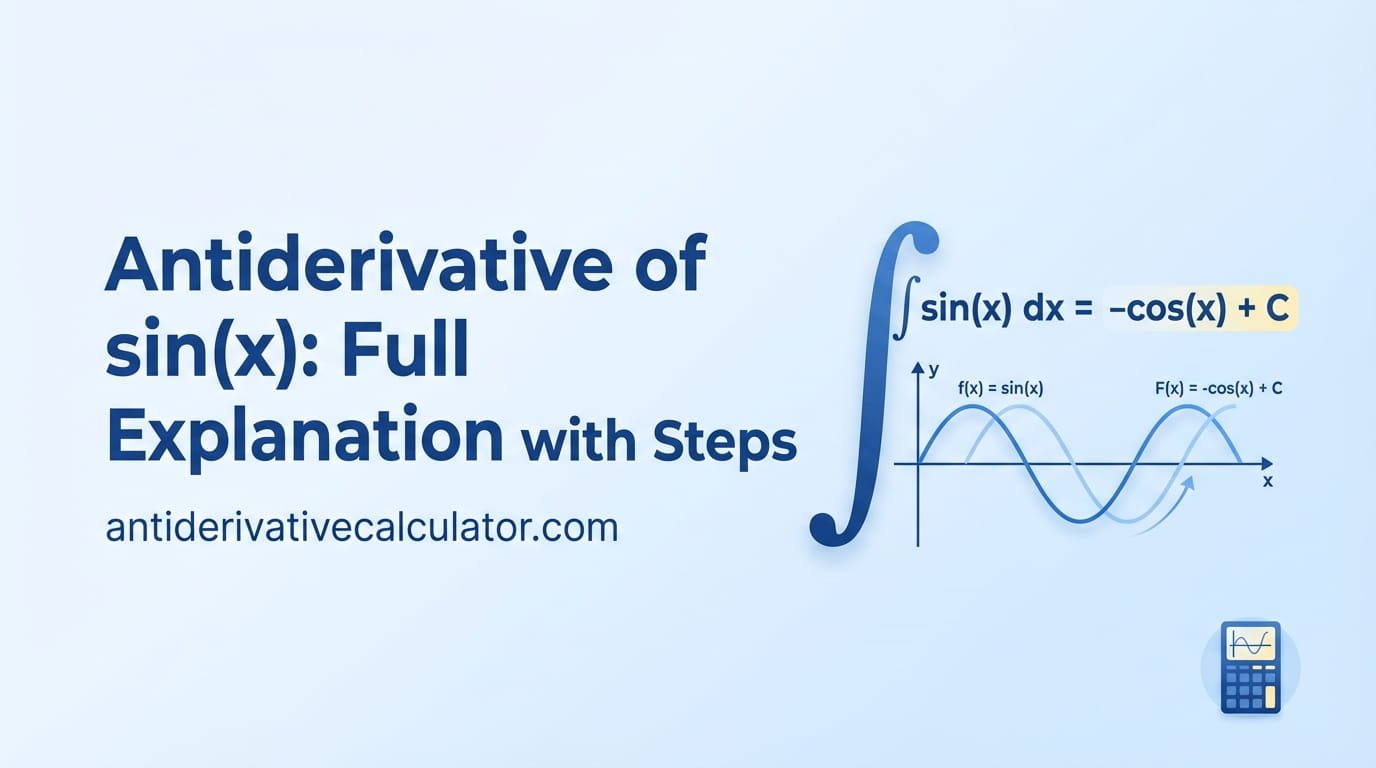
The antiderivative of sin(x) is −cos(x) + C. That negative sign is not a typo — it is a fundamental part of the rule, and understanding exactly where it comes from makes it impossible to forget. Once you see the logic behind it, the rule sticks for good.
In this guide, you will get a complete explanation of the antiderivative of sin(x) — where the rule comes from, how to apply it step by step, how it extends to more complex sine functions, and what mistakes to watch out for along the way. Worked examples are included throughout so nothing stays abstract.
What Is the Antiderivative of sin(x)?
The antiderivative — also called the indefinite integral — of sin(x) is:
∫ sin(x) dx = −cos(x) + C
Where C is the constant of integration.
This rule tells you that when you integrate sin(x), the result is negative cosine of x, plus the constant C. The process of finding this is called integration, and it is the reverse of differentiation.
Two things in this result deserve your full attention right away:
- The negative sign: The result is −cos(x), not cos(x). This negative is essential and cannot be dropped. It is the single most commonly forgotten detail in trig integration.
- The + C: Every indefinite integral ends with + C — the constant of integration. It accounts for the fact that any constant disappears when differentiated, so when reversing the process we must acknowledge it could have been there.
Where Does This Rule Come From?
The best way to truly understand — and permanently remember — any antiderivative rule is to see exactly where it comes from. For sin(x), the explanation is beautifully simple.
You probably already know the derivative of cos(x). Here it is:
The derivative of cos(x) is −sin(x).
Now, finding an antiderivative is the reverse of finding a derivative. So if the derivative of cos(x) is −sin(x), then the antiderivative of −sin(x) must be cos(x). But our function is sin(x) — not −sin(x). So we need to adjust.
If the antiderivative of −sin(x) is cos(x), then by flipping the sign on both sides, the antiderivative of sin(x) must be −cos(x). Add the + C, and you have the complete rule.
In other words: the negative sign in the answer exists because differentiation introduced a negative sign — and reversing that process brings the negative sign along with it.
Verifying the Rule by Differentiating
One of the most powerful habits in calculus is verifying every antiderivative by differentiating the result. If the derivative of your answer equals the original function, the antiderivative is correct. Let us do that now for this rule.
Claim: ∫ sin(x) dx = −cos(x) + C
Verification: Differentiate −cos(x) + C.
- The derivative of −cos(x) is −(−sin(x)) = sin(x).
- The derivative of C is 0.
- Combined result: sin(x) + 0 = sin(x).
The derivative of our answer is sin(x) — exactly the original function. The rule is confirmed. This verification step works for every integration result, and doing it consistently is one of the best habits you can build in calculus.
The Antiderivative of sin(ax) — With a Coefficient Inside
Once you are comfortable with the basic rule, the next step is handling sine functions where a constant is multiplied inside the argument — like sin(2x), sin(5x), or sin(−3x). These come up frequently in calculus and require a small but important adjustment.
The general rule is:
∫ sin(ax) dx = −(1/a) cos(ax) + C
Where a is any non-zero constant.
In plain English: integrate sin(ax) the same way as sin(x), but divide the result by the constant a sitting inside the argument.
Why divide by a? This adjustment reverses the chain rule effect. When you differentiate −(1/a) cos(ax), the chain rule brings down the inner constant a, which multiplies with 1/a to produce 1 — leaving just sin(ax). Dividing by a in the antiderivative is exactly what is needed to cancel that chain rule multiplication on the way back.
You can also derive this result cleanly using u-substitution by letting u = ax. Both approaches arrive at the same answer — use whichever feels more natural as you are learning.
The Antiderivative of a · sin(x) — With a Coefficient Outside
What if the constant is multiplied in front of the sine function instead of inside it — like 4sin(x) or −2sin(x)? This is even simpler to handle.
When a constant multiplies an entire function, you can pull it outside the integral sign and deal with it separately. This is called the constant multiple rule:
∫ a · sin(x) dx = a · ∫ sin(x) dx = a · (−cos(x)) + C = −a · cos(x) + C
So the antiderivative of 7sin(x) is −7cos(x) + C. The antiderivative of −3sin(x) is 3cos(x) + C. The process is always the same — pull the constant out, apply the rule to sin(x), multiply back in, and add + C.
Worked Examples: Antiderivative of sin(x) Step by Step
Step 1: Identify the function. This is sin(x) with no coefficient inside or outside.
Step 2: Apply the core rule directly: ∫ sin(x) dx = −cos(x).
Step 3: Add + C.
✅ Answer: −cos(x) + C
Check: Differentiate −cos(x) + C → −(−sin(x)) + 0 = sin(x). ✓
Step 1: Identify the function. This is sin with inner coefficient a = 3.
Step 2: Apply the extended rule: ∫ sin(ax) dx = −(1/a) cos(ax).
Step 3: Substitute a = 3: −(1/3) cos(3x).
Step 4: Add + C.
✅ Answer: −(1/3)cos(3x) + C
Check: Differentiate using the chain rule → −(1/3) · (−sin(3x)) · 3 = sin(3x). ✓
Step 1: Identify the function. The constant 5 is outside the sine function.
Step 2: Pull the constant outside the integral: 5 · ∫ sin(x) dx.
Step 3: Apply the core rule: ∫ sin(x) dx = −cos(x).
Step 4: Multiply back: 5 · (−cos(x)) = −5cos(x).
Step 5: Add + C.
✅ Answer: −5cos(x) + C
Check: Differentiate −5cos(x) + C → −5 · (−sin(x)) + 0 = 5sin(x). ✓
Step 1: Split into two separate terms using the sum rule: 4sin(2x) and 3x².
Step 2: Antiderivative of 4sin(2x).
Inner coefficient a = 2. Apply extended rule: −(1/2)cos(2x).
Multiply by outer coefficient 4: 4 · (−(1/2)cos(2x)) = −2cos(2x).
Step 3: Antiderivative of 3x².
Apply the power rule: 3 · (x³/3) = x³.
Step 4: Combine both results and add + C.
✅ Answer: −2cos(2x) + x³ + C
Check: Differentiate → −2 · (−sin(2x)) · 2 + 3x² = 4sin(2x) + 3x². ✓
Original function: sin(4x)
Step 1: Let u = 4x.
Step 2: Differentiate: du/dx = 4, so du = 4 dx, which means dx = du/4.
Step 3: Substitute into the integral: ∫ sin(u) · (du/4) = (1/4) ∫ sin(u) du.
Step 4: Apply the core rule: (1/4) · (−cos(u)) = −(1/4)cos(u).
Step 5: Substitute back: replace u with 4x.
Step 6: Add + C.
✅ Answer: −(1/4)cos(4x) + C
Check: Differentiate → −(1/4) · (−sin(4x)) · 4 = sin(4x). ✓
Common Mistakes When Finding the Antiderivative of sin(x)
Even students who know this rule well can drop marks through small, avoidable errors. Here are the mistakes that come up most often:
- Writing cos(x) + C instead of −cos(x) + C: This is the single most common error in trig integration. The negative sign is part of the rule — it is not optional and cannot be dropped. Always double-check that it is there.
- Forgetting to divide by the inner coefficient: When integrating sin(ax), you must divide the result by a. Writing −cos(ax) + C instead of −(1/a)cos(ax) + C is a very common mistake, especially under exam pressure.
- Confusing the rule with the derivative rule: The derivative of sin(x) is cos(x) — positive, no adjustment. The antiderivative of sin(x) is −cos(x) — negative. These are easy to mix up. Keep them clearly separate in your notes.
- Forgetting + C: As with every indefinite integral, the constant of integration is always required. It is part of a complete, correct answer.
- Not verifying the answer: A thirty-second differentiation check catches every one of the errors above instantly. Make it a habit on every problem.
Frequently Asked Questions
Why is the antiderivative of sin(x) negative cosine and not just cosine?
Because the derivative of cos(x) is negative sin(x) — not positive sin(x). Since finding an antiderivative reverses differentiation, the antiderivative of sin(x) must be −cos(x) to account for that negative sign. If the antiderivative were positive cos(x), differentiating it would give −sin(x), not sin(x) — which would be wrong. The negative sign is necessary to make the relationship between sin and cos work correctly in both directions.
What is the antiderivative of sin(x) compared to the antiderivative of cos(x)?
The two rules are mirror images of each other — but with one important difference in sign. The antiderivative of sin(x) is −cos(x) + C — negative cosine. The antiderivative of cos(x) is sin(x) + C — positive sine. Sin integrates to negative cos. Cos integrates to positive sin. Keeping that sign pattern clear in your memory will prevent a very common category of mistakes in trig integration.
Can I use an antiderivative calculator to check sin(x) integration problems?
Absolutely — and it is especially useful for trig problems where the negative sign and inner coefficients make errors easy to introduce. After working through a problem yourself, enter the original function into the antiderivative calculator on this site to verify your result instantly. If the answers do not match, compare them carefully — a missing negative sign or a forgotten division by the inner coefficient is almost always the source of the difference.
Conclusion
The antiderivative of sin(x) is −cos(x) + C — and now you know exactly why that negative sign is there, where the rule comes from, and how to apply it confidently across a range of problem types. Remember to always divide by the inner coefficient when integrating sin(ax), always carry the negative sign through, and always verify your answer by differentiating it. These three habits will keep your trig integration accurate every time. Ready to test your understanding? Use the antiderivative calculator on this site to check your sin(x) integration answers instantly and keep building your calculus skills one step at a time!
“`