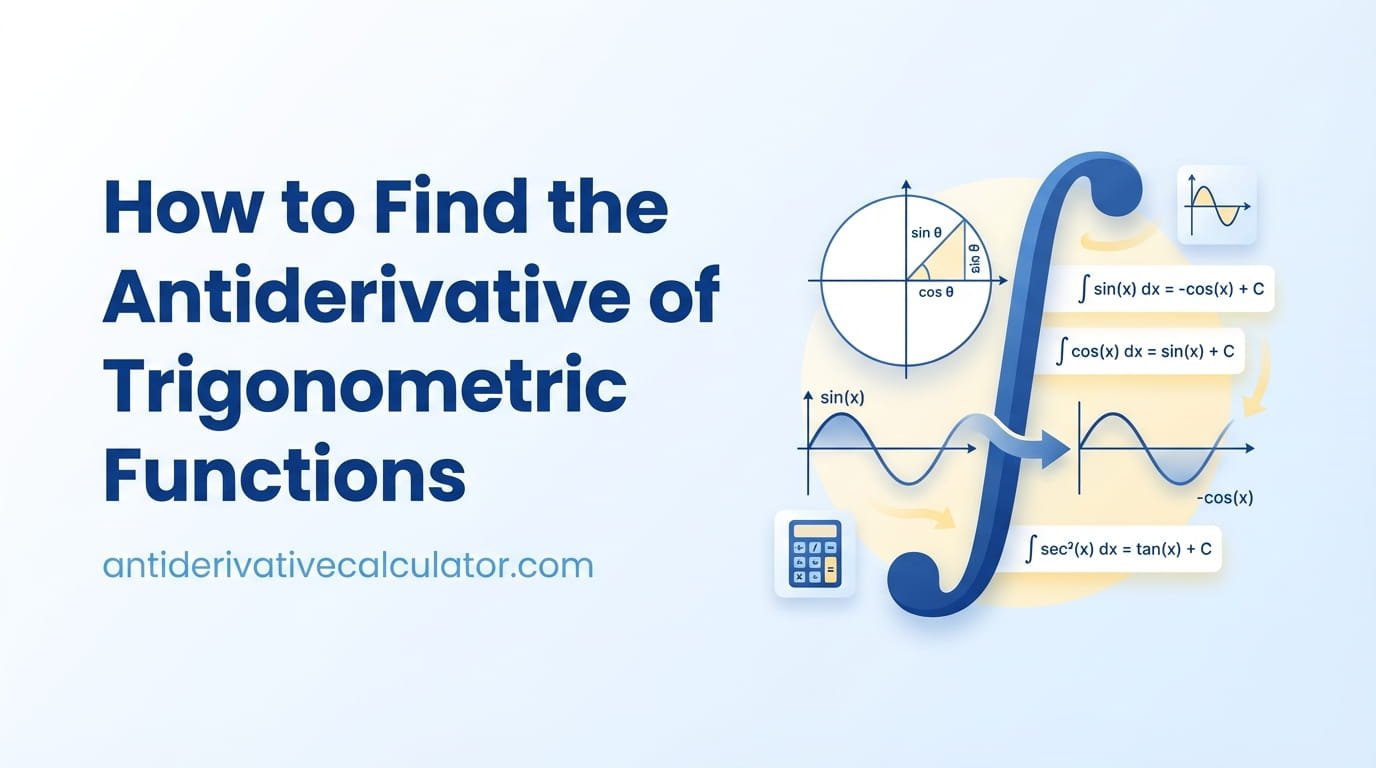
How to Find the Antiderivative of Trigonometric Functions
Trigonometry and calculus go hand in hand. Once you move past basic polynomials and start working with sine, cosine, and other trig functions, a whole new set of integration rules comes into play. At first glance, these rules might seem like a lot to memorize — but there is actually a very clear pattern connecting all of them.
Finding the antiderivative of trigonometric functions is a skill that shows up constantly in calculus courses, physics problems, and engineering applications. The good news is that most of the core trig antiderivatives follow directly from rules you already know about derivatives — just run in reverse.
In this guide, you will learn every essential trig antiderivative rule, understand where each one comes from, and work through real examples step by step. By the end, you will have a solid, reliable toolkit for handling any basic trig integration problem that comes your way.
Why Trig Antiderivatives Follow a Pattern
Before jumping into the rules, here is something that makes them much easier to learn: every trig antiderivative rule comes directly from a trig derivative rule — just reversed.
For example, you probably already know that the derivative of sin(x) is cos(x). So it makes perfect sense that the antiderivative of cos(x) is sin(x). The two operations are exact opposites — differentiation and integration always undo each other.
This means you do not need to memorize a brand new set of facts. If you already know your trig derivatives, you are more than halfway there. Just flip the relationship around, add + C, and you have the antiderivative rule.
The Six Core Trig Antiderivative Rules
There are six trigonometric functions in mathematics: sine, cosine, tangent, cosecant, secant, and cotangent. Each one has its own antiderivative rule. Here they are, presented clearly with a short explanation of each.
1. Antiderivative of sin(x)
The derivative of cos(x) is −sin(x). Reversing that relationship gives us:
∫ sin(x) dx = −cos(x) + C
The negative sign is critical here. It is the most commonly forgotten detail in this rule. A good way to remember it: sin and cos take turns being negative when you go back and forth between differentiation and integration.
2. Antiderivative of cos(x)
The derivative of sin(x) is cos(x). Reversing that directly gives us:
∫ cos(x) dx = sin(x) + C
This one has no negative sign — which trips some students up after learning the sin rule. Just remember: the cosine rule is the clean, positive one.
3. Antiderivative of sec²(x)
The derivative of tan(x) is sec²(x). So the reverse is:
∫ sec²(x) dx = tan(x) + C
This rule comes up very frequently in calculus problems, so it is worth memorizing early. Whenever you see sec²(x) in an integral, think: the answer is tan(x).
4. Antiderivative of csc²(x)
The derivative of cot(x) is −csc²(x). Reversing that gives:
∫ csc²(x) dx = −cot(x) + C
Notice the negative sign again — the same pattern as with sin(x). The cosecant squared rule and the sine rule both produce a negative result when integrated.
5. Antiderivative of sec(x) · tan(x)
The derivative of sec(x) is sec(x) · tan(x). Reversing that gives:
∫ sec(x) · tan(x) dx = sec(x) + C
This rule looks unusual at first — a product of two functions integrating to a single one. But it follows directly from the derivative, so once you see where it comes from, it makes complete sense.
6. Antiderivative of csc(x) · cot(x)
The derivative of csc(x) is −csc(x) · cot(x). Reversing that gives:
∫ csc(x) · cot(x) dx = −csc(x) + C
Again, watch out for the negative sign. Rules involving cosecant and cotangent tend to carry negatives — noticing that pattern makes them easier to remember as a group.
Quick Reference: All Six Rules at a Glance
- ∫ sin(x) dx = −cos(x) + C
- ∫ cos(x) dx = sin(x) + C
- ∫ sec²(x) dx = tan(x) + C
- ∫ csc²(x) dx = −cot(x) + C
- ∫ sec(x) · tan(x) dx = sec(x) + C
- ∫ csc(x) · cot(x) dx = −csc(x) + C
Trig Antiderivatives with a Coefficient Inside the Function
Things get slightly more interesting when a constant is multiplied inside the trig function — like sin(3x) or cos(5x). In these cases, you need to account for that inner constant using a small adjustment.
The general rule is: when you integrate a trig function with a constant a inside, divide the result by that constant a.
In formula form for the two most common cases:
- ∫ sin(ax) dx = −(1/a) cos(ax) + C
- ∫ cos(ax) dx = (1/a) sin(ax) + C
This adjustment comes directly from the chain rule. When you differentiate (1/a) sin(ax), the chain rule brings down the inner constant a, which cancels with the (1/a) out front — giving you back cos(ax). So dividing by a is the correct way to reverse that chain rule effect.
You can also handle these problems using u-substitution by letting u equal the inner expression. Both approaches give the same answer — use whichever feels more natural to you.
Worked Examples: Finding the Antiderivative of Trig Functions Step by Step
Step 1: Identify the function. This is a basic sine function with no coefficient inside.
Step 2: Apply the sine rule directly.
Step 3: Add + C.
✅ Answer: −cos(x) + C
Check: The derivative of −cos(x) is −(−sin(x)) = sin(x). ✓
Step 1: Identify the function. This is cosine with a coefficient of 4 inside.
Step 2: Apply the cosine rule — the antiderivative of cos(x) is sin(x).
Step 3: Divide by the inner coefficient: (1/4) sin(4x).
Step 4: Add + C.
✅ Answer: (1/4) sin(4x) + C
Check: Differentiate using the chain rule — (1/4) · cos(4x) · 4 = cos(4x). ✓
Step 1: Split into two separate terms using the sum rule: 3sec²(x) and 2cos(x).
Step 2: Antiderivative of 3sec²(x).
Apply the sec² rule: ∫ sec²(x) dx = tan(x).
Multiply by the coefficient: 3 · tan(x) = 3tan(x).
Step 3: Antiderivative of 2cos(x).
Apply the cosine rule: ∫ cos(x) dx = sin(x).
Multiply by the coefficient: 2 · sin(x) = 2sin(x).
Step 4: Combine both results and add + C.
✅ Answer: 3tan(x) + 2sin(x) + C
Check: Differentiate — 3sec²(x) + 2cos(x). ✓
Step 1: Split into two terms: sin(2x) and sec(x) · tan(x).
Step 2: Antiderivative of sin(2x).
Apply the sine rule with inner coefficient 2: −(1/2) cos(2x).
Step 3: Antiderivative of sec(x) · tan(x).
Apply the rule directly: sec(x).
Step 4: Combine, apply the subtraction, and add + C.
✅ Answer: −(1/2)cos(2x) − sec(x) + C
Check: Differentiate — −(1/2) · (−sin(2x)) · 2 − sec(x) · tan(x) = sin(2x) − sec(x)tan(x). ✓
Trig Antiderivatives and U-Substitution
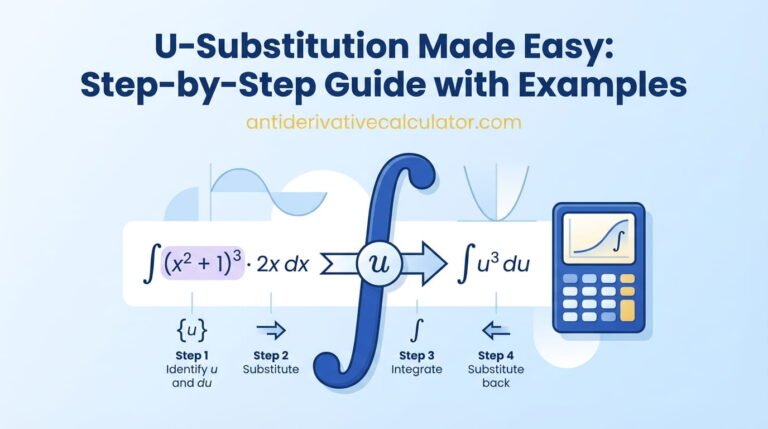
When the argument of a trig function is more complex than a simple constant — for example sin(x²) or cos(3x + 1) — the basic trig rules alone are not enough. You will need to combine them with u-substitution.
The process works exactly the same way as with other functions:
- Let u equal the expression inside the trig function.
- Find du and solve for dx.
- Substitute u and the new dx into the integral.
- Apply the appropriate trig antiderivative rule in terms of u.
- Substitute back to express the answer in terms of x.
- Add + C.
For example, ∫ cos(x² ) · 2x dx becomes ∫ cos(u) du after letting u = x², giving a clean answer of sin(x²) + C. The key, as always with u-substitution, is that the derivative of the inner function must appear somewhere else in the integral for the method to work smoothly.
Most Common Mistakes with Trig Antiderivatives
Even when you know the rules, a few specific errors come up again and again. Here is what to watch out for:
- Forgetting the negative sign on ∫ sin(x) dx: The answer is −cos(x) + C, not cos(x) + C. That negative is part of the rule — leaving it out makes the answer wrong.
- Forgetting to divide by the inner coefficient: When integrating sin(ax) or cos(ax), you must divide by a. Skipping this step is one of the most frequent mistakes in trig integration.
- Mixing up which rules carry negative signs: The rules for sin, csc², and csc·cot all produce negative results. The rules for cos, sec², and sec·tan do not. Keeping a reference list nearby while practicing helps lock in these differences.
- Forgetting + C: As with every indefinite integral, the constant of integration must always appear in the final answer.
- Not checking the answer: Differentiating your result is the fastest way to catch any of the above mistakes before they cost you marks.
Frequently Asked Questions
Why is the antiderivative of sin(x) negative but the antiderivative of cos(x) is not?
It comes directly from the derivative rules. The derivative of cos(x) is negative sin(x) — so reversing that process means the antiderivative of sin(x) is negative cos(x). The derivative of sin(x) is positive cos(x), so reversing that gives a positive sin(x) as the antiderivative of cos(x). The sign in each antiderivative simply reflects the sign in the original derivative relationship.
Do I need to memorize all six trig antiderivative rules?
For most beginner calculus courses, you are expected to know at least the first three — sin(x), cos(x), and sec²(x) — from memory. The remaining three come up less often but are still worth learning. The best approach is to connect each antiderivative rule back to its matching derivative rule. Once that connection clicks, the rules become much easier to recall under pressure during an exam.
Can I use an antiderivative calculator to check trig integration problems?
Yes — and it is especially helpful when learning trig antiderivatives, since the negative signs and coefficients make it easy to make small errors. After working through a problem step by step on your own, use the antiderivative calculator on this site to verify your answer instantly. If your answer does not match, go back through the steps carefully — a misplaced negative sign or a forgotten coefficient is usually the culprit.
Conclusion
Finding the antiderivative of trigonometric functions becomes much less intimidating once you see the pattern: every trig antiderivative rule is just a trig derivative rule reversed. Learn the six core rules, pay close attention to negative signs, always divide by any inner coefficient, and never forget your + C. Practice with a mix of simple and combined expressions until the rules feel automatic. And whenever you want to double-check your work, the antiderivative calculator on this site is ready to verify your trig integration answers instantly — helping you build accuracy and confidence one problem at a time!
“`