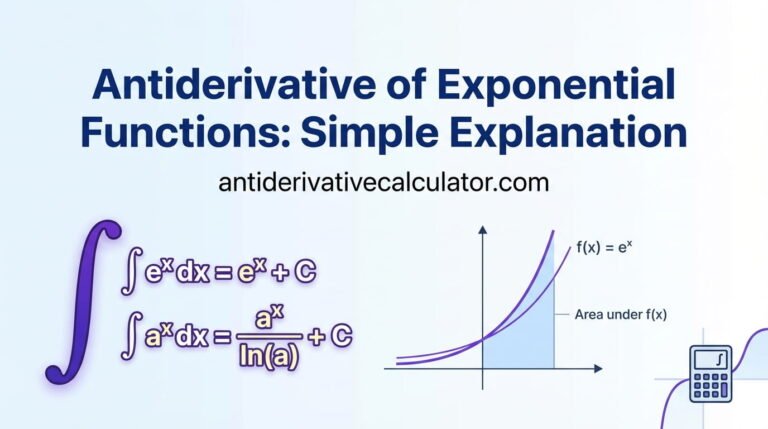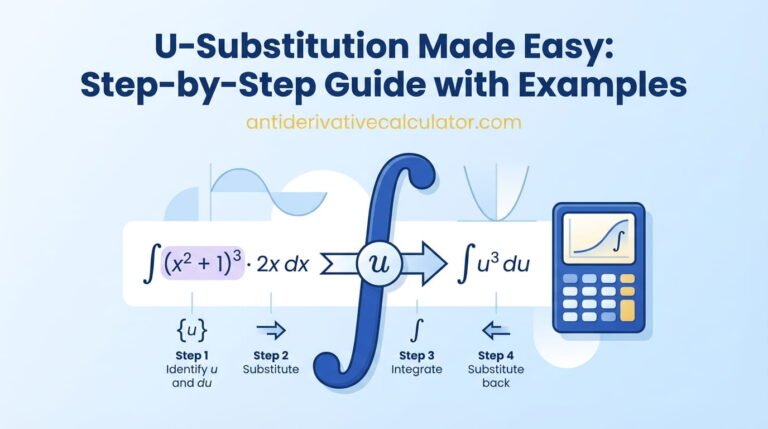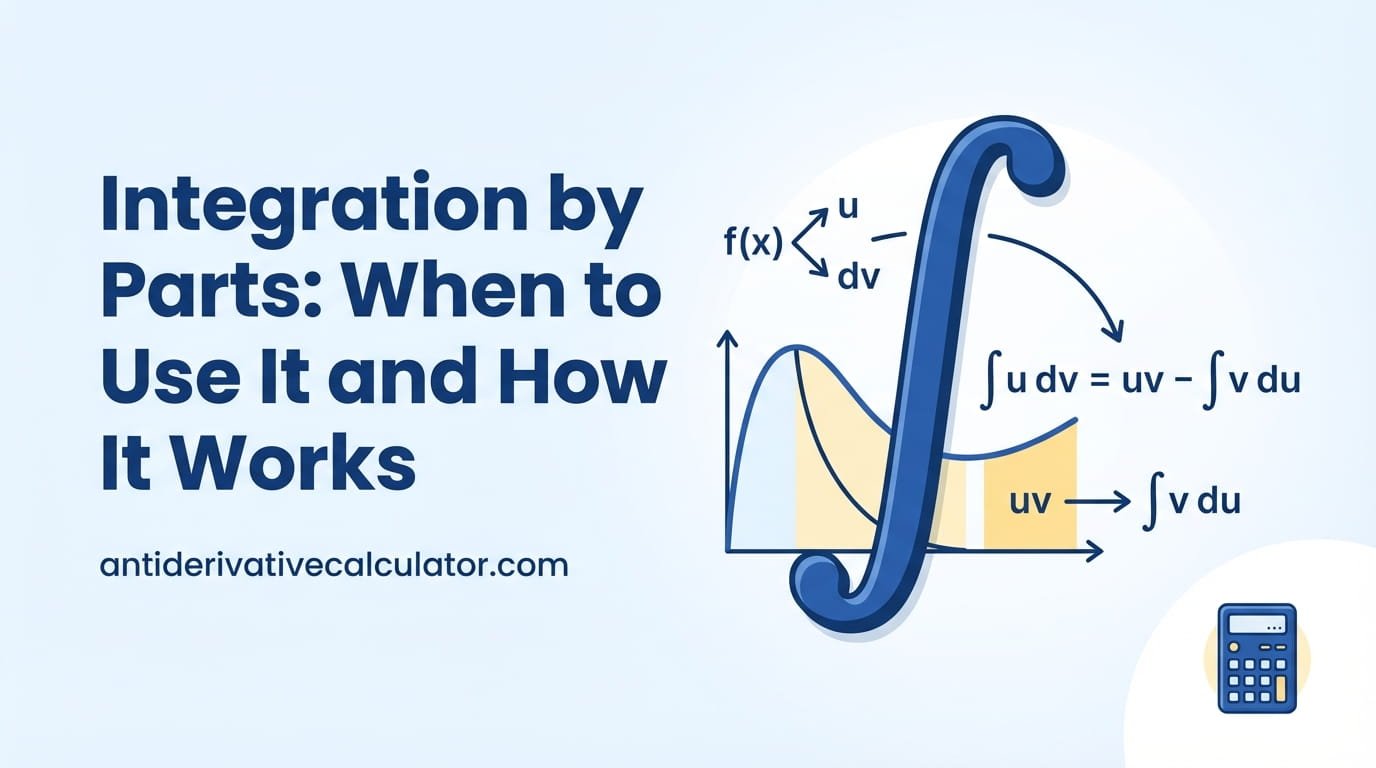
The integration by parts formula is \(\int u\,dv = uv – \int v\,du\). Pick \(u\) with the LIATE rule (Logs, Inverse trig, Algebra, Trig, Exponentials), find \(du\) and \(v\), then plug in. Example: \(\int x e^x\,dx = xe^x – e^x + C\).
Some integrals are a product of two very different functions, like \(x e^x\) or \(x\cos x\). The power rule cannot handle them, and u-substitution does not work either, because neither part is the derivative of the other. Integration by parts is the tool made for exactly this job.
This guide gives you the formula, a simple way to choose \(u\), eight worked examples from easy to tricky, the tabular shortcut, and a short practice set with answers.
The Integration by Parts Formula
For a definite integral, the same idea becomes:
\[\int_a^b u\,dv = \Big[uv\Big]_a^b – \int_a^b v\,du.\]
Where the formula comes from
It is the product rule run backward. Start with \(\frac{d}{dx}(uv) = u\,v’ + v\,u’\). Integrate both sides: \(uv = \int u\,dv + \int v\,du\). Move one integral to the other side and you have the formula. That is why integration by parts works best on products.
How to Choose u and dv: The LIATE Rule
The whole method depends on a good choice of \(u\). Choose the function that comes first in this list:
| Letter | Type | Examples |
|---|---|---|
| L | Logarithms | \(\ln x,\ \log_2 x\) |
| I | Inverse trig | \(\tan^{-1}x,\ \sin^{-1}x\) |
| A | Algebraic | \(x,\ x^2,\ 3x+1\) |
| T | Trig | \(\sin x,\ \cos 2x\) |
| E | Exponential | \(e^x,\ 2^x\) |
Why it works: you want \(u\) to get simpler when you differentiate it, and you want \(dv\) to be easy to integrate. Logs and inverse trig get much simpler when differentiated but are hard to integrate, so they go first. Exponentials stay the same either way, so they go last.
Integration by Parts in 4 Steps
- Split the integral into u and dv. Use LIATE. Everything that is not \(u\) (including \(dx\)) is \(dv\).
- Find du and v. Differentiate \(u\). Integrate \(dv\) (no \(+C\) needed here).
- Plug into the formula. Write \(uv – \int v\,du\).
- Finish the new integral and check. The new integral should be easier. Differentiate your answer to make sure you get the original function back.
8 Worked Examples, From Easy to Tricky
Example 1: \(\int x e^x\,dx\)
LIATE says algebra comes before exponentials, so \(u = x\) and \(dv = e^x\,dx\). Then \(du = dx\) and \(v = e^x\).
\[\int x e^x\,dx = xe^x – \int e^x\,dx = xe^x – e^x + C.\]
Example 2: \(\int x\cos x\,dx\)
\(u = x\), \(dv = \cos x\,dx\), so \(du = dx\) and \(v = \sin x\).
\[\int x\cos x\,dx = x\sin x – \int \sin x\,dx = x\sin x + \cos x + C.\]
Example 3: \(\int \ln x\,dx\) (the “hidden 1” trick)
There seems to be only one function here. Write it as \(\ln x \cdot 1\). Let \(u = \ln x\) and \(dv = dx\). Then \(du = \frac{1}{x}\,dx\) and \(v = x\).
\[\int \ln x\,dx = x\ln x – \int x\cdot\frac{1}{x}\,dx = x\ln x – x + C.\]
Read the full story in the antiderivative of ln x.
Example 4: \(\int x \ln x\,dx\)
Logs come first in LIATE, so \(u = \ln x\) and \(dv = x\,dx\). Then \(du = \frac{1}{x}\,dx\) and \(v = \frac{x^2}{2}\).
\[\int x\ln x\,dx = \frac{x^2}{2}\ln x – \int \frac{x}{2}\,dx = \frac{x^2}{2}\ln x – \frac{x^2}{4} + C.\]
Example 5: \(\int x^2 e^x\,dx\) (parts twice)
First round: \(u = x^2\), \(dv = e^x\,dx\), so \(\int x^2e^x\,dx = x^2e^x – \int 2x e^x\,dx\). The new integral is Example 1 times 2:
\[\int x^2 e^x\,dx = x^2e^x – 2(xe^x – e^x) + C = e^x\left(x^2 – 2x + 2\right) + C.\]
Example 6: \(\int \tan^{-1}x\,dx\)
Use the hidden 1 again: \(u = \tan^{-1}x\), \(dv = dx\), so \(du = \frac{1}{1+x^2}\,dx\) and \(v = x\).
\[\int \tan^{-1}x\,dx = x\tan^{-1}x – \int \frac{x}{1+x^2}\,dx = x\tan^{-1}x – \tfrac12\ln\left(1+x^2\right) + C.\]
The last integral used a quick u-substitution with \(w = 1 + x^2\).
Example 7: \(\int e^x \sin x\,dx\) (the loop)
Here parts never makes the integral disappear. Instead, it comes back. Call the integral \(I\).
Round 1, with \(u = \sin x\), \(dv = e^x\,dx\): \(I = e^x\sin x – \int e^x\cos x\,dx\).
Round 2, with \(u = \cos x\), \(dv = e^x\,dx\): \(\int e^x\cos x\,dx = e^x\cos x + I\).
So \(I = e^x\sin x – e^x\cos x – I\). Add \(I\) to both sides and divide by 2:
\[\int e^x\sin x\,dx = \tfrac12 e^x\left(\sin x – \cos x\right) + C.\]
Example 8: a definite integral, \(\int_0^1 x e^x\,dx\)
Use the answer from Example 1 and evaluate from 0 to 1:
\[\Big[xe^x – e^x\Big]_0^1 = (e – e) – (0 – 1) = 1.\]
The Tabular Method: A Shortcut for Repeated Parts
When \(u\) is a polynomial that becomes 0 after a few derivatives, the tabular method saves a lot of writing. Make two columns: derivatives of \(u\) on the left, integrals of \(dv\) on the right. Then multiply along the diagonals with alternating signs \(+, -, +, -, \dots\)
Example: \(\int x^3 e^x\,dx\)
| Sign | Derivatives of \(x^3\) | Integrals of \(e^x\) |
|---|---|---|
| \(+\) | \(x^3\) | \(e^x\) |
| \(-\) | \(3x^2\) | \(e^x\) |
| \(+\) | \(6x\) | \(e^x\) |
| \(-\) | \(6\) | \(e^x\) |
| \(0\) | \(e^x\) |
Multiplying each left entry by the right entry one row down gives
\[\int x^3e^x\,dx = x^3e^x – 3x^2e^x + 6xe^x – 6e^x + C = e^x\left(x^3 – 3x^2 + 6x – 6\right) + C.\]
When to Use Integration by Parts: 4 Signs
Integration by parts is the standard way to integrate two functions multiplied together, but not every product needs it. Use it when you see one of these signs:
- Two different kinds of functions are multiplied. A power of \(x\) times \(e^x\), \(\sin x\) or \(\cos x\), as in \(\int x\cos x\,dx\) or \(\int x^2e^x\,dx\).
- A lone log or inverse trig function. \(\int \ln x\,dx\) and \(\int \arctan x\,dx\) have no simple rule, but parts with \(dv = dx\) solves them. See the antiderivative of ln x.
- An exponential times a trig function. \(\int e^x\sin x\,dx\) needs parts twice; the original integral comes back, and you solve for it.
- Substitution fails. If no part of the integral is the derivative of another part, try parts next.
Parts or substitution? A 10-second test
| Ask yourself | If yes, use | Example |
|---|---|---|
| Is one factor the derivative of the inside of the other? | U-substitution | \(\int x e^{x^2}\,dx\) |
| Is it a product of two unrelated types (A, T, E, L, I)? | Integration by parts | \(\int x e^x\,dx\) |
| Is it a fraction of polynomials? | Partial fractions | \(\int \frac{1}{x^2-1}\,dx\) |
When You Should NOT Use Integration by Parts
- When one part is the derivative of the inside of the other. \(\int x e^{x^2}\,dx\) looks like a product, but \(u = x^2\) substitution solves it in one line: \(\tfrac12 e^{x^2} + C\).
- When algebra simplifies it first. \(\int x(x^2 + 1)\,dx = \int (x^3 + x)\,dx\) just needs the power rule.
- When the integral is a rational function. Try partial fractions instead.
Three Mistakes to Avoid
Choosing u backward. With \(u = e^x\) and \(dv = x\,dx\), Example 1 turns into \(\int \frac{x^2}{2}e^x\,dx\), which is harder than where you started. If the new integral gets worse, swap your choice.
- Dropping the minus sign in front of \(\int v\,du\), especially in the second round.
- Forgetting the boundary term \(\big[uv\big]_a^b\) in definite integrals.
Practice Problems
Try each one, then open the answer. You can check any of them in the integration by parts calculator.
1. \(\int x\sin x\,dx\)
\(-x\cos x + \sin x + C\)
2. \(\int x e^{2x}\,dx\)
\(\tfrac12 xe^{2x} – \tfrac14 e^{2x} + C\)
3. \(\int x^2\ln x\,dx\)
\(\tfrac{x^3}{3}\ln x – \tfrac{x^3}{9} + C\)
4. \(\int_1^e \ln x\,dx\)
\(\big[x\ln x – x\big]_1^e = (e – e) – (0 – 1) = 1\)
Calculators for This Topic
Practice what you just read. Each tool shows full steps and checks its own answer.
- ∂Integration by Parts Calculator – LIATE choice, u, dv, v and du shown clearly.
- ∫Integral Calculator – Solve indefinite and definite integrals step by step.
- ∫Antiderivative Calculator – Find any antiderivative with full steps and a check.
Frequently Asked Questions
What is the integration by parts formula?
It is \(\int u\,dv = uv – \int v\,du\). You split the integrand into a part \(u\) that you differentiate and a part \(dv\) that you integrate.
How do I know when to use integration by parts?
Use it when the integrand is a product of two different kinds of functions, such as a polynomial times an exponential or trig function, or when you see a lone \(\ln x\) or \(\tan^{-1}x\). If a substitution works, use that instead because it is faster.
What does LIATE stand for?
Logarithmic, Inverse trigonometric, Algebraic, Trigonometric, Exponential. Choose \(u\) from whichever type appears first in that list.
What is the tabular method?
It is a shortcut for integrals like \(\int x^n e^x\,dx\) or \(\int x^n\sin x\,dx\), where you would otherwise use parts several times. You list derivatives of \(u\) and integrals of \(dv\) in a table and multiply diagonally with alternating signs.
Do I add +C to v?
No. Any constant you add to \(v\) cancels out in the end, so you can leave it out and add a single \(+C\) to the final answer.