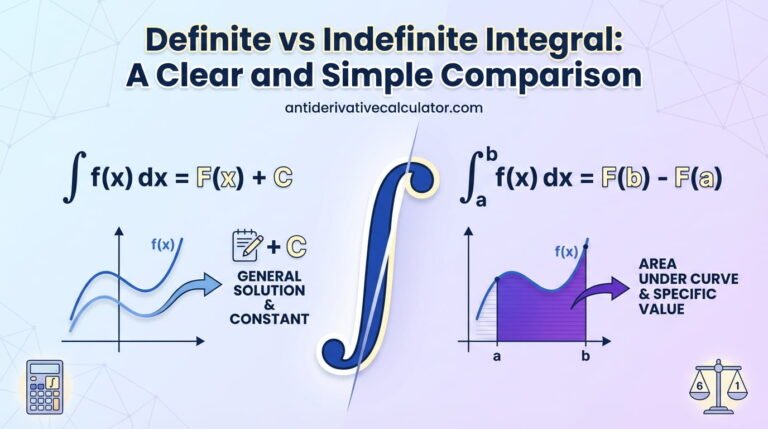
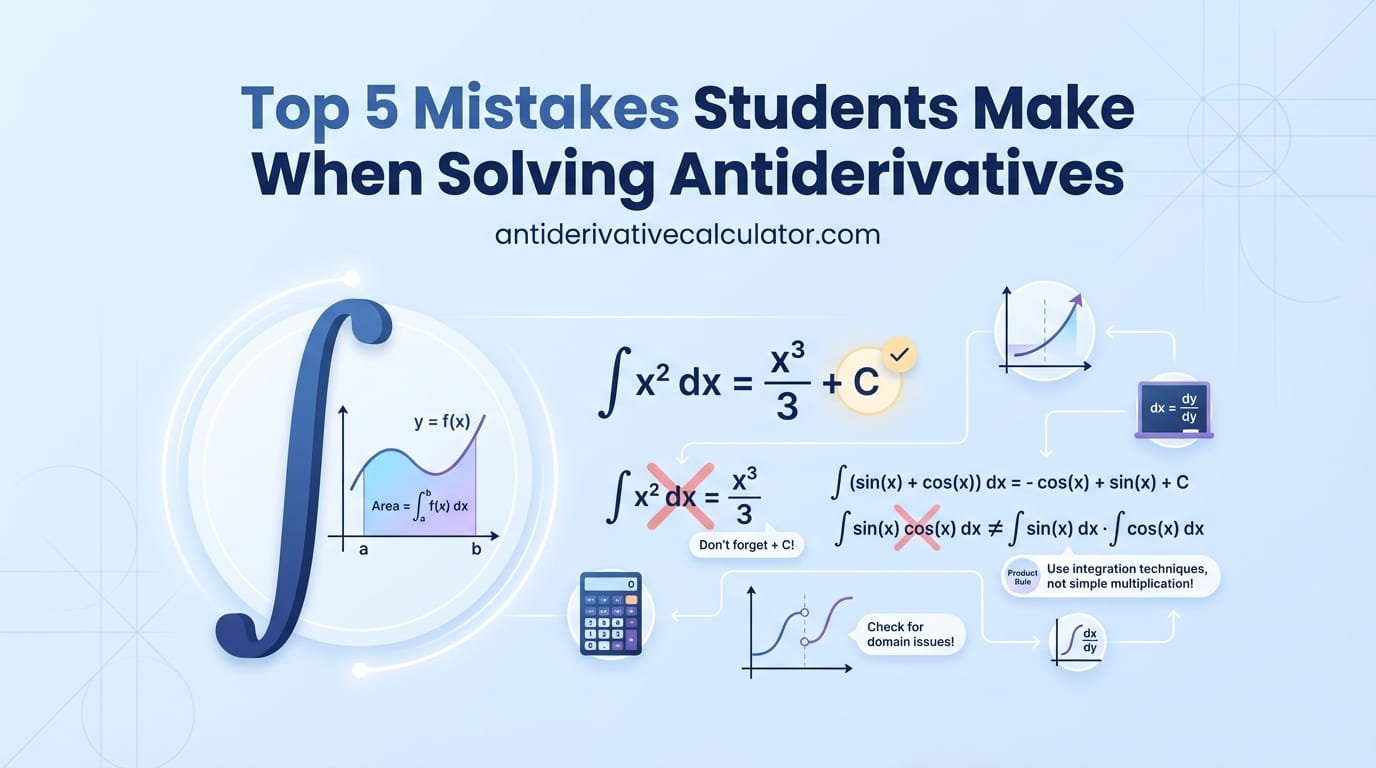
Top 5 Mistakes Students Make When Solving Antiderivatives
You have studied the rules. You have watched the examples. You understand the concept — at least when someone else is doing it. But when you sit down and work through an antiderivative problem yourself, something keeps going wrong. The answer does not match. The verification fails. The marks are not there.
The frustrating truth is that most integration errors are not caused by a lack of understanding. They are caused by a small set of specific, repeatable antiderivative mistakes that students make again and again — often without even realizing it. The same five errors account for the vast majority of lost marks in basic calculus.
In this guide, you will learn exactly what those five mistakes are, why each one happens, what the correct approach looks like, and how to build the habits that prevent them permanently. Once you can name a mistake and understand it clearly, it becomes very hard to keep making it.
Why the Same Mistakes Keep Happening
Before diving into the list, it is worth understanding why these particular errors are so persistent. Integration problems are multi-step processes with several places where things can go wrong. Under time pressure — during a homework session or an exam — students tend to rush, skip steps, and rely on habit rather than careful reasoning.
The mistakes below are not random. They happen at predictable points in predictable ways. Knowing exactly where the danger spots are is the first step toward navigating them successfully every time.
Mistake 1: Forgetting the Constant of Integration (+ C)
This is the single most common antiderivative mistake in all of basic calculus — and it is also the most preventable. Every indefinite integral must end with + C. Every single one. Without exception.
The + C is not a stylistic preference or a technicality your teacher is being fussy about. It has real mathematical meaning. When you differentiate any constant — whether it is 0, 5, or 1,000 — the result is zero. That constant disappears completely. So when you reverse the process through integration, there is no way to know what constant was originally present. Writing + C is your way of acknowledging that uncertainty and producing a mathematically complete answer.
An answer without + C is not just incomplete — it is technically wrong, because it implies the antiderivative is a single specific function when it is actually an entire family of functions differing by a constant.
Why It Keeps Happening
Students forget + C most often when they are rushing, when the problem has many steps and + C feels like an afterthought, or when they are focused on getting the main expression right and mentally check out before finishing. It also gets dropped frequently in the middle of multi-step problems like integration by parts — where + C is correctly saved for the very end but sometimes never arrives there.
The Fix
Make + C a non-negotiable final step in your process — not something you add if you remember, but something you write as automatically as you write the equals sign. A useful habit: after writing any antiderivative, physically say “+ C” out loud or tap your pen on the paper before moving on. That tiny deliberate action interrupts the rushing reflex and makes the habit stick.
∫ 4x³ dx
❌ Wrong: x⁴
✅ Correct: x⁴ + C
The expression x⁴ is only one member of the family of antiderivatives. x⁴ + C is the complete, correct general answer.
Mistake 2: Forgetting to Divide by the Inner Coefficient
This mistake appears constantly when students integrate functions with a constant multiplied inside the argument — like e^(3x), sin(4x), or (2x + 1)⁵. The student correctly identifies the outer function and applies the right rule, but forgets to divide by the inner constant. The result looks plausible but is mathematically wrong.
The reason division is required comes from the chain rule. When you differentiate a composite function like e^(3x), the chain rule brings down the inner constant 3 as a multiplier. To reverse that process through integration, you must divide by 3 — otherwise differentiating your answer would give 3e^(3x), not e^(3x).
This applies to every function with a constant inside: exponentials, trig functions, powers of linear expressions, and logarithms of linear expressions. The inner coefficient always requires a corresponding division in the antiderivative.
Why It Keeps Happening
Students apply the outer rule correctly and feel like they are done. The inner coefficient is easy to overlook — especially when the problem looks clean and the answer feels complete without the division. This mistake is also more common under time pressure, when the temptation to write a quick answer and move on overrides careful checking.
The Fix
Build a two-part mental checklist for any integral involving a composite function. Step one: apply the appropriate rule to the outer function. Step two: immediately ask, “Is there an inner coefficient? If yes, divide by it.” Make these two steps inseparable in your process — never do one without the other. Then verify by differentiating: if your answer differentiates back to the original function, the division was handled correctly.
∫ e^(5x) dx
❌ Wrong: e^(5x) + C
✅ Correct: (1/5)e^(5x) + C
Check: Differentiate (1/5)e^(5x) + C using the chain rule → (1/5) · e^(5x) · 5 = e^(5x). ✓
Check the wrong answer: Differentiate e^(5x) + C → 5e^(5x). That gives 5e^(5x), not e^(5x). ✗
Mistake 3: Applying the Power Rule to ln(x), eˣ, or Trig Functions
The power rule is so useful and so frequently used that some students begin applying it to everything — including functions where it simply does not apply. The most common cases are attempting to use the power rule on 1/x (which is x⁻¹), on eˣ, or on trig functions like sin(x) or cos(x).
Each of these functions has its own specific antiderivative rule that is completely different from the power rule. Applying the power rule to them produces either a mathematical impossibility or a completely wrong answer.
The clearest example is 1/x, which is x⁻¹. A student applying the power rule would add 1 to the exponent (giving x⁰ = 1) and divide by the new exponent (0) — producing 1/0, which is undefined. The correct answer is ln|x| + C. No amount of adjusting the power rule will produce that result. It simply is the wrong tool for this function.
Why It Keeps Happening
The power rule feels safe and familiar, so students default to it when uncertain. Functions like x⁻¹ look like power functions — the notation suggests the power rule should work — so students try it before checking whether the special case applies. For eˣ and trig functions, the error is slightly different: students sometimes try to treat e or the trig expression as a base to which a power-rule-style adjustment applies.
The Fix
Before applying any rule, identify the function type precisely. Ask yourself: is this a polynomial or power function? Is the variable in the base with a constant exponent — like x³ — or is the variable in the exponent — like eˣ? Is this 1/x specifically, which is the one case where the power rule fails? Building this habit of type identification before rule application eliminates this category of mistake almost entirely.
∫ (1/x) dx
❌ Wrong: x⁰/0 + C (undefined — division by zero)
✅ Correct: ln|x| + C
The power rule breaks down at n = −1. The natural log rule is the correct tool for 1/x.
Mistake 4: Dropping the Negative Sign in Trig Antiderivatives
Trigonometric antiderivatives carry a negative sign in two of the most commonly used rules — and that negative sign disappears from student answers with alarming regularity. The two rules most affected are:
- ∫ sin(x) dx = −cos(x) + C
- ∫ csc²(x) dx = −cot(x) + C
Writing cos(x) + C instead of −cos(x) + C is one of the most common single-point errors in all of introductory calculus. It is especially problematic because the answer looks entirely reasonable — cos(x) + C is a valid-looking expression that does not trigger an obvious alarm the way a nonsensical answer might.
The negative sign exists for a precise mathematical reason. The derivative of cos(x) is −sin(x) — not +sin(x). So reversing that process to find the antiderivative of sin(x) must produce −cos(x). The negative is not incidental — it is the direct consequence of how differentiation and integration relate to each other for these specific functions.
Why It Keeps Happening
Students often remember the connection between sin and cos without remembering which direction the negative goes. Under exam pressure, the brain defaults to the more familiar and symmetrical-looking answer — and cos(x) + C feels more natural than −cos(x) + C to someone who is not fully certain of the rule. The negative sign is also easy to drop when copying work from one line to the next during a multi-step problem.
The Fix
Connect the trig antiderivative rules back to their derivative origins. Do not just memorize that ∫ sin(x) dx = −cos(x) + C — understand why. The derivative of cos(x) is −sin(x). Therefore the antiderivative of sin(x) must be −cos(x). That causal chain is much harder to misremember than a disconnected formula. And always verify: differentiate your trig antiderivative answer immediately. A missing negative will show up instantly in the verification step.
∫ sin(x) dx
❌ Wrong: cos(x) + C
✅ Correct: −cos(x) + C
Check the wrong answer: Differentiate cos(x) + C → −sin(x). That gives −sin(x), not sin(x). ✗
Check the correct answer: Differentiate −cos(x) + C → −(−sin(x)) = sin(x). ✓
Mistake 5: Skipping the Verification Step
This is the mistake that allows all the other mistakes to survive. Every error described above — the missing + C, the forgotten inner coefficient division, the wrong rule choice, the dropped negative sign — would be caught immediately by a simple, reliable check that takes less than a minute: differentiating the answer.
The relationship between differentiation and integration is exact and complete. The derivative of a correct antiderivative always equals the original function — always, without exception. This means that differentiating your answer is not just a good idea. It is a mathematically guaranteed error-detection method. If the derivative of your answer matches the original function, your antiderivative is correct. If it does not, an error exists and you know to look for it.
Despite this, an enormous number of students skip this step entirely — either because they are rushing, because they feel confident in their answer, or because verifying feels like extra work rather than an essential part of the process.
Why It Keeps Happening
Verification is not taught with the same urgency as the integration rules themselves. It tends to be mentioned as an optional check rather than presented as a required final step. Students who are short on time in an exam or homework session treat it as dispensable — which is exactly backwards. The verification step is most valuable precisely when time pressure is highest, because that is when rushing-induced errors are most likely to occur.
The Fix
Make verification the mandatory last step of every integration problem — not optional, not skippable under any circumstances. Treat it the same way you treat writing + C: a required part of a complete answer. For extra reliability during study sessions, use the antiderivative calculator on this site as a secondary check after your own differentiation verification. When both methods confirm the same result, your answer is correct with complete confidence.
∫ cos(3x) dx
Student’s answer: sin(3x) + C (forgot to divide by inner coefficient)
No verification performed. Student moves on confident the answer is correct.
What verification would have caught: Differentiate sin(3x) + C → cos(3x) · 3 = 3cos(3x). That gives 3cos(3x), not cos(3x). ✗ Error immediately identified.
✅ Correct answer: (1/3)sin(3x) + C
Check: Differentiate (1/3)sin(3x) + C → (1/3) · cos(3x) · 3 = cos(3x). ✓
Summary: The Five Mistakes and Their Fixes at a Glance
- Mistake 1 — Missing + C: Always write + C as the final step of every indefinite integral. No exceptions.
- Mistake 2 — Forgetting to divide by inner coefficient: After applying the outer rule, always ask if there is an inner constant and divide by it. Verify with differentiation.
- Mistake 3 — Wrong rule for ln, eˣ, or trig: Identify the function type before choosing a rule. Never apply the power rule to 1/x, eˣ, or trig functions.
- Mistake 4 — Dropping the negative in trig antiderivatives: Connect each trig rule to its derivative origin. Always verify trig answers by differentiating immediately.
- Mistake 5 — Skipping verification: Differentiate every antiderivative answer before moving on. This step catches all other errors reliably and quickly.
Frequently Asked Questions
How do I stop making the same antiderivative mistakes repeatedly?
The most effective approach is to keep a personal mistake log. Every time the antiderivative calculator or your own verification catches an error, write down what the mistake was, which rule was involved, and what the correct approach should have been. Review that log before every study session and before every exam. Targeted awareness of your own specific error patterns is far more effective than general review — because it addresses the exact weak points in your process rather than everything at once.
Is it possible to get the right answer even if I make one of these mistakes?
Occasionally, but rarely — and you should never rely on it. Some errors cancel each other out in very specific circumstances, producing an accidentally correct answer. But an accidentally correct answer does not indicate correct understanding, and the same error will cost marks in a different problem where the cancellation does not occur. The only reliable path to consistent correct answers is a correct process — applied carefully, verified every time, with no steps skipped.
Can an antiderivative calculator help me avoid these mistakes?
Yes — used correctly, it is one of the most effective tools for eliminating antiderivative mistakes. After attempting every problem independently, enter the original function into the antiderivative calculator on this site and compare the result to your answer. If they match, your process was correct. If they differ, investigate the specific difference — a missing + C, a different coefficient, a sign discrepancy — and trace it back to the step in your working where the error occurred. That targeted investigation, repeated consistently, is what turns occasional mistakes into permanent corrections.
Conclusion
The top five antiderivative mistakes — missing + C, forgetting to divide by the inner coefficient, using the wrong rule for special functions, dropping negative signs in trig antiderivatives, and skipping verification — account for the overwhelming majority of integration errors made by beginner calculus students. Every single one of them is preventable with the right habits: write + C every time, check for inner coefficients every time, identify function types before choosing rules, connect trig rules to their derivative origins, and differentiate every answer before moving on. Use the antiderivative calculator on this site to catch anything you miss and turn every error into a learning opportunity. With these habits in place, your integration accuracy will improve faster than you might expect — and those lost marks will start coming back.
“`