
How to Study Calculus on Your Own: A Beginner’s Roadmap
Calculus has a reputation for being one of the hardest subjects a student can tackle. But here is something that surprises most beginners: calculus is not actually impossibly difficult — it is just poorly sequenced by most people who try to learn it. When you learn the right topics in the right order, with the right habits, calculus opens up in a way that feels genuinely rewarding rather than endlessly frustrating.
The good news is that you do not need a classroom, an expensive tutor, or a prestigious university to learn calculus well. Thousands of students successfully teach themselves calculus every year using freely available resources, structured practice, and a clear roadmap. What they all have in common is not exceptional intelligence — it is a sensible plan and consistent follow-through.
This guide gives you exactly that. You will learn how to study calculus on your own from the very beginning — what to learn first, what order to follow, which habits matter most, what tools to use, and how to know when you are genuinely ready to move forward. Whether your goal is to pass an exam, prepare for university, or simply understand one of the most powerful branches of mathematics ever developed, this roadmap will take you there step by step.
Step 1: Build Your Prerequisites First
The single most common reason students struggle with calculus is not a weakness in calculus itself — it is gaps in the mathematics that calculus is built on. Before touching any calculus topic, make sure you are genuinely comfortable with the following:
Algebra
Algebra is the language of calculus. You need to be fast and confident with expanding and factoring expressions, working with fractions and negative numbers, solving equations, and simplifying complex expressions. If algebraic manipulation feels slow or uncertain, calculus problems will grind to a halt constantly — not because of the calculus, but because of the algebra inside it.
Functions
Calculus is fundamentally the study of functions — how they change, what areas they enclose, what limits they approach. You need to understand what a function is, how to read and interpret function notation like f(x), and how to work with common function types including polynomials, rational functions, and exponentials.
Trigonometry
Trig functions — sin, cos, tan and their relatives — appear throughout calculus, especially in differentiation and integration. You need to know the basic trig ratios, the unit circle, and the key identities. Shaky trig knowledge creates confusion at almost every stage of calculus, so time spent here is always well invested.
Precalculus Concepts
Logarithms, exponential functions, and the basics of limits are the bridge between standard algebra and calculus. If your school offered a precalculus or mathematical methods course, that material is your foundation. If not, a few weeks spent on these topics online will pay off enormously once calculus begins in earnest.
Step 2: Learn the Concept of a Limit
Limits are the conceptual foundation that everything in calculus rests on. A limit asks: as x gets closer and closer to some value, what does the function approach? It is a deceptively simple idea that unlocks the entire subject.
You do not need to spend weeks on limits before moving on. The goal at this stage is to understand the concept clearly — what a limit means, how to evaluate simple limits, and what it means for a limit to exist or not exist. You will revisit and deepen your understanding of limits throughout your calculus journey.
Pay particular attention to the concept of a limit as x approaches infinity — this will come up in many integration contexts later and is worth understanding early.
Step 3: Master Differentiation Before Touching Integration
Derivatives come before integrals — not just in the typical curriculum, but for a deep mathematical reason. Integration is the reverse of differentiation. Every antiderivative rule is a derivative rule run backwards. If your derivative knowledge is shaky, your integration will be too — at every level, from the most basic power rule to advanced techniques like integration by parts.
Here is the order to follow for learning differentiation:
- The power rule — differentiating xⁿ. This is the foundation of everything else.
- The constant and constant multiple rules — handling coefficients and plain numbers.
- The sum and difference rules — differentiating expressions with multiple terms.
- The product rule — differentiating products of two functions.
- The quotient rule — differentiating fractions of functions.
- The chain rule — differentiating composite functions. This is the most important rule and the one that connects most directly to u-substitution in integration.
- Trig derivatives — derivatives of sin, cos, tan, and related functions.
- Exponential and logarithmic derivatives — including the critical fact that the derivative of eˣ is eˣ and the derivative of ln(x) is 1/x.
Do not rush through this list. Each rule should feel completely automatic before you move to the next. Test yourself by covering your notes and differentiating a variety of functions from memory. That automaticity is what allows your brain to focus on the new ideas in integration rather than struggling to recall derivative facts.
Step 4: Learn Integration in the Right Order
Once differentiation feels solid, you are ready to begin integration. The order matters here just as much as it did for derivatives. Here is the sequence that builds most logically:
Start with the Concept of an Antiderivative
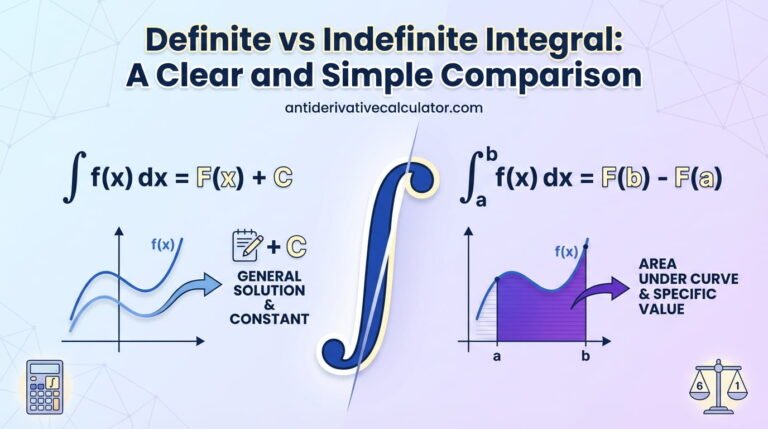
Understand what an antiderivative is before worrying about techniques. An antiderivative is the reverse of a derivative — a function whose derivative equals the original function. Make sure you also understand what the + C means and why it is always required. This conceptual foundation makes every rule that follows feel logical rather than arbitrary.
Learn the Basic Antiderivative Rules
In this order: the power rule for antiderivatives, the constant rule, the constant multiple rule, the sum and difference rule, the natural log rule (for 1/x), the exponential rule (for eˣ and e^(ax)), and the six core trig antiderivative rules. Learn each one with its reason — understand where it comes from — not just its formula.
Practice These Rules Extensively Before Moving On
This is where many self-learners rush — and where the foundation cracks. Spend real time here. Work through dozens of problems applying just these basic rules until the process feels fast and automatic. Use an antiderivative calculator to check every answer and verify by differentiating your results. Do not move to u-substitution until the basic rules are genuinely solid.
Learn U-Substitution
U-substitution is the integration version of the chain rule. It handles composite functions — situations where one function is nested inside another — by temporarily replacing the inner expression with the variable u. Learn the full step-by-step process, practice identifying when to use it, and work through a wide variety of examples until the technique feels reliable.
Learn Integration by Parts
Integration by parts handles products of two different types of functions — things like x · eˣ or x · cos(x). It comes from the product rule in differentiation and uses the formula ∫ u · dv = u · v − ∫ v · du. Learn the LIATE rule for choosing u and dv, and practice the method on many different examples.
Understand Definite Integrals
Once you can find antiderivatives confidently, definite integrals are a natural next step. A definite integral evaluates the antiderivative between two specific limits — producing a number rather than a function. Learn the Fundamental Theorem of Calculus and practice evaluating definite integrals using the F(b) − F(a) method.
Step 5: Build the Right Study Habits
Knowing what to study is only half the equation. How you study matters just as much — and in calculus, a few specific habits make an enormous difference in how quickly you improve.
Always Attempt Problems Before Reading Solutions
This is the single most important study habit in all of mathematics. Reading a solution without attempting the problem first gives you the illusion of understanding without building actual skill. Your brain needs to struggle with a problem — even unsuccessfully — before a solution becomes genuinely informative. Always try first. Always.
Write Every Step
In calculus, especially integration, every step matters. Skipping steps does not save time — it hides errors. Students who write everything out clearly make fewer mistakes and find errors faster when they do occur. Make full written working non-negotiable on every problem, regardless of how simple it seems.
Verify Every Answer by Differentiating
After finding any antiderivative, differentiate your answer and confirm it gives back the original function. This takes thirty seconds and catches every error with complete reliability. It also reinforces your derivative skills at the same time — giving you double practice in a single step.
Use Spaced Repetition
Return to earlier material regularly, not just when you are first learning it. Revisiting power rule problems after learning u-substitution keeps the foundational rules sharp and helps you see how they connect to the more advanced techniques. Spaced repetition is one of the most research-supported study methods for building long-term mathematical memory.
Study in Focused Sessions
One hour of focused, distraction-free calculus practice is worth more than three hours of half-distracted studying. Close other tabs, put your phone away, and commit fully to each session. Calculus demands genuine concentration — it rewards it too.
Step 6: Use the Right Resources
Self-studying calculus is far easier today than it has ever been before. The resources available online are genuinely excellent — but the sheer volume of them can be overwhelming. Here is a focused selection of resource types that work best:
A Good Textbook
A structured calculus textbook provides the organized, progressive framework that self-study needs. It does not need to be expensive — several excellent calculus textbooks are freely available as PDFs online. Look for one that includes worked examples, exercise sets with answers, and clear explanations of both concepts and procedures.
Video Explanations
Video content is especially useful for calculus because watching someone work through a problem in real time — explaining each step as they go — can clarify ideas that a static textbook explanation leaves murky. Use videos to supplement your textbook, particularly when a concept is not clicking from the written explanation alone.
An Antiderivative Calculator
An antiderivative calculator is one of the most practical tools available for self-studying calculus. Use it after attempting every integration problem to check your answer instantly, investigate discrepancies, and confirm your understanding. The immediate feedback it provides dramatically shortens the learning cycle and helps you identify weak spots before they become ingrained habits.
Practice Problem Sets
Problems, problems, and more problems. The resource that will improve your calculus ability most directly is not another explanation — it is more practice with feedback. Find problem sets that cover a wide range of difficulty levels and function types, and work through them consistently with the full verification habit described above.
Step 7: Know When to Move Forward — and When to Stay
One of the trickiest aspects of self-directed learning is knowing when you have genuinely mastered a topic versus when you just feel comfortable with it after seeing familiar examples. These are very different states of readiness.
Here is a reliable test: take five problems of the type you have been studying — problems you have never seen before — and solve them without notes, without hints, and without the calculator. Check your answers only after finishing all five.
If you get four or five correct, with full working, + C in every answer, and every answer verified: you are genuinely ready to move on.
If you get two or three correct, or had to guess at which method to use, or made consistent errors of the same type: stay with this topic for another week of varied practice before moving forward.
Being honest with yourself at this stage is what separates students who build lasting calculus ability from those who accumulate surface understanding that falls apart under exam pressure.
Common Mistakes Self-Learners Make — and How to Avoid Them
- Moving too fast: Rushing from one topic to the next without consolidating understanding is the most common self-study mistake in calculus. Slow down at each stage and make sure the foundation is genuinely solid before building on it.
- Passive learning: Watching videos and reading examples without attempting problems independently gives a false sense of progress. Active problem-solving is where real learning happens.
- Ignoring prerequisites: Skipping the algebra and trig review because it feels like going backwards is a false economy. Every hour spent on prerequisites returns multiple hours of smoother calculus progress.
- Not checking answers: Practicing problems without verifying answers means potentially reinforcing wrong methods. Always check — by hand differentiation or with a calculator — every single time.
- Studying only familiar problem types: Drilling the same type of problem repeatedly builds narrow competence. Make sure your practice includes a wide variety of function types and technique combinations.
Frequently Asked Questions
How long does it take to learn calculus on your own?
For a complete beginner starting from solid algebra and trig foundations, a focused self-study program covering differentiation, basic integration, u-substitution, integration by parts, and definite integrals typically takes three to six months with consistent daily practice. The pace depends entirely on how much time you invest each day and how thoroughly you consolidate each topic before moving on. Rushing produces surface understanding that collapses under pressure. Steady, verified progress produces durable skill.
Do I need a teacher to learn calculus, or can I really do it alone?
You can genuinely learn calculus independently — thousands of students do it every year. What you need is not a teacher but a structure: a clear learning sequence, consistent practice, accurate feedback on your answers, and honest self-assessment at each stage. A good textbook provides the structure, problem sets provide the practice, and tools like an antiderivative calculator provide the feedback. The self-assessment is yours to do — and if you do it honestly, self-study can be just as effective as classroom learning for most students.
What is the most important habit for learning calculus on your own?
Attempting every problem independently before checking any answer — and then verifying every answer after completing it. This two-part habit — attempt first, verify after — is the engine of genuine mathematical progress. The attempt forces active engagement with the material. The verification ensures that any errors are caught and understood rather than repeated. Combined with consistent daily practice and honest self-assessment, this habit will take you further in calculus than any other single change you can make to your study approach.
Conclusion
Learning how to study calculus on your own is absolutely achievable — but it requires a plan, the right sequence, and the right habits. Start with solid prerequisites, master differentiation before touching integration, learn integration rules in the correct order, verify every answer, and practice widely across different problem types. Use the antiderivative calculator on this site as your personal feedback tool throughout the journey — checking your integration answers, identifying mistakes early, and building the kind of genuine confidence that holds up when it matters most. The roadmap is here. The tools are available. All that remains is consistent, honest effort — and calculus will open up for you one step at a time.
“`