Definite vs Indefinite Integral: A Clear and Simple Comparison
If you have spent any time studying calculus, you have almost certainly come across two terms that sound very similar but mean very different things: definite integral and indefinite integral. They are both types of integration, they both involve antiderivatives, and they can look confusingly alike when written in mathematical notation. But what they produce — and what they mean — could not be more different.
Understanding the distinction between definite vs indefinite integral is one of the most important conceptual steps in all of introductory calculus. Get this clear in your head, and a huge range of integration problems suddenly start making a lot more sense.
In this guide, you will get a complete, side-by-side comparison of both types of integral — what each one is, what each one produces, how each one is written, when each one is used, and how they connect to antiderivatives. Worked examples are included for both so nothing stays abstract.
What Is an Indefinite Integral?
An indefinite integral is simply another name for an antiderivative. When you find the indefinite integral of a function, you are asking: “What function, when differentiated, gives me back this one?”
The result of an indefinite integral is always a function — specifically, a general function that includes the constant of integration, + C. It is not a number. It is not a specific value. It is an entire family of functions that all share the same derivative.
Here is what an indefinite integral looks like in notation:
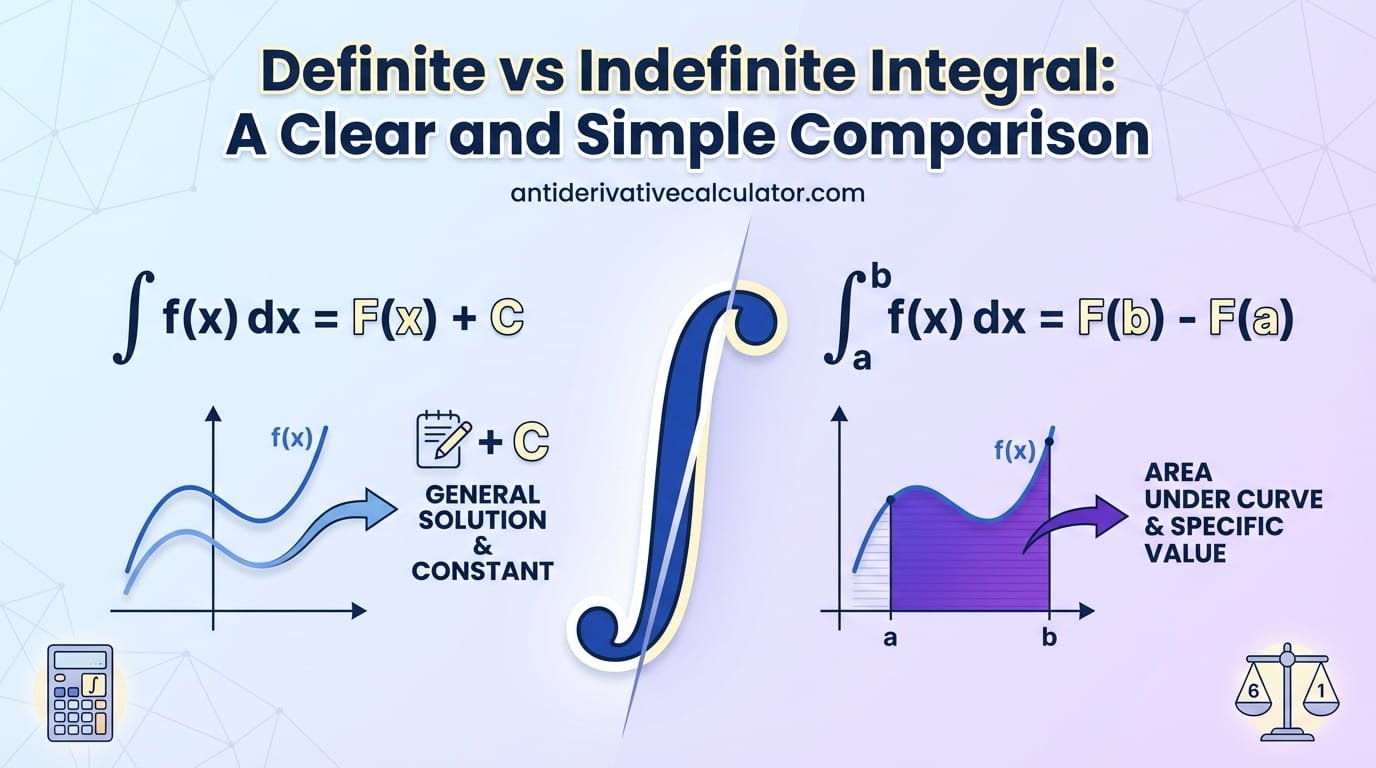
∫ f(x) dx = F(x) + C
Where F(x) is the antiderivative of f(x) and C is the constant of integration.
The key features of an indefinite integral are:
- No limits of integration — there are no numbers written above or below the ∫ symbol.
- The result is a function — specifically F(x) + C, not a number.
- + C is always required — it represents the unknown constant that disappears during differentiation.
- It represents a family of curves — all the possible antiderivatives of f(x), shifted vertically by different values of C.
Finding an indefinite integral is the core skill built by learning all the antiderivative rules — the power rule, trig rules, exponential rules, u-substitution, and integration by parts. Every time you apply those rules and write + C at the end, you are computing an indefinite integral.
What Is a Definite Integral?
A definite integral takes the process one step further. Instead of finding a general family of functions, it calculates a specific number — typically representing the area under a curve between two specific points on the x-axis.
Those two specific points are called the limits of integration — a lower limit and an upper limit — and they appear as numbers written below and above the ∫ symbol.
∫ₐᵇ f(x) dx = F(b) − F(a)
Where a is the lower limit, b is the upper limit, and F(x) is the antiderivative of f(x).
The key features of a definite integral are:
- Limits of integration are present — a number at the bottom (lower limit) and a number at the top (upper limit) of the ∫ symbol.
- The result is a number — a specific, exact value, not a function.
- No + C in the final answer — because the C values cancel out when you evaluate F(b) − F(a).
- It represents a measurable quantity — most commonly the area between the curve and the x-axis between x = a and x = b.
Why Does + C Disappear in a Definite Integral?
One of the most common points of confusion for beginners is why the + C that is so important in indefinite integrals simply vanishes when evaluating a definite integral. The explanation is clean and satisfying.
When you evaluate a definite integral using F(b) − F(a), you are substituting both limits into the antiderivative and subtracting. If your antiderivative is F(x) + C, then:
F(b) + C − (F(a) + C) = F(b) + C − F(a) − C = F(b) − F(a)
The two C values are identical, so they cancel each other out perfectly. The result is always F(b) − F(a) — a specific number — regardless of what value C might have taken. This is why definite integrals produce exact numerical answers rather than families of functions.
Definite vs Indefinite Integral: Side-by-Side Comparison
Here is a clear, direct comparison of both types of integral across the features that matter most to a beginner:
- Limits of integration: Indefinite integrals have none. Definite integrals have a lower limit (a) and upper limit (b) written on the ∫ symbol.
- Result type: An indefinite integral produces a function — F(x) + C. A definite integral produces a specific number — F(b) − F(a).
- Constant of integration: Always required in an indefinite integral answer. Cancels out and disappears in a definite integral calculation.
- What it represents: An indefinite integral represents a family of antiderivatives — all curves that share the same derivative. A definite integral represents a measurable quantity, most commonly the area under a curve between two x-values.
- Notation difference: ∫ f(x) dx for indefinite. ∫ₐᵇ f(x) dx for definite.
- How it is evaluated: Indefinite — apply integration rules and write + C. Definite — find the antiderivative, substitute both limits, then subtract: F(b) − F(a).
How to Evaluate a Definite Integral: Step by Step
Evaluating a definite integral follows a clear, repeatable process. Here are the steps every time:
- Find the antiderivative of the function using the appropriate rule. Do not write + C at this stage — you will not need it.
- Write the antiderivative in bracket notation: [F(x)]ₐᵇ — this signals that you are about to evaluate between the two limits.
- Substitute the upper limit (b) into F(x) to get F(b).
- Substitute the lower limit (a) into F(x) to get F(a).
- Subtract: F(b) − F(a). The result is your final answer — a specific number.
This process is called the Fundamental Theorem of Calculus in action. It is the bridge that connects the concept of an antiderivative to the concept of a measurable area — one of the most profound ideas in all of mathematics.
Worked Examples: Indefinite and Definite Integral Side by Side
Problem: ∫ 2x dx
Step 1: Apply the power rule to 2x.
Add 1 to the exponent: 1 + 1 = 2. So x becomes x².
Multiply by coefficient: 2 × (x²/2) = x².
Step 2: Add + C.
✅ Answer: x² + C
This is a function — an entire family of parabolas, each shifted vertically by a different value of C.
Check: Differentiate x² + C → 2x. ✓
Problem: ∫₁³ 2x dx
Step 1: Find the antiderivative of 2x: F(x) = x².
(No + C needed — it will cancel.)
Step 2: Write in bracket notation: [x²]₁³
Step 3: Substitute the upper limit: F(3) = 3² = 9.
Step 4: Substitute the lower limit: F(1) = 1² = 1.
Step 5: Subtract: F(3) − F(1) = 9 − 1 = 8.
✅ Answer: 8
This is a specific number — representing the area under the curve y = 2x between x = 1 and x = 3.
Problem: ∫ cos(x) dx
Step 1: Apply the trig antiderivative rule: ∫ cos(x) dx = sin(x).
Step 2: Add + C.
✅ Answer: sin(x) + C
Check: Differentiate sin(x) + C → cos(x). ✓
Problem: ∫₀^(π/2) cos(x) dx
Step 1: Find the antiderivative: F(x) = sin(x).
Step 2: Write in bracket notation: [sin(x)]₀^(π/2)
Step 3: Substitute upper limit: F(π/2) = sin(π/2) = 1.
Step 4: Substitute lower limit: F(0) = sin(0) = 0.
Step 5: Subtract: 1 − 0 = 1.
✅ Answer: 1
The area under the cosine curve between x = 0 and x = π/2 is exactly 1.
Real-World Meaning of Each Type of Integral
One of the best ways to cement the difference between these two types of integral is to think about what each one means in real-world terms.
Indefinite Integral in Real Life
Imagine you know the velocity of a moving object at every point in time — described by a function v(t). The indefinite integral of v(t) gives you the general position function s(t) + C. The + C represents the unknown starting position — you know how the object is moving, but not where it started. Without additional information (an initial condition), you can only describe the general family of possible positions.
Definite Integral in Real Life
Now suppose you know the velocity function v(t) and you also know the object’s starting and ending times. The definite integral of v(t) between those two times gives you a specific number — the total distance traveled during that interval. The starting and ending times are your limits of integration, and the result is an exact, measurable quantity with no ambiguity.
This is the real-world difference in a nutshell: the indefinite integral gives you a general relationship. The definite integral gives you a specific measurement.
Common Mistakes When Working with Both Types
Knowing the conceptual difference is important — but applying it correctly under exam conditions requires avoiding a few very common errors:
- Writing + C in a definite integral answer: The + C cancels out during the F(b) − F(a) subtraction, so it should never appear in the final answer of a definite integral. Including it suggests a misunderstanding of what type of integral you are computing.
- Forgetting + C in an indefinite integral answer: The reverse error — leaving + C out of an indefinite integral result. Without it, the answer is incomplete and technically incorrect.
- Subtracting the limits in the wrong order: A definite integral is always F(b) − F(a) — upper limit minus lower limit. Reversing this gives the wrong sign on the answer.
- Forgetting to substitute both limits: Some students substitute only the upper limit and forget to evaluate and subtract F(a). Both substitutions are required for a correct result.
- Confusing the two types when reading a problem: Always check the notation before starting. If there are numbers on the ∫ symbol, it is a definite integral and you need to evaluate between limits. If there are no numbers, it is indefinite and you need + C.
Frequently Asked Questions
Is a definite integral the same as an antiderivative?
Not exactly. An antiderivative — also called an indefinite integral — is a function. A definite integral uses the antiderivative as a tool but produces a number, not a function. The definite integral evaluates the antiderivative at two specific limits and subtracts — F(b) − F(a) — to produce a single numerical value. So every definite integral calculation involves finding an antiderivative first, but the two concepts are not the same thing.
Why do I need to learn indefinite integrals if definite integrals give real answers?
Because you cannot compute a definite integral without first finding the antiderivative — which is exactly what an indefinite integral gives you. The indefinite integral is the essential first step inside every definite integral calculation. Understanding the indefinite integral deeply — including why + C exists and what it means — makes definite integrals much easier to work with and much harder to make errors in. One concept builds directly on top of the other.
Can I use an antiderivative calculator for both definite and indefinite integrals?
Yes — and it is a valuable tool for both. For indefinite integrals, enter the function and the calculator returns the antiderivative with + C. For definite integrals, many calculators also allow you to specify the limits of integration and will return the exact numerical result. Use the antiderivative calculator on this site to verify your integration work, catch errors before they cost you marks, and build confidence in both types of integral as your calculus skills develop.
Conclusion
The difference between definite vs indefinite integral comes down to one core distinction: an indefinite integral produces a function (with + C), while a definite integral produces a number (by evaluating that function between two specific limits and subtracting). Both types rely on the same antiderivative rules, and both are essential tools in calculus — the indefinite integral builds the general solution, and the definite integral turns that solution into a specific, measurable result. Master both clearly, keep the notation straight, and never mix up when + C belongs and when it does not. Ready to practice? Use the antiderivative calculator on this site to explore both types of integral and sharpen your integration skills one problem at a time!
“`