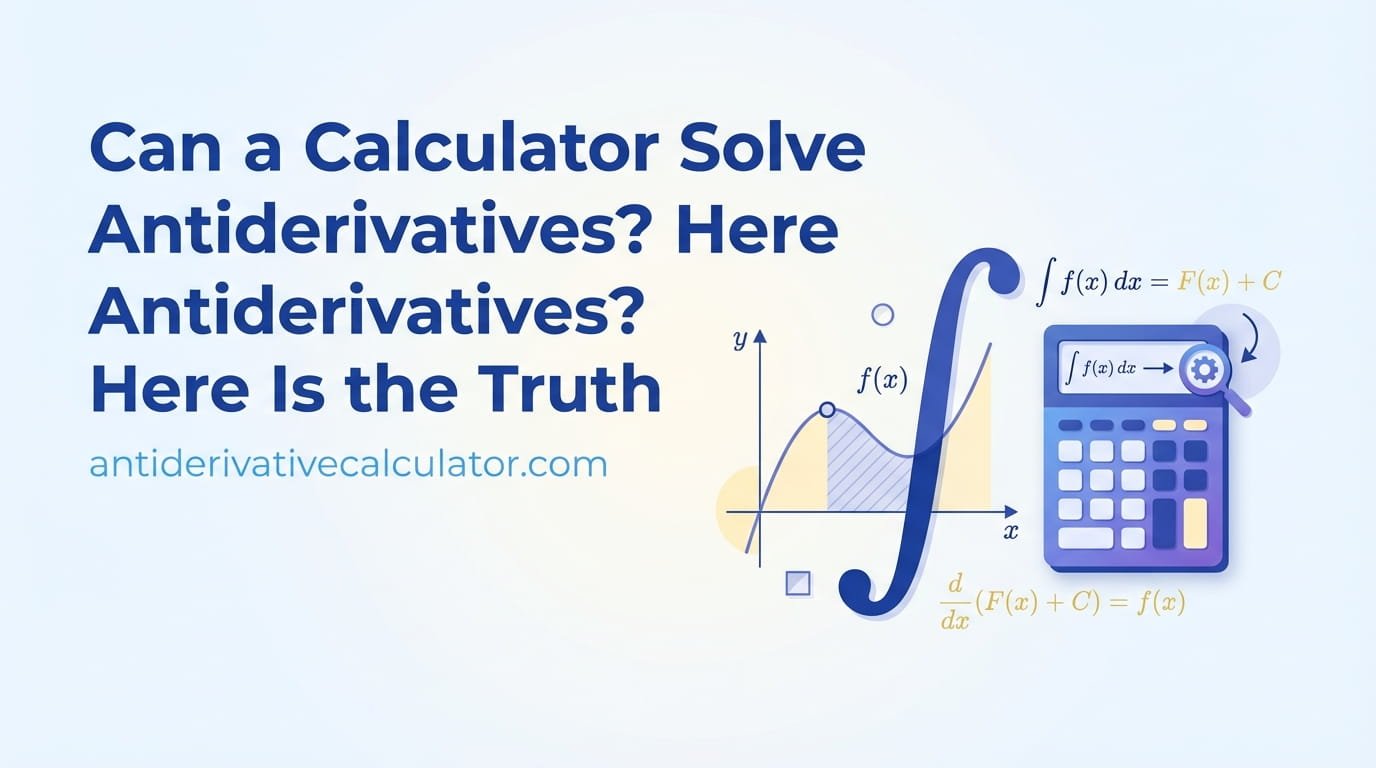
Can a Calculator Solve Antiderivatives? Here Is the Truth

It is one of the most common questions students ask when they first discover online math tools: “Can a calculator actually solve antiderivatives?” The short answer is yes — but the full answer is a lot more interesting and useful than that single word suggests.

Understanding what an antiderivative calculator can do, how it does it, and where its limits are will help you use it more effectively and make smarter decisions about when to rely on it and when to work through a problem yourself. There is a truth about these tools that most students never stop to think about — and once you understand it, everything clicks.

In this post, you will get a clear, honest look at exactly how calculators handle antiderivatives, what they are genuinely good at, what they cannot do no matter how advanced they are, and how you can use that knowledge to become a better calculus student.

So — Can a Calculator Solve Antiderivatives?

Yes. A well-designed antiderivative calculator can solve a very wide range of integration problems accurately and instantly. It can handle polynomials, exponential functions, trigonometric functions, logarithms, and many combinations of these — including problems that require advanced techniques like u-substitution or integration by parts.

For the types of functions a beginner or intermediate calculus student typically encounters, a reliable antiderivative calculator will produce the correct result the vast majority of the time. That is genuinely useful — and it is why so many students and educators treat these tools as legitimate aids for learning and checking work.

But here is the part that matters just as much: the calculator gives you an answer. It does not give you understanding. And in calculus, those two things are very different.

💡 The Core Truth: An antiderivative calculator is a tool for computing results — not a tool for building understanding. The computation is the easy part. The understanding is the part that earns you marks on exams, helps you solve new problems, and makes calculus genuinely useful in the real world. Only you can develop that — the calculator cannot do it for you.

How Does a Calculator Solve Antiderivatives?

Most students never think about this — they just type in a function and get an answer. But understanding the basics of how the tool works helps you trust it appropriately and spot situations where it might not give you exactly what you need.

Modern antiderivative calculators use a combination of approaches to find results:

Pattern Matching Against Known Rules

The simplest and most common method is pattern matching. The calculator recognizes that the input matches a known form — like xⁿ, eˣ, sin(x), or aˣ — and applies the corresponding antiderivative rule directly. This is exactly what you do when you apply the power rule or a trig antiderivative rule by hand. The calculator just does it faster.

Algorithmic Techniques

For more complex functions, calculators use systematic algorithms — step-by-step mathematical procedures — that attempt different integration techniques in sequence. These include methods equivalent to substitution, integration by parts, partial fractions, and trigonometric identities. The algorithm tries each approach until one produces a clean result.

Symbolic Computation

Advanced calculators use symbolic computation engines — software systems that manipulate mathematical expressions algebraically rather than numerically. These systems can handle surprisingly complex integrals and produce exact answers in terms of familiar functions. This is different from numerical approximation, which estimates a value rather than finding an exact expression.

Understanding that calculators use real mathematical techniques — not magic — also means understanding that they have real limitations, just like any technique does.

What an Antiderivative Calculator Does Very Well

Let us be specific about where these tools genuinely shine. For the following types of problems, a good antiderivative calculator is fast, accurate, and genuinely useful:

  • Standard polynomial functions — expressions like 4x³ + 7x² − 3x + 9. The power rule applies cleanly and the calculator handles these instantly.
  • Basic exponential functions — like eˣ, e^(3x), or 5ˣ. These follow clean rules and produce reliable results every time.
  • Standard trigonometric functions — sin(x), cos(x), sec²(x), and their straightforward combinations.
  • Functions requiring u-substitution — as long as the substitution is clean and the derivative of the inner function is present in the integrand.
  • Functions requiring integration by parts — standard products like x · eˣ or x · cos(x) that follow the LIATE rule predictably.
  • Sums and differences of the above — combined expressions that can be split and integrated term by term.

For all of these, the calculator is a reliable, time-saving tool that produces results you can trust — provided you have entered the function correctly.

What an Antiderivative Calculator Cannot Do

This is the part most students never think about — and it is genuinely important. No matter how advanced an antiderivative calculator is, there are things it simply cannot do:

It Cannot Explain the Process

The calculator gives you an answer — a finished expression. It does not show you which rule was applied, why that rule was the right choice, or how each step of the process unfolded. If your goal is to understand integration, the calculator output alone does not teach you that. You have to do the thinking yourself and use the answer as a reference point, not a lesson.

It Cannot Solve Every Integral

This surprises many students, but it is mathematically true: not every function has an antiderivative that can be expressed using standard mathematical functions. Some integrals simply cannot be solved in closed form — meaning there is no neat expression involving polynomials, exponentials, trig functions, or logarithms that gives the exact answer. A famous example is ∫ e^(−x²) dx, which cannot be expressed in terms of elementary functions at all. Even the most powerful calculator in the world will not produce a clean answer for these — because no clean answer exists.

It Cannot Set Up the Problem for You

In applied calculus — physics, engineering, economics — the hardest part is often not the integration itself. It is recognizing that integration is needed, setting up the correct integral, and interpreting the result in context. A calculator can evaluate the integral once it is set up, but it cannot read a word problem, identify what needs to be integrated, or tell you what the answer means in the real world. That reasoning is entirely yours to do.

It Cannot Replace Exam Performance

Most calculus exams are taken without a calculator — or with only limited calculator access. If you have used a calculator as a substitute for practice rather than a supplement to it, you will find yourself unable to reproduce the steps under exam conditions. The calculator cannot sit the exam for you. Only your own understanding can do that.

It Cannot Catch Input Errors

If you type the wrong function into the calculator — a missing parenthesis, a wrong exponent, a misplaced sign — the calculator will solve the wrong problem perfectly. It has no way of knowing what you intended. The result will be accurate for what you typed, not necessarily for what you meant. This is why checking your input carefully before hitting calculate is always important.

The Difference Between a Numerical Approximation and an Exact Answer

One nuance worth understanding clearly is the difference between two types of calculator output:

Exact Symbolic Answers

This is what a proper antiderivative calculator produces for indefinite integrals — a clean mathematical expression like x⁴/4 + sin(x) + C. This is the true antiderivative, expressed in terms of standard functions. It is exact, not approximate.

Numerical Approximations

Some calculators — particularly basic graphing calculators — can only compute numerical approximations of definite integrals between two specific limits. They return a number like 4.712… rather than an exact expression. This is useful for certain applications but is not the same as finding the antiderivative. If your goal is to find the antiderivative of a function and practice your calculus skills, you want a symbolic result — not a numerical estimate.

Understanding this difference helps you choose the right tool for the right task and interpret results correctly when they appear.

When Should You Use a Calculator — and When Should You Not?

Here is a practical framework for making that decision every time you sit down to study:

Use the Calculator When:

  • You have already attempted the problem by hand and want to check your answer.
  • You are working on a complex problem where integration is one small step in a larger solution and you do not want to lose time on calculation.
  • You are studying a new rule and want to see multiple correct examples quickly to identify the pattern.
  • You are doing pre-exam review and want to rapidly identify which types of problems still give you trouble.

Do Not Use the Calculator When:

  • You have not attempted the problem yourself yet. Always try first.
  • You are in an exam or timed assessment where calculators are not permitted.
  • You are trying to memorize a rule — seeing the answer does not help that process. Repetitive hand practice does.
  • The problem is straightforward enough that working through it yourself takes only a minute or two. That practice is valuable and worth doing.

Worked Example: What the Calculator Gives You — and What It Does Not

Example — Find the antiderivative of x · sin(x)

What the calculator gives you:
You enter: x * sin(x), variable = x.
The calculator returns: −x · cos(x) + sin(x) + C

What the calculator does NOT give you:

  • It does not tell you that this required integration by parts.
  • It does not explain that u = x and dv = sin(x) dx were the correct choices.
  • It does not show the intermediate steps: finding du = dx and v = −cos(x).
  • It does not explain why the formula ∫ u · dv = u · v − ∫ v · du was applied.
  • It does not verify the result by differentiating — that step is yours to do.

What a smart student does with this output:
They compare it to their own attempt, identify whether they chose u and dv correctly, retrace any steps that differ, differentiate the result by hand to verify it, and note the technique used so they recognize it faster next time.

The calculator gave a correct answer. The student turned it into a learning experience.

Frequently Asked Questions

Are all antiderivative calculators equally accurate?

No — quality varies between tools. A well-built symbolic computation calculator will handle a wide range of functions accurately, including those requiring advanced techniques. A basic numeric calculator may only approximate values for definite integrals and cannot produce exact antiderivative expressions at all. For learning and checking calculus work, always use a calculator that returns a full symbolic expression — including + C — rather than just a number.

What happens when the calculator cannot find an antiderivative?

Some functions genuinely do not have antiderivatives expressible in standard mathematical terms. When a calculator encounters one of these, it will either return an error, display a message saying no closed-form solution exists, or return a result expressed in terms of special functions you may not have learned yet. This does not mean the calculator is broken — it means the integral itself has no simple exact form. These situations are rare at the beginner level but become more common in advanced calculus.

Should I trust the antiderivative calculator on this site?

Yes — and you should also verify every result yourself. The most reliable habit in calculus is to differentiate any antiderivative you receive, whether from a calculator or from your own hand calculation, and confirm that it gives back the original function. If it does, the answer is correct. This verification step takes seconds, reinforces your derivative skills, and gives you complete confidence in every result you work with.

Conclusion

Yes — a calculator can solve antiderivatives, and it can do so quickly, accurately, and reliably for the vast majority of problems you will encounter in a calculus course. But the truth goes deeper than that simple yes. A calculator computes results. It does not build understanding, explain technique, set up problems, or prepare you for exams. Those things are yours to develop — and the best way to develop them is to use the antiderivative calculator on this site as a checking and learning tool, not a replacement for your own thinking. Try every problem yourself first, use the calculator to verify and investigate, and let every result make you a little sharper. That combination — your effort plus a reliable tool — is what real calculus progress looks like.

“`

Similar Posts

Leave a Reply

Your email address will not be published. Required fields are marked *